
Choosing an indoor air quality (IAQ) monitor for a commercial building comes down to three decisions: which parameters you need to measure (CO₂, PM2.5/PM10, VOCs, CO, temperature, humidity), whether you need continuous fixed monitoring or a handheld instrument for spot investigations, and whether the device gives you defensible, logged data — not just a phone-app number. Consumer devices sold for home use rarely meet any of those three requirements for a facility manager, industrial hygienist, or environmental consultant.
Why Does IAQ Monitoring for Commercial Buildings Need Different Equipment Than Home Monitors?
Because the buyer, the deliverable, and the liability are different. A $50–$300 consumer air quality monitor (the kind that dominates search results for "indoor air quality monitor") is built to show a homeowner a color-coded number on an app. It's not built to produce a defensible measurement for a tenant complaint, a WHMIS-related work refusal, an insurance claim, or a building commissioning report.
Commercial and industrial IAQ work has three requirements consumer devices don't meet:
- Calibration traceability. A facility manager responding to a sick-building complaint needs an instrument with a calibration certificate and a documented accuracy spec — not a factory-set consumer sensor.
- Data logging for a defensible record. Investigations typically run over hours or days, not a single spot reading. The instrument needs to log timestamped data you can hand to a consultant, an insurer, or a regulator.
- Multi-point and multi-parameter capability. A single office floor plan usually needs readings at several locations, correlated against CO₂, particulate, and sometimes VOC data simultaneously — something a single consumer sensor puck can't do.
This is the gap professional-grade instruments from TSI and Met One Instruments fill — the same category environmental consultants, industrial hygienists, and facilities engineers use for Phase II-adjacent building assessments, tenant fit-outs, and post-renovation air clearance testing.
Which Air Quality Parameters Should You Actually Measure?
Start with CO₂, PM2.5/PM10, and CO — these three cover the majority of tenant complaints and ventilation questions. Add VOCs and formaldehyde specifically for renovation, new-furniture, or off-gassing investigations.
CO₂ — the ventilation proxy
CO₂ doesn't harm occupants at typical indoor concentrations, but it's the standard proxy for outdoor-air ventilation rate. Elevated CO₂ (above roughly 1,000 ppm) in an occupied space usually means the HVAC system isn't bringing in enough fresh air per occupant — the single most common root cause behind "stuffy office" and fatigue complaints.
Particulate matter (PM2.5, PM10, PM1)
Fine particulate from HVAC filtration gaps, nearby construction, wildfire smoke infiltration, or printing/manufacturing processes is measured in µg/m³ or mg/m³ depending on the instrument. This is where a dedicated aerosol photometer — not a general "IAQ" probe — gives the resolution needed.
Carbon monoxide (CO)
CO investigations in commercial buildings usually trace to parking garage exhaust infiltration, malfunctioning combustion equipment, or attached-garage tenant spaces. Unlike CO₂, CO has an acute health threshold and is the parameter most likely to trigger an emergency response.
VOCs and formaldehyde
Volatile organic compounds off-gas from paint, adhesives, new carpet, and furniture. Formaldehyde specifically is flagged in post-construction and new-build tenant complaints. These require either a dedicated VOC probe or lab-analyzed sorbent tube sampling for defensible formaldehyde numbers.
Temperature and relative humidity
Logged alongside the above — humidity above ~60% sustained is a mold-risk indicator, and temperature swings often explain occupant comfort complaints that get mis-attributed to "air quality."
Should You Use Continuous Fixed Monitoring or a Handheld Spot-Check Instrument?
Use a handheld instrument for investigations, walkthroughs, and periodic building assessments; use fixed continuous monitoring only when you need a permanent record (e.g., a parking garage CO system, or an ongoing tenant dispute). Most commercial IAQ work — the kind ERE customers are doing — is handheld.
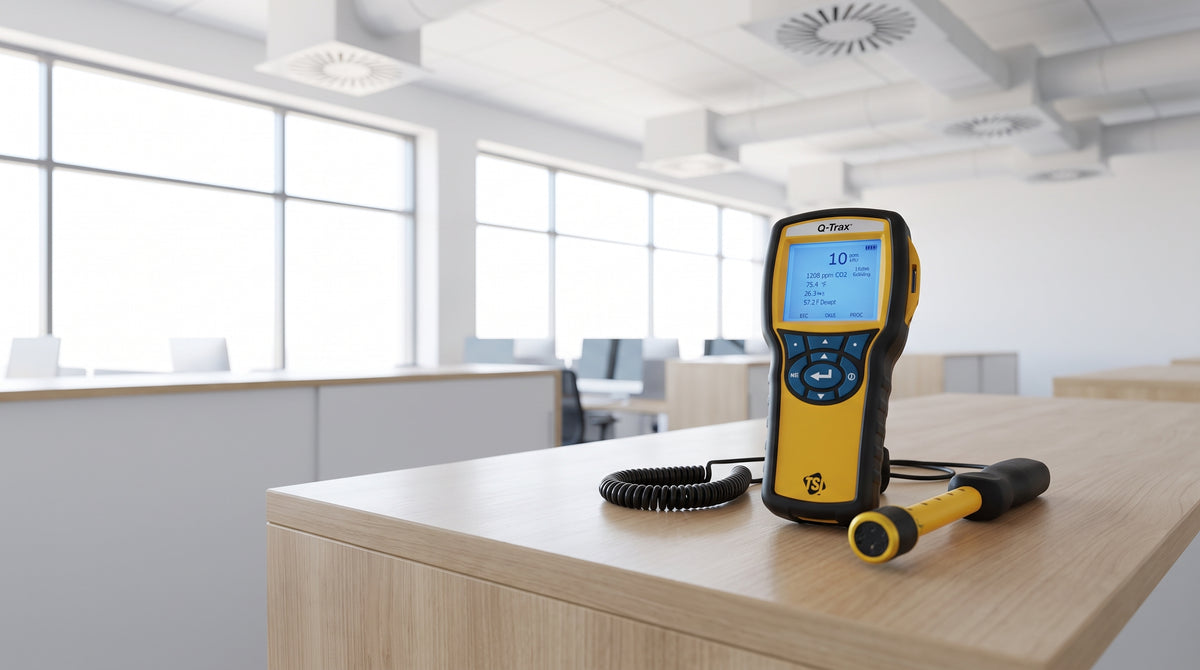
A handheld multi-parameter monitor like the TSI Q-Trak™ 7575 is built for exactly this workflow: walk the floor plan, log CO₂/CO/temperature/humidity at each location, export the data set, and hand a consultant a report with numbers instead of impressions. Fixed continuous systems (wall-mounted CO/CO₂ controllers tied to a BMS) are a separate category, more common in parking garages and mechanical rooms than in general office IAQ investigations — see our portable gas detector collection if a fixed parking-garage CO system is the actual need.
What Do Canadian Standards and Guidance Say About Acceptable IAQ Levels?
Canada does not have a single binding indoor air quality regulation for commercial/office buildings the way it does for occupational exposure limits. Instead, three sources are what consultants and facility managers actually cite:
- CCOHS' Indoor Air Quality guidance — the standard reference Canadian OHS professionals use for parameter thresholds, investigation protocol, and when IAQ complaints should escalate to a full assessment.
- ASTM D6245 — the standard guide for using CO₂ concentration to evaluate ventilation adequacy in occupied buildings, and the methodology most building-commissioning IAQ assessments are built around.
- Provincial occupational health and safety regulations — Quebec's RSST, Ontario's O. Reg. 833, and similar frameworks — which set enforceable exposure limits for specific contaminants (CO, formaldehyde) in workplaces, distinct from general office comfort guidance.
The practical takeaway: there's no single number to chase. A defensible IAQ investigation measures multiple parameters against the CCOHS/ASTM D6245 framework and documents the readings — which is exactly what a logging, multi-parameter instrument is built to produce.
How Do You Choose the Right IAQ Monitor for Your Building?
Match the instrument to the complaint. A general comfort/ventilation complaint calls for a multi-parameter monitor; a dust, smoke, or particulate-specific complaint calls for a dedicated aerosol monitor or particle counter.
| Instrument | Measures | Best for |
|---|---|---|
| TSI Q-Trak™ 7575 | CO₂ (NDIR, 0–5,000 ppm), CO (electrochemical, 0–500 ppm), temperature, relative humidity; calculates dew point and % outside air | General IAQ investigations, ventilation adequacy assessments, building commissioning, industrial hygiene surveys. Logs up to 39 days at 1-minute intervals. |
| TSI DustTrak™ II 8532 | Real-time aerosol mass concentration, 0.001–150 mg/m³, selectable PM1/PM2.5/PM4/PM10/respirable size fractions | Dust, smoke, or particulate-specific complaints; occupational hygiene surveys; point-source location for a specific emission. |
| Met One Aerocet 532 | PM1/PM2.5/PM4/PM7/PM10 and total suspended particulate (mass), plus an 8-channel particle counter (0.3–10 microns), RH and temperature | Combined mass-and-count particulate work — cleanroom-adjacent environments, HVAC filtration verification, wildfire-smoke infiltration checks. |
All three log data internally and export via USB or Bluetooth for reporting — the baseline requirement for any measurement a client, tenant, or regulator will actually accept. Browse our full range in the air sampling equipment collection.
What Are the Most Common Commercial IAQ Investigation Scenarios?
Four scenarios account for most IAQ callouts ERE customers handle:
- Tenant comfort complaints ("stuffy," "can't concentrate") — almost always a CO₂/ventilation check first. A Q-Trak 7575 walkthrough across occupied zones usually finds the answer in under a day.
- Post-renovation or new-build occupancy — VOC and formaldehyde off-gassing from new materials. Requires a VOC-capable probe or sorbent-tube lab sampling alongside the standard parameters.
- Wildfire smoke or nearby-construction dust infiltration — a DustTrak II or Aerocet 532 quantifies whether HVAC filtration is actually keeping particulate out, and by how much.
- Parking garage or loading dock CO risk — usually resolved with fixed CO monitoring tied to garage exhaust fans rather than a handheld spot-check; see the portable gas detector collection for the fixed-system side of this.
For broader environmental sampling and site-assessment context, see our Phase II Environmental Site Assessment equipment checklist — many of the same documentation-and-defensibility principles apply.
Need help choosing an IAQ monitor for your building?
ERE Inc. has supplied environmental consultants, facility managers, and industrial hygienists across Canada with calibrated air quality instruments for over 30 years. Talk to a real specialist about your specific investigation.
→ Request a Quote | 1-888-287-EREC | Browse Air Sampling Equipment | sales@ereinc.com
Frequently Asked Questions
What CO₂ level indicates poor ventilation in an office?
Sustained CO₂ readings above roughly 1,000 ppm in an occupied space generally indicate the HVAC system isn't delivering enough outdoor air per occupant, per the ASTM D6245 framework consultants use to evaluate ventilation adequacy. Isolated spikes during peak occupancy are normal; sustained elevation across a workday is the signal worth investigating.
Can a consumer smart-home air quality monitor be used for a commercial building assessment?
Not for a defensible one. Consumer devices typically lack calibration certificates, don't export raw logged data in a report-ready format, and aren't rated for the multi-point, multi-day data collection a tenant complaint or commissioning report requires. Professional-grade instruments with calibration traceability are the standard consultants and facility managers use.
Do I need a separate instrument for CO₂/CO and for particulate matter?
Usually yes. A multi-parameter monitor like the Q-Trak 7575 covers CO₂, CO, temperature, and humidity in one handheld unit, but dedicated aerosol photometers (DustTrak II) or particle counters (Aerocet 532) give the resolution needed when particulate is the specific concern — the sensor technology and calibration are different.
How often should IAQ instruments be calibrated?
Most manufacturers specify annual calibration for CO₂/CO sensors and aerosol photometers, though frequency should follow the manufacturer's spec sheet and your organization's quality program. ERE offers calibration services for TSI and Met One instruments — see our repair and calibration services.
Is indoor air quality monitoring required by law in Canada?
There's no single national IAQ regulation for commercial buildings. Provincial OHS regulations set enforceable limits for specific workplace contaminants (CO, formaldehyde), while CCOHS and ASTM D6245 provide the guidance framework most consultants and facility managers use for general building assessments.
Related articles
- Air Sampling Pumps: A Buyer's Guide for Environmental & Occupational Hygiene Professionals
- Confined Space Gas Monitoring Requirements in Canada
- Portable Gas Detectors: A Buyer's Guide for Canada
- Water Quality Meters for Environmental Work: A Buyer's Guide
Lire en français : Surveillance de la qualité de l'air intérieur : guide d'achat pour bâtiments commerciaux au Canada