
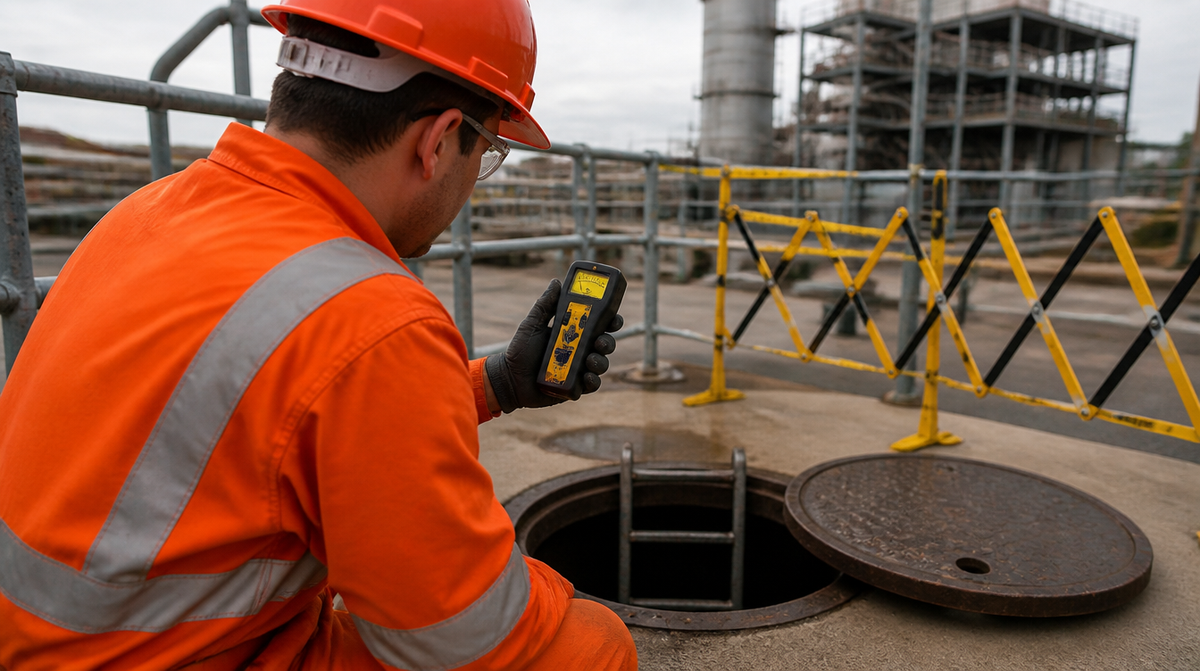
A portable gas detector is the last line of defence between your workers and an atmosphere that can kill in seconds. Choosing the wrong instrument — wrong sensor type, wrong detection range, wrong certification — is not an optimization problem. It is a compliance failure and a safety failure. This guide covers everything a Canadian safety officer, environmental consultant, or industrial hygienist needs to select, spec, and source portable gas detection equipment for purchase or short-term rental.
Types of Portable Gas Detectors — and When You Need Each
Every portable gas detector falls into one of four categories. The category you need depends on the hazard, the regulation, and the task. Buying a 4-gas detector when you need a PID wastes money. Carrying a single-gas H2S monitor into a confined space with unknown atmospheres is dangerous. Match the instrument to the job.
Single-Gas Detectors — Personal Safety Monitors
A single-gas detector measures one specific gas: hydrogen sulphide (H2S), carbon monoxide (CO), oxygen (O2), or a combustible gas (LEL). These are clip-on personal monitors worn by individual workers in environments with a known, specific hazard.
Typical applications: oil and gas field workers carrying an H2S monitor as a personal alarm, steel mills and parking structures monitoring CO, water treatment operators checking O2 depletion near chemical dosing rooms.
ERE stocks: RKI SC-04 (single-gas, multiple sensor options), BW Technologies GasAlertClip Extreme, RAE Systems ToxiRAE Pro.
Limitation: A single-gas monitor detects only what its sensor is designed for. It will not warn about other hazards present in the atmosphere. Never use a single-gas instrument as your sole protection in an IDLH or unknown-atmosphere environment.
4-Gas / Multi-Gas Detectors — The Confined Space Workhorse
A multi-gas detector monitors multiple gases simultaneously. The standard configuration — often called a 4-gas detector — measures H2S, CO, O2, and LEL (lower explosive limit for combustible gases). This is the minimum instrument required for confined space entry under CSA Z1006 and virtually every provincial OH&S regulation in Canada.
Typical applications: confined space entry (tanks, vaults, manholes, vessels), process plant turnarounds, excavations, utility tunnel entry, mining stope entry.
ERE stocks: RKI GX-3R Pro (compact 4-gas with pump option), BW Technologies GasAlertMicroClip XL, BW GasAlertMax XT II (pump-equipped for pre-entry), RAE Systems MultiRAE (configurable up to 6 gases). Browse the full selection in our portable gas detector collection.
Some multi-gas instruments accept 5 or 6 sensors, allowing you to add PID, SO2, NH3, Cl2, or other target gases beyond the standard four. The RKI GX-6000 and RAE Systems MultiRAE are examples of expandable platforms — useful when your work sites present hazards beyond the standard quartet.
PID / VOC Detectors — Environmental and Industrial Hygiene
Photoionization detectors (PIDs) measure volatile organic compounds (VOCs) in real time by ionizing gas molecules with a UV lamp. They quantify total VOC concentration in parts per million (ppm) or parts per billion (ppb) — making them essential for environmental site assessment, indoor air quality investigations, and industrial hygiene exposure monitoring.
Typical applications: contaminated site assessment (Phase II ESAs), hazmat response screening, indoor air quality complaints, chemical plant fugitive emission surveys, soil vapour intrusion investigations, environmental sampling programs.
ERE stocks: RAE Systems MiniRAE 3000 (0.1–15,000 ppm, benchmark PID), Ion Science Tiger (0.001–20,000 ppm, fast response), Ion Science Cub (personal VOC monitor), RAE Systems ppbRAE 3000 (ppb-level for IAQ).
Key spec — lamp energy: PID lamps come in 10.6 eV (standard, detects most common VOCs), 11.7 eV (broader detection including some chlorinated compounds), and 9.8 eV (selective for aromatics like BTEX). Most environmental work starts with a 10.6 eV lamp. Choose higher energy only when you need to detect compounds with higher ionization potentials.
Specialty Instruments — Landfill Gas, Fixed Systems, and Beyond
Some applications require purpose-built analyzers that do not fit neatly into the categories above:
- Landfill gas analyzers — The LANDTEC GEM 5000 simultaneously measures CH4, CO2, O2, CO, H2S, and differential pressure. It is the industry standard for landfill gas extraction monitoring, compliance reporting, and NSPS/EG verification. ERE supplies and services the GEM 5000 for landfill operators across Canada.
- Fixed gas detection systems — Permanently installed sensors wired to control panels for continuous monitoring in process plants, pump stations, parking garages, and battery rooms. These are engineered systems, not portable instruments. Contact ERE for system design and sensor selection.
- Area monitors — Larger portable units placed at a work perimeter to provide area-wide gas monitoring during construction, welding, or remediation. The RAE Systems AreaRAE and RKI Eagle 2 serve this role.
Key Specifications Explained: Sensors, Range, and Response
Understanding sensor technology helps you evaluate instruments beyond the marketing spec sheet. Every portable gas detector uses one or more of these sensor types:
| Sensor Type | What It Detects | How It Works | Strengths | Limitations |
|---|---|---|---|---|
| Electrochemical | Toxic gases (H2S, CO, SO2, NH3, Cl2, NO2) | Target gas reacts at an electrode, producing a current proportional to concentration | Highly selective, low power, proven technology | Finite lifespan (2–3 years typical), cross-sensitivity to some interferents |
| Catalytic bead | Combustible gases (LEL) | Gas oxidizes on a heated catalyst; resistance change measured via Wheatstone bridge | Reliable, well-understood, detects most combustibles | Can be poisoned by silicones, lead, sulphur compounds; requires O2 to function |
| Infrared (NDIR) | CO2, CH4, other hydrocarbons | Measures IR absorption at wavelengths specific to the target gas | No sensor poisoning, long lifespan, works in inert atmospheres | Higher cost, does not detect H2 |
| Photoionization (PID) | VOCs (total) | UV lamp ionizes gas molecules; ion current proportional to concentration | Broad-spectrum VOC detection, real-time, ppb sensitivity | Non-selective (measures total VOCs), lamp degrades with use, humidity effects |
Detection Range
Match the instrument's detection range to your expected concentrations. An H2S sensor rated 0–100 ppm covers most confined space and oil field applications (STEL = 10 ppm, ceiling = 15 ppm in most provinces). A PID rated 0–15,000 ppm covers most environmental site work but will not catch sub-ppm IAQ concerns — for that, you need a ppb-resolution instrument like the ppbRAE 3000.
Response Time
Response time (T90) is how long the sensor takes to reach 90% of the actual concentration. For toxic gas alarms in IDLH environments, faster is non-negotiable — look for T90 under 15 seconds. For trend monitoring during environmental site assessment, a 30-second T90 is acceptable. Pump-equipped instruments generally respond faster than diffusion-mode units because they actively draw the sample to the sensor.
Bump Test vs. Calibration
These are not the same thing:
- Bump test — A quick functional check. Expose the sensor to a known concentration of target gas and verify the alarm triggers. Takes 1–2 minutes. Performed daily or before each use. Required by most Canadian OH&S regulations and CSA Z1006 before every confined space entry.
- Calibration — A full sensor adjustment. Expose the sensor to certified calibration gas and adjust the reading to match the known concentration. Takes 5–15 minutes per sensor. Performed at intervals specified by the manufacturer (typically every 30, 90, or 180 days depending on the instrument and application).
ERE provides calibration gas, calibration service, and bump test equipment for all major brands. If you are renting from ERE, instruments ship freshly calibrated with current certificates.
Gas Detector Rental vs. Purchase: Decision Framework
ERE stocks gas detectors for purchase and short-term rental. The right choice depends on usage frequency, fleet size, and total cost of ownership.
When Rental Makes Sense
- Short-term projects — A 3-week site assessment does not justify buying a $5,000+ multi-gas instrument that will sit in a case for 11 months.
- Seasonal or intermittent work — Environmental consultants with a summer-heavy field season may rent during peak months and avoid winter storage, calibration maintenance, and sensor expiry on idle instruments.
- Try before buying — Renting lets you field-test an RKI GX-3R Pro against a BW MicroClip before committing to a fleet purchase.
- Surge capacity — Your fleet covers normal operations but a large turnaround or emergency response requires 15 additional units for two weeks.
- Avoiding calibration burden — ERE rental instruments ship freshly calibrated with bump test gas included. You use the instrument, return it, and ERE handles the service cycle.
For more detail on rental logistics and what to expect, see our Gas Detector Rental Guide.
When Purchase Makes Sense
- Daily or near-daily use — If the instrument goes to the field 3+ times per week year-round, ownership cost per use drops below rental within 6–12 months.
- Standardized fleet — Large operations (mining, oil and gas, municipal utilities) benefit from a single platform across all crews — consistent training, spare parts, and calibration gas compatibility.
- Compliance documentation — Owning your instruments gives full control over calibration records, bump test logs, and maintenance history for regulatory audits.
Request a quote for purchase or rental — ERE's instrument specialists will help you right-size the fleet.
Confined Space Gas Detection Requirements in Canada
Confined space entry is the single most regulated application for portable gas detectors in Canadian industry. The requirements are clear and non-negotiable:
CSA Z1006 — The National Standard
CSA Z1006 (Management of Work in Confined Spaces) establishes the framework for confined space programs in Canada. Key gas detection requirements:
- Pre-entry atmospheric testing — Test the atmosphere before any worker enters. Use a pump-equipped instrument (not diffusion-only) to draw samples from the entry point and at depth within the space.
- Minimum four gases — O2, LEL, H2S, and CO must be monitored at minimum. Additional gases may be required based on hazard assessment.
- Continuous monitoring — Once entry begins, gas detection must remain continuous for the duration of the entry. Workers inside the space wear personal multi-gas monitors.
- Instrument verification — Bump test (functional check with certified gas) before each day of use. Full calibration per manufacturer's schedule.
For a deeper dive into the regulatory landscape, see our Confined Space Gas Detection Requirements guide.
Provincial Variations
Each province layers its own OH&S regulations on top of the CSA framework:
- Ontario — O. Reg. 632/05 (Confined Spaces) under the OHSA. Requires written entry procedures, atmospheric testing before and during entry, and rescue plan. Specifies acceptable O2 range (19.5–23%).
- Alberta — OHS Code Part 5 (Confined Spaces). Requires competent person to verify atmosphere before entry. Specifies hazard assessment must identify all potential atmospheric hazards, not just the standard four gases.
- Quebec — RSST (Regulation respecting occupational health and safety), sections on confined spaces. Requires atmospheric testing by a qualified person, continuous monitoring, and ventilation where feasible.
- British Columbia — WorkSafeBC OHS Regulation Part 9 (Confined Spaces). Requires written procedures, qualified tester, atmospheric monitoring before and during entry.
In all provinces, the fundamental requirement is the same: test the atmosphere, monitor continuously, and use properly maintained and calibrated instruments. The differences lie in documentation, qualification requirements for testers, and specific acceptable limits.
Calibration and Bump Testing: What Is Required, How Often
A gas detector is only as reliable as its last calibration. Sensor drift, environmental contamination, and simple age degrade accuracy over time. Canadian regulations and manufacturer requirements converge on a two-tier maintenance regime:
Daily Bump Test
Before each day of use (or before each confined space entry), expose every sensor to certified calibration gas and verify the instrument alarms at the correct set point. This takes 60–90 seconds per instrument. If the bump test fails, the instrument must be fully calibrated before use.
Bump test equipment is straightforward: a cylinder of certified multi-gas calibration mix, a regulator, and a flow adapter specific to your instrument. ERE supplies calibration gas kits for all major instruments — RKI, BW, RAE, Ion Science.
Full Calibration
Full calibration adjusts each sensor's response curve against a certified standard. Frequency depends on the manufacturer and application:
- RKI instruments: every 180 days (some models 90 days)
- BW Technologies: every 180 days
- RAE Systems: every 180 days (or per iGas/ProRAE Studio schedule)
- Ion Science: every 6 months standard; 3 months for ppb-level work
Critical: If your instrument is used in an environment known to contain sensor poisons (silicones, lead compounds, high concentrations of H2S for catalytic bead sensors), calibrate more frequently. Post-exposure calibration verification is good practice.
ERE offers in-house calibration service for instruments purchased or rented from us. Send your fleet in on a regular schedule, and we return instruments with fresh calibration certificates and full sensor health reports. For the complete calibration protocol, see our Gas Detector Calibration Guide.
Choosing a Gas Detector by Application
The fastest way to narrow your selection is to start with what you are doing, not what instrument looks appealing. Here is how application maps to instrument type and specific models ERE supplies:
Confined Space Entry
Minimum: 4-gas detector (H2S, CO, O2, LEL). Pump-equipped for pre-entry testing; diffusion-mode personal monitors for entrants and attendants.
Recommended: RKI GX-3R Pro (compact, reliable, pump adapter available), BW GasAlertMax XT II (built-in pump), or RAE Systems MultiRAE (expandable to 6 gases for complex atmospheres).
Environmental Site Assessment
Primary instrument: PID/VOC detector for soil vapour and groundwater off-gassing screening. 4-gas monitor as a safety backup in excavations.
Recommended: RAE Systems MiniRAE 3000 (workhorse PID, 10.6 eV), Ion Science Tiger (wide range, fast response, humidity resistant). Pair with environmental sampling equipment for complete site characterization.
Industrial Hygiene and Indoor Air Quality
Primary instrument: ppb-resolution PID for low-level VOC exposure assessment. Single-gas monitors for specific target substances.
Recommended: RAE Systems ppbRAE 3000 (1 ppb resolution), Ion Science Cub (personal VOC exposure monitor).
Oil and Gas
Primary instruments: Personal H2S single-gas monitor for all field personnel. Multi-gas for confined space and process work. LEL-capable instrument for hot work permits.
Recommended: RKI SC-04 (single-gas H2S), RKI GX-3R Pro or GX-6000 (multi-gas with IR option for eliminating catalytic bead poisoning).
Mining
Requirements: Multi-gas with O2, CO, CH4/LEL, and often NO2 or SO2 depending on mine type. Intrinsic safety certification mandatory.
Recommended: RKI GX-6000 (configurable sensor array, pump, data logging), RAE Systems MultiRAE (up to 6 simultaneous gases).
Landfill Gas Monitoring
Primary instrument: Dedicated landfill gas analyzer measuring CH4, CO2, O2, balance gas, plus trace gases (CO, H2S) and pressure.
Recommended: LANDTEC GEM 5000 — the industry standard for landfill gas extraction system optimization, emissions compliance, and wellfield tuning. ERE supplies, rents, and services the GEM 5000.
Remediation and Abatement
Primary instruments: PID for VOC monitoring at treatment system influent/effluent and site perimeter. 4-gas for worker protection in excavations and treatment system enclosures.
Recommended: MiniRAE 3000 or Tiger PID for process monitoring, GX-3R Pro for personal protection. For the treatment side of remediation systems, see our guides on oil-water separators and industrial filter bags for air handling.
Need a gas detector for your next project?
ERE Inc. stocks portable gas detectors for purchase and short-term rental across Canada. Expert calibration and service support included.
→ Request a Quote | 1-888-287-EREC | Buy Gas Detectors | Rent Gas Detectors | sales@ereinc.com
Frequently Asked Questions
What is the difference between a 4-gas detector and a multi-gas detector?
A 4-gas detector is a type of multi-gas detector configured with the four sensors required for confined space entry: H2S, CO, O2, and LEL. "Multi-gas" is the broader term — it includes instruments that monitor 4, 5, or 6+ gases simultaneously. Some multi-gas platforms (like the RKI GX-6000 or RAE MultiRAE) accept additional sensors beyond the standard four for applications where SO2, NH3, PID, or other targets must be monitored.
How often do gas detectors need to be calibrated?
Most manufacturers specify full calibration every 90 to 180 days, depending on the model and application. Daily bump testing (a quick functional check with certified gas) is required before each use. Canadian OH&S regulations and CSA Z1006 require that instruments be maintained according to the manufacturer's specifications — if the manual says 180 days, that is your maximum interval. Harsh environments or exposure to sensor poisons may require more frequent calibration.
Can I rent a gas detector instead of buying one?
Yes. ERE Inc. offers gas detector rental for short-term projects, seasonal work, and fleet surge capacity. Rental instruments ship freshly calibrated with bump test gas and accessories included. Rental eliminates the ongoing costs of calibration, sensor replacement, and storage for instruments that would otherwise sit idle between projects.
What gas detector do I need for confined space entry in Canada?
At minimum, a 4-gas detector measuring O2, LEL, H2S, and CO — per CSA Z1006 and all provincial OH&S regulations. The instrument must be bump tested before each entry and calibrated per the manufacturer's schedule. A pump-equipped model (like the BW GasAlertMax XT II or RKI GX-3R Pro with pump adapter) is required for pre-entry testing from outside the space. Entrants and attendants carry personal monitors in continuous diffusion mode.
What is a PID detector used for?
A photoionization detector (PID) measures total volatile organic compounds (VOCs) in real time. It does not identify individual compounds — it quantifies the total VOC concentration. PIDs are used for environmental site assessments (screening soil vapour, groundwater off-gassing), indoor air quality investigations, industrial hygiene exposure monitoring, and hazmat response. They are not substitutes for toxic gas monitors (H2S, CO) or LEL combustible gas detection.
Related Guides
- Gas Detector Rental: What to Know Before You Rent
- Gas Detector Calibration: Requirements and Schedule
- Confined Space Gas Detection: Canadian Requirements
- Gas Detector Battery and Sensor Maintenance: A Field Guide
- Indoor Air Quality Monitoring for Commercial Buildings: A Buyer's Guide
Lire en français : Détecteurs de gaz portatifs : guide d'achat pour le Canada