
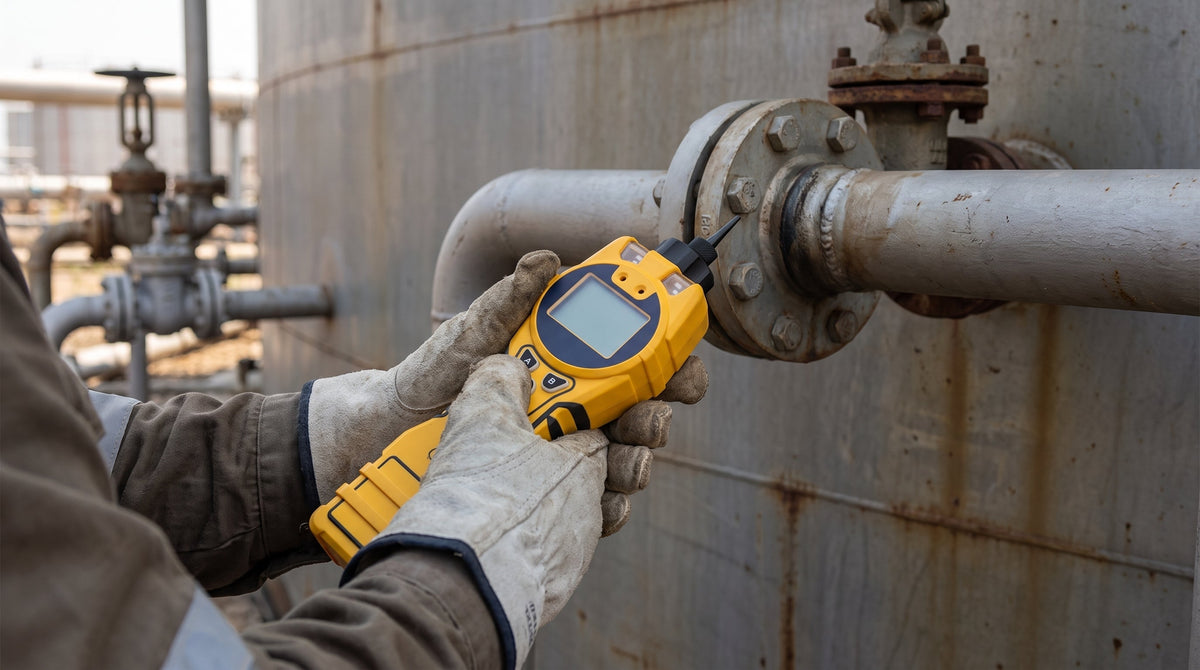
A photoionization detector (PID) uses ultraviolet light to detect volatile organic compounds (VOCs) and other easily-ionized gases at concentrations as low as parts-per-billion — far below what catalytic or electrochemical sensors can resolve. Environmental consultants use PIDs for soil vapour screening on Phase II ESA sites; industrial hygienists use them for confined space entry and fenceline benzene monitoring; oil & gas operators use them for fugitive emissions and leak detection. This guide covers how PID technology works, how it differs from other VOC sensor types, and how to choose between Ion Science's Tiger, Cub, Falco 2, and Titan 2 platforms — the PID line ERE distributes across Canada.
What Does a Photoionization Detector Measure?
A photoionization detector measures total VOC concentration — not a single named chemical, unless it has been configured with a selective sensor or pre-filter. The sensor responds to any gas molecule whose ionization energy is lower than the UV lamp's photon energy, which in practice covers most aromatic hydrocarbons (benzene, toluene, xylene), chlorinated solvents, ketones, and fuel vapours. It does not respond to methane, carbon monoxide, hydrogen sulfide, or oxygen/nitrogen — gases with ionization energies above the lamp output — which is why PIDs are typically deployed alongside, not instead of, a standard 4-gas monitor.
Response is reported as an equivalent concentration relative to the calibration gas (usually isobutylene), then corrected using a response factor for the specific compound of interest if it's known. ERE's Ion Science instruments ship with an internal gas table of over 700 VOCs and toxic compounds with pre-loaded response factors, so field staff can select the target compound and read a corrected concentration directly.
How Does a Photoionization Detector Work?
The PID's UV lamp emits high-energy photons into a small ionization chamber. When a gas molecule's ionization energy is below the lamp's photon energy, the photon knocks an electron off the molecule, creating a positive ion and a free electron. Two electrodes inside the chamber collect these charged particles, producing a small current proportional to the number of ionization events — and therefore to gas concentration.
Lamp energy is the primary variable separating detector types:
| Lamp energy | What it ionizes | Typical use |
|---|---|---|
| 10.0 eV | Aromatics (benzene, toluene) and TACs, with reduced response to alkanes | Benzene/TAC-focused work — Titan 2, Cub TAC, Tiger XT Select |
| 10.6 eV | Broadest VOC range — most solvents, fuels, and aromatics | General VOC screening — Tiger XT, XTL, Cub standard |
| 11.7 eV | Extends response to lower-molecular-weight compounds the 10.6 eV lamp misses | Specialized applications requiring broader coverage — Tiger XT (11.7 eV option) |
Ion Science's MiniPID sensor design adds a fenced electrode geometry and humidity-resistant coating, which reduces the false-positive drift that older PID designs show in high-humidity confined spaces — a common failure mode ERE customers ask about when comparing PID brands.
Is a PID the Same as a VOC Detector?
"VOC detector" is the broader category; PID is the sensor technology inside most handheld VOC detectors sold today. Two other VOC-adjacent technologies exist — flame ionization detectors (FID) and metal oxide semiconductor (MOS) sensors — but neither is common in ERE's portable instrument line. FID offers similar sensitivity but requires a hydrogen fuel supply, making it impractical for field screening. MOS sensors are lower cost but drift more and lack the ppb-level resolution a PID delivers, which matters for Phase II ESA work where regulatory action levels sit in the low parts-per-billion range.
Practically, when a Canadian environmental consultant or industrial hygienist says "VOC detector" or "VOC meter," they almost always mean a PID-based instrument — the terms are used interchangeably in the field even though PID is the more precise technical term.
Which Ion Science PID Is Right for Your Application?
ERE distributes six Ion Science PID platforms, split between handheld (spot-check, confined space) and fixed (continuous, fenceline) configurations.
Handheld: General VOC Screening
The Tiger XT Handheld VOC Detector covers 0.1 – 20,000 ppm (ppm model) or down to 1 ppb (ppb model), with an internal gas table of 700+ compounds and up to 120,000 logged readings. It's the standard choice for site walks, IAQ investigations, and general industrial hygiene screening where you need broad VOC coverage rather than a single named compound.
The Tiger XTL Handheld VOC Detector trades top-end range (0.1 – 5,000 ppm) for the fastest response time in the line — 2 seconds to reading and 2 seconds to clear down. Specify the XTL over the XT when rapid sequential readings matter more than extreme range, such as confined space pre-entry checks where crews need a fast go/no-go result.
Handheld: Personal Monitoring
The Cub Personal VOC Detector is a compact, wearable PID sized for continuous personal exposure monitoring rather than spot-checking. It logs up to 30,000 readings and supports pre-programmed TWA and STEL alarms (ppb model) — the alarm structure occupational hygiene programs need to flag exposure limit exceedances in real time, not just after downloading data.
Handheld: Selective Benzene Detection
The Tiger XT Select Benzene & TAC VOC Detector uses a 10.0 eV lamp for total aromatic compound (TAC) response, then adds a benzene pre-filter tube for selective benzene readings when TACs are detected. This two-stage workflow — screen broad, then confirm selective — suits refinery turnarounds, marine spill response, and loading-dock monitoring where benzene is the regulated compound of concern but other aromatics are also present.
Fixed: Continuous Area & Process Monitoring
The Falco 2 Fixed VOC Detector is available in pumped and diffused configurations across five detection ranges (0.001 – 3,000 ppm depending on model), UL certified, and rated for -40°C to +50°C operation. Specify the pumped model for underground vaults, confined spaces, or any location where you need to draw a sample line rather than rely on ambient diffusion to the sensor.
The Titan 2 Benzene Monitor is a fixed, benzene-specific instrument (0.02 – 20 ppm, 10 ppb resolution) built for continuous compliance monitoring at fencelines, tank farms, and asphalt production facilities — sectors where benzene is the specific regulated target rather than one compound among many. Its 4-20 mA and RS485 outputs integrate directly into an existing plant control or SCADA system.
How Do You Select the Right PID for Your Facility?
Work through these five questions before ordering:
- Fixed or portable? Continuous fenceline/process monitoring needs a fixed unit (Falco 2, Titan 2) with a control-system output; spot-checks and confined space entry need a handheld (Tiger, Cub).
- Total VOC or one named compound? General screening uses a broad-range 10.6 eV lamp (Tiger XT/XTL, Falco 2 standard); benzene-specific compliance uses a 10.0 eV lamp or dedicated benzene sensor (Titan 2, Tiger XT Select, Cub TAC).
- What concentration range does your action level fall in? Regulatory action levels for soil vapour and benzene fenceline monitoring often sit in the low ppb range — confirm your target compound's action level against the instrument's stated sensitivity before ordering the ppm variant when you need ppb.
- Spot-check or continuous personal exposure? Occasional site screening suits the Tiger line; workers who need continuous wearable monitoring with TWA/STEL alarms need the Cub.
- What's your hazardous-location classification? All six platforms carry ATEX, IECEx, and CSA intrinsically-safe certification (CSA C22.2 No. 30), but confirm the specific zone/division rating against your site's classification before specifying an instrument for a Class I hazardous location.
Do Photoionization Detectors Need Calibration?
Yes. PID lamps and sensor electrodes drift over time and with contamination, so accuracy depends on a documented calibration schedule — typically bump-tested before each field day and full 2-point calibrated every 3-6 months, or per your site's QA/QC program. Calibration uses a certified span gas matched to the target compound: isobutylene for general VOC calibration (the industry-standard reference gas most PIDs are factory-calibrated against) or benzene span gas for benzene-specific instruments like the Titan 2. ERE stocks the isobutylene and benzene calibration gas cylinders, regulators, and calibration adaptors that match each Ion Science platform.
For instruments used in regulated work — Phase II ESA sampling, confined space entry certification, or fenceline compliance reporting — CCOHS occupational exposure guidance expects calibration records to be maintained and auditable alongside the exposure data itself, not just the instrument readings.
Where Are Photoionization Detectors Used in Canada?
Phase II Environmental Site Assessment
PIDs screen soil headspace and borehole air for VOC contamination during Phase II ESA fieldwork under Ontario Regulation 153/04, Quebec's Règlement sur la protection et la réhabilitation des terrains, and BC's Contaminated Sites Regulation. A quick PID reading on a soil sample or monitoring well headspace tells field staff which locations warrant laboratory confirmation — reducing the number of samples sent for costly lab analysis.
Confined Space Entry
Before personnel enter a tank, vault, or below-grade structure, a PID reading confirms VOC levels are within safe limits alongside the standard oxygen/LEL/toxic gas check. See ERE's confined space gas monitoring guide for the full pre-entry testing sequence — PID VOC screening is one component of that sequence, not a replacement for the 4-gas check.
Oil & Gas Fugitive Emissions
Refineries and upstream facilities use handheld PIDs for leak detection and repair (LDAR) surveys and fixed benzene monitors (Titan 2) at fencelines and tank farms to demonstrate continuous compliance with provincial air quality permits.
Industrial Hygiene & Confined Manufacturing
Facilities using solvents, adhesives, or fuel handle personal exposure monitoring with wearable PIDs (Cub) that log TWA and STEL exceedances for occupational health compliance records.
For the full range of Ion Science and other portable gas detection instruments ERE stocks, sells, rents, and calibrates, visit the portable gas detectors collection at ERE. For related VOC-adjacent air monitoring instruments, see ERE's air sampling equipment collection.
Need a Tiger or Cub for a short-term Phase II ESA project instead of purchasing? ERE's rental fleet includes Ion Science PIDs — see the gas detector rental guide for availability and calibration terms.
Need help choosing between PID models or sizing a fixed benzene monitor?
ERE Inc. has distributed environmental and industrial gas detection instruments to Canadian consultants, industrial hygienists, and facility operators for over 30 years. Our technical team can confirm the right lamp energy, range, and configuration for your application before you order.
→ Request a Quote | 1-888-287-EREC | Browse Portable Gas Detectors | sales@ereinc.com
Frequently Asked Questions
What is a photoionization detector used for?
A photoionization detector (PID) is used to measure total volatile organic compound (VOC) concentration in air, typically for environmental site screening, confined space entry, industrial hygiene exposure monitoring, and oil & gas fugitive emissions detection. It gives a fast, sensitive reading of hundreds of VOCs and select toxic compounds without needing a specific chemical identified in advance.
Can a photoionization detector detect methane or carbon monoxide?
No. A standard PID does not respond to methane, carbon monoxide, hydrogen sulfide, oxygen, or nitrogen — these have ionization energies above the UV lamp's photon output. PIDs are used alongside, not instead of, a standard 4-gas monitor that covers O2, LEL/combustibles, CO, and H2S.
How often does a PID need to be calibrated?
Most Ion Science PIDs need a bump test before each field day and a full 2-point calibration against a certified span gas every 3-6 months, or per your site's QA/QC program. Calibration frequency should increase if the instrument is used in high-humidity or heavily contaminated atmospheres, since lamp and electrode drift accelerates under those conditions.
What's the difference between the Tiger XT and Tiger XTL?
The Tiger XT covers a wider range (0.1 – 20,000 ppm) with a larger internal gas table, suited to general VOC screening. The Tiger XTL covers a narrower range (0.1 – 5,000 ppm) but has the fastest response time in the line — 2 seconds to reading, 2 seconds to clear — making it the better choice when crews need rapid sequential go/no-go readings, such as confined space pre-entry checks.
Can a PID detect benzene specifically, or only total VOCs?
A standard PID reads total VOC/TAC response, not benzene alone. Selective benzene detection requires either a dedicated benzene sensor — like the Titan 2 fixed monitor's MiniPID T2 10.0 eV sensor — or a general PID fitted with a benzene pre-filter tube, as on the Tiger XT Select. Both approaches are used in ERE's Ion Science line depending on whether the application needs continuous fixed monitoring or portable selective screening.
Related articles
- Portable Gas Detectors: Buyer's Guide for Canada
- Confined Space Gas Monitoring Requirements in Canada
- Gas Detector Calibration in Canada: Requirements & Schedule
- Gas Detector Battery and Sensor Maintenance: A Field Guide
Lire en français : Détecteurs à photoionisation (PID) : guide d'achat pour le Canada