
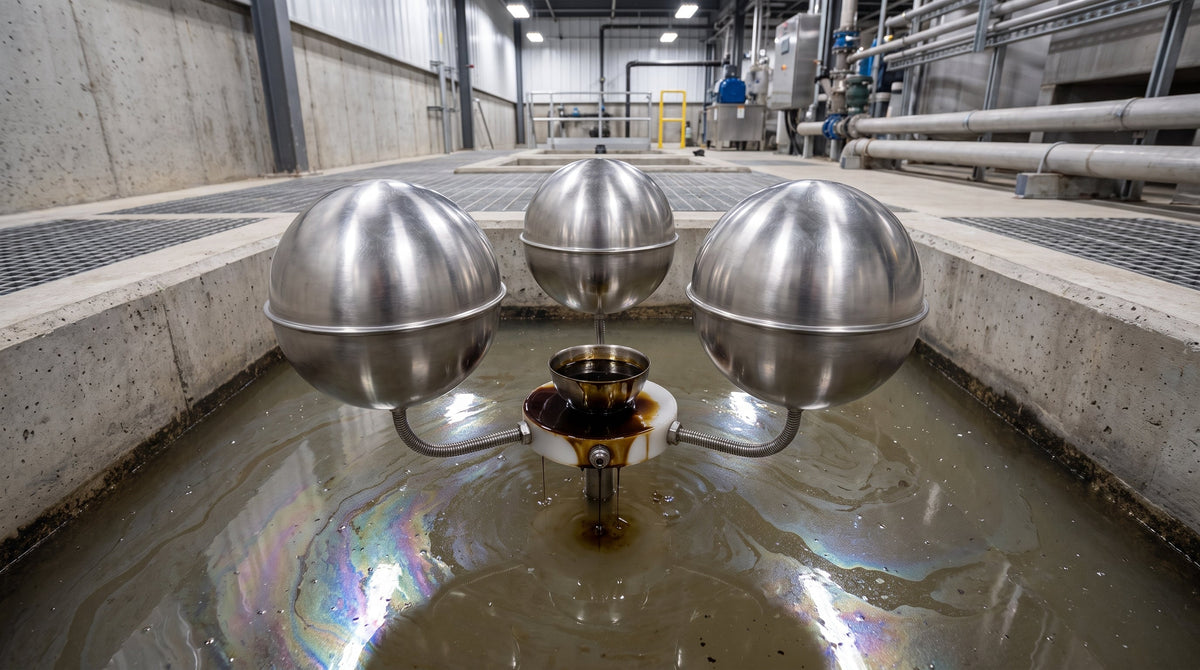
An oil skimmer removes free-floating oil from a water surface — a sump, a wastewater tank, a coolant reservoir, or a monitoring well — without pumping out the water underneath it. The right type depends on where the oil sits, how much you need to recover per day, and whether the water needs to stay in the system afterward.
What Is an Oil Skimmer and How Does It Work?
An oil skimmer is a device that recovers free (non-emulsified) oil floating on a water surface by exploiting the fact that oil is lighter than water and does not mix with it. Most designs use an oil-attracting (oleophilic) or oil-repelling-water (hydrophobic) surface — a belt, a mesh cartridge, or a floating collection head — to pull the oil layer off the water without drawing the water itself into the recovery stream.
What separates one skimmer from another is how that surface is presented to the oil: a moving belt dragged through the layer, a floating cartridge that wicks it passively, or a submerged pump triggered by a level sensor. Each approach trades off oil purity, flow rate, and how much operator attention the unit needs.
What Types of Oil Skimmers Are There?
ERE stocks and rents four distinct oil-skimmer designs, each built for a different water condition and recovery target.
Interface Skimmers
An interface skimmer, like the Olio-Skim™, floats directly at the oil/water boundary. Oil and a small amount of water are drawn through an adjustable skimming head and delivered downstream to a Vertical Gravity Separator (VGS) for final separation. Because the head is adjustable, an operator can raise or lower the oil-to-water ratio being drawn off as effluent conditions change — a fit for food-industry and industrial wastewater where floating solids have already been screened out. The Olio-Skim runs in as little as 6" of water and connects via a 1/2" hose barb.
Coolant-Selective Skimmers
Machining and CNC operations need oil out of the coolant sump without losing the coolant itself. The Centipede Coolant Oil Skimmer runs continuously with no belts or blades to change, and recovers 93% oil to 7% coolant — compared to roughly 51% oil / 49% coolant for a traditional belt skimmer working the same sump. At 4.5 gallons (17 liters) of oil recovery per day, it is sized for fixed installation directly in the tank, not for large open-water recovery.
Passive Mesh Cartridge Skimmers
For a monitoring well, sump, or containment pit where oil accumulates slowly, a passive skimmer needs no power and no moving parts. The Oil Bucket™ is an independently floating unit built around an oleophilic/hydrophobic mesh cartridge (60 or 100 mesh) that wicks oil into a 2-liter reservoir and trips a visual alarm when full. It weighs 7 lbs and needs no external plumbing.
Pump-Based Scavenger Systems
Where free product (LNAPL) needs active, continuous recovery — a groundwater remediation well, an open lagoon, a large-diameter pit — a scavenger system pairs a floating mesh buoy with a remote pump and control panel. The Oil Scavenger™ System ships in two configurations: a large-diameter/open-area unit and a shallow/narrow-well unit rated for wells as small as 2" in diameter with depth to water under 20 ft. The shallow/narrow model recovers up to 4 GPM (14.8 LPM) and runs from an explosion-proof control panel for use in hazardous locations.
Which Oil Skimmer Should You Choose for Your Application?
| Skimmer Type | How It Recovers Oil | Typical Application | Oil Purity / Rate |
|---|---|---|---|
| Interface (Olio-Skim™) | Floats at oil/water boundary, adjustable head feeds a gravity separator | Food & industrial wastewater pretreatment | Adjustable oil-to-water ratio |
| Coolant-selective (Centipede) | Continuous oil-selective drum, no belts/blades | CNC & machining coolant sumps | 93% oil / 7% coolant |
| Passive mesh cartridge (Oil Bucket™) | Oleophilic/hydrophobic mesh wicks oil into a reservoir | Monitoring wells, small pits, slow accumulation | 2 L reservoir, visual full-alarm |
| Pump-based scavenger (Oil Scavenger™) | Floating buoy + remote pump, level-sensor triggered | Groundwater remediation wells, open-area LNAPL recovery | Up to 4 GPM (14.8 LPM) |
| Traditional belt skimmer (reference) | Oleophilic belt dragged through oil layer, wiped clean | Large open sumps and spill ponds | ~51% oil / 49% water |
Quick Selection Steps
- Identify where the oil sits. Continuous wastewater flow feeding a separator points to an interface skimmer; a fixed coolant tank points to a coolant-selective unit; a well or pit points to a passive or pump-based system.
- Set your required recovery rate. A few liters a day (passive mesh) is a different equipment class than 4 GPM of active pumped recovery.
- Check for a hazardous-location requirement. Sites with flammable vapors need explosion-proof, CSA-certified control panels — standard in the pump-based scavenger systems, not in passive units.
- Decide how much attention the unit can get. Passive cartridges need periodic reservoir changes; belt and coolant-selective skimmers need scheduled inspection; pump-based systems need power and a level sensor.
- Confirm the downstream path. A skimmer that feeds a gravity separator (like the Olio-Skim) needs that separator sized and in place — the skimmer alone is not a discharge-ready solution.
How Much Oil Can an Oil Skimmer Recover?
Recovery rate and recovery purity are two different numbers, and mixing them up is the most common sizing mistake. A belt skimmer moving a lot of surface area can pull a high volume of liquid off a sump, but roughly half of what it recovers is water — meaning downstream handling (storage, disposal, or a separator) has to deal with that water too. A coolant-selective unit like the Centipede trades total throughput for purity: 4.5 gallons a day, but 93% of that is oil, not coolant, which is what actually matters when the goal is extending coolant life rather than processing volume.
For active remediation recovery, the shallow/narrow Oil Scavenger™ configuration is rated up to 4 GPM (14.8 LPM) of free-phase hydrocarbon, and can draw a well down to a measurable ~2" product layer — a spec that matters when a site's remediation plan sets a target LNAPL thickness rather than a total-volume target.
Do You Need an Oil Skimmer or a Full Oil/Water Separator?
A skimmer removes floating oil from a static or semi-static surface. It does not treat a continuous incoming flow to a discharge-ready standard on its own. If your facility has water constantly entering and needing to leave clean — a wash bay, a process discharge, a stormwater outfall — you need an oil/water separator sized to that flow, not a skimmer. Our complete guide to oil/water separators covers sizing by peak flow rate and the difference between a coalescing separator and a simple gravity unit.
Where a skimmer earns its keep is upstream or standalone: pulling free product off a monitoring well before it spreads, keeping a coolant sump usable between fluid changes, or feeding a separator so it isn't overloaded with raw oil. Several of ERE's separator installations use exactly this combination — a skimmer for the bulk of the free oil, a separator for final polish before discharge. See our guide on oil/water separator maintenance for how skimming interacts with cleaning schedules.
What Regulations Apply to Oil Recovery and Discharge in Canada?
Provincial and municipal sewer-use bylaws set numeric limits on oil and grease in any discharge to a sanitary or storm sewer, and the Canadian Council of Ministers of the Environment (CCME) publishes the water-quality guidance those local limits are built from — a skimmer that keeps free product out of the discharge stream in the first place is usually the cheapest way to stay under those limits, well ahead of an expensive treatment upgrade. Where recovery equipment operates in a flammable-vapor environment — a fuel-handling area, a remediation well near a former gas station site — the electrical components (pumps, control panels, level sensors) need to meet CSA-certified explosion-proof standards for hazardous (Class I) locations, which is why systems like the Oil Scavenger's control panel are built explosion-proof from the factory rather than retrofitted.
For our full range of oil recovery and separation equipment, see the Oil/Water Separators collection. ERE supplies, sizes, and rents skimmers alongside full separator systems for facilities across Canada.
Not sure which oil skimmer fits your site?
ERE Inc. has been Canada's environmental equipment specialist for 30+ years — sizing, purchase, and rental for every skimmer type on this page. Talk to a real engineer about your application.
→ Get a sizing quote | 1-888-287-EREC | Browse Oil/Water Separators | sales@ereinc.com
Frequently Asked Questions
What is an oil skimmer used for?
An oil skimmer removes free-floating oil from a water surface — a sump, wastewater tank, coolant reservoir, or monitoring well — so the oil can be recovered or disposed of separately, without pumping out the water underneath it.
Can an oil skimmer replace an oil/water separator?
No. A skimmer recovers oil from a static or semi-static surface; it does not treat a continuous incoming flow to a discharge-ready standard. Facilities with constant flow needing treatment before discharge require a properly sized oil/water separator, with a skimmer used upstream if free product volume is high.
How often does an oil skimmer need to be serviced?
It depends on the type. Passive mesh cartridge skimmers need periodic reservoir changes when the visual alarm trips; belt and coolant-selective skimmers need scheduled inspection of the recovery surface; pump-based scavenger systems need power, level-sensor checks, and periodic pump service.
Related articles
- Oil/Water Separators: The Complete Industrial Guide
- Oil/Water Separator Maintenance Guide
- Oil Interceptors: How They Work and When You Need One
- Oil/Water Separators for Truck Wash & Fleet Wash Facilities
Lire en français : Écumeurs d'huile : types, fonctionnement et choix