
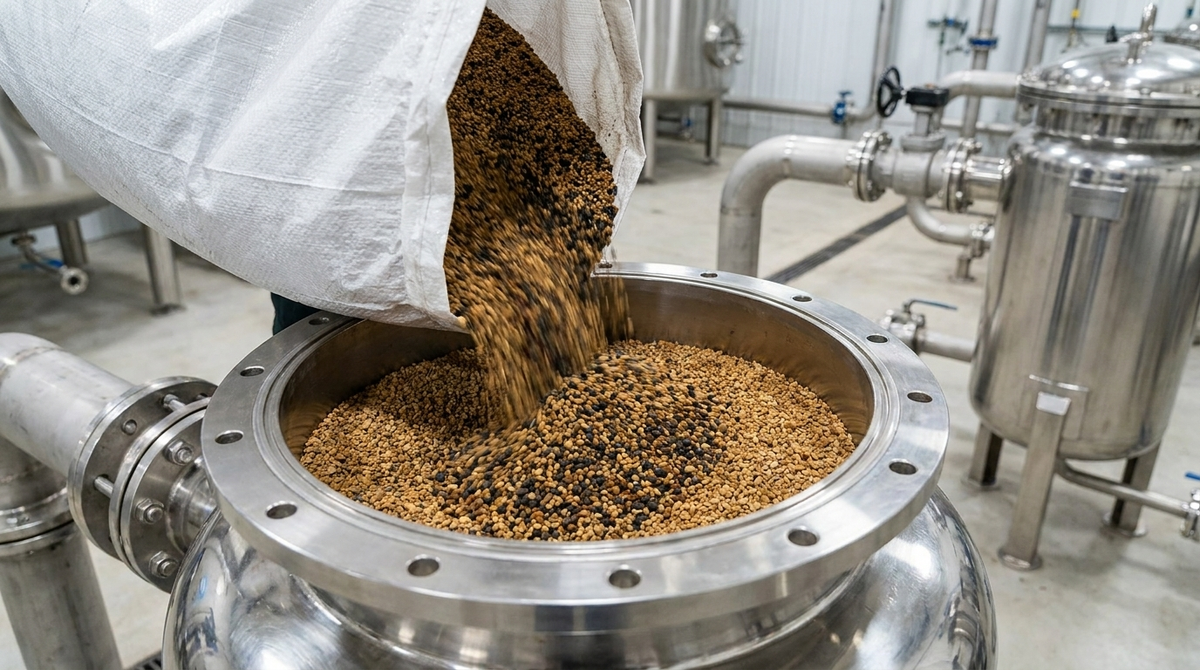
Choosing the wrong filtration media is an expensive mistake: the media either fails to remove your target contaminant, exhausts prematurely, or requires operating conditions your system cannot deliver. This guide covers the main industrial water filtration media types, how each works, and how to match the right medium to your water quality problem.
What is filtration media?
Filtration media is the granular or structured material inside a pressure filter vessel or gravity filter bed that physically or chemically removes contaminants from water. Unlike membrane filtration — which separates particles by pore size under pressure — media filtration relies on adsorption, catalytic oxidation, ion exchange, or mechanical straining as water passes through the bed at controlled flow rates.
Industrial and environmental applications — groundwater treatment, process water conditioning, pump-and-treat remediation, and municipal pre-treatment — demand media that can handle high flow rates, wide pH ranges, and variable contaminant concentrations over multi-year service lifetimes. Residential-grade media sold in small bags is not rated for these duty cycles.
Filtration media types by target contaminant
Iron, hydrogen sulfide, and manganese: Filox™
Dissolved iron (Fe²⁺) and manganese (Mn²⁺) are among the most common groundwater quality problems at industrial sites and municipal wells across Canada. Both oxidize and precipitate at neutral to alkaline pH, fouling equipment, staining infrastructure, and triggering regulatory exceedances in discharge permits.
Filox™ media (Watts Water Quality) is a high-density manganese dioxide medium that catalytically oxidizes dissolved iron, hydrogen sulfide, and manganese, then filters the precipitated particles from the water stream. Compared to traditional greensand and Birm, Filox™ offers:
- Wider operating pH range: 5.5–9.0 (greensand and Birm require pH ≥6.8)
- Service flow rate: up to 5 GPM per square foot of bed area
- Backwash rate: 12–16 GPM/ft² — no permanganate regenerant required
- Effective for dissolved iron up to 15 mg/L, manganese up to 3 mg/L, H₂S up to 5 mg/L
- Lower total operating cost versus systems requiring potassium permanganate dosing
For groundwater remediation sites where iron and H₂S co-occur — common at petroleum hydrocarbon and chlorinated solvent plumes — Filox™ is the preferred specification. The absence of a permanganate system simplifies regulatory reporting and eliminates a secondary chemical hazard on site.
Filox™ operates on dissolved oxygen or low-dose chlorine injection as the oxidant, making it compatible with existing aeration pre-treatment systems common at pump-and-treat installations.
ERE supplies Filox™ media (SKU: A8033, Watts Water Quality) from Canadian inventory. Contact our technical team for sizing data and availability.
Turbidity and suspended solids: RhinoSand and multimedia beds
Silica-based filter media — including garnet, gravel, and engineered silica sands such as RhinoSand — are the first-line defence against suspended solids, sediment, and turbidity in industrial water streams. Multimedia filter beds layer different grain densities (typically anthracite over fine sand over garnet gravel) to capture particles across a size gradient, extending run time between backwashes and reducing pressure drop.
RhinoSand is a high-silica, rounded-grain sand media used in industrial pressure filters and gravity sand filters:
- Available in multiple effective size grades: 0.35–1.5 mm
- Uniformity coefficient ≤1.4 for consistent bed depth and predictable pressure drop
- Silica content ≥99%
- NSF/ANSI 61 compliant for potable water contact applications
- Suitable for high-solids industrial feed streams, stormwater treatment, and well rehabilitation
Dissolved organics, chlorine, and pump-and-treat: activated carbon
Granular activated carbon (GAC) and liquid-phase bituminous coal activated carbon are the standard media for removing dissolved organic compounds, chlorine, chloramines, herbicides, trace organics, and taste/odour compounds from industrial water streams.
In environmental and industrial applications, activated carbon is used to:
- Strip trace organics and volatile organic compounds (VOCs) from contaminated groundwater in pump-and-treat systems
- Polish process water effluent before discharge to reduce BOD and COD to permit levels
- Remove residual chlorine ahead of sensitive process equipment or ion exchange resin beds
- Protect downstream RO membranes from oxidation by free chlorine
- Treat landfill leachate and industrial wastewater to discharge consent limits
ERE stocks liquid-phase activated carbon (ERE Inc., bituminous coal base) for industrial and environmental remediation duty. Typical iodine number: 900–1,050 mg/g. Contact ERE for inventory and media sizing calculations.
Arsenic, fluoride, and selenium: activated alumina
Activated alumina (Al₂O₃) removes arsenic (As³⁺ and As⁵⁺), fluoride, and selenium from water through an adsorption-ion exchange mechanism. It can be regenerated with caustic soda and sulfuric acid, extending service life compared to single-use adsorbents.
Common Canadian applications include:
- Mine-impacted water treatment where arsenic concentrations exceed CCME guidelines (0.005 mg/L drinking water, 0.05 mg/L aquatic life)
- Naturally occurring fluoride removal in deep aquifer wells (Northern Ontario, Saskatchewan, parts of Alberta)
- Tertiary polishing ahead of compliance discharge points on environmental remediation sites
Activated alumina performs best at pH 5.5–6.0 for arsenic removal. Feed water at higher pH requires pre-adjustment to maintain adsorption efficiency.
Demineralization and high-purity water: mixed-bed resin
Mixed-bed ion exchange resin combines strong-acid cation resin and strong-base anion resin in a single vessel, producing near-ultrapure demineralized water — typically less than 1 µS/cm conductivity. Industrial applications include boiler makeup water, pharmaceutical process water, laboratory reagent-grade water, and final polishing after reverse osmosis in ultrapure water systems.
Unlike single-bed water softeners, mixed-bed resin is not regenerated in place at industrial scale — it is replaced or sent to a specialized regeneration facility when exhausted, as indicated by rising outlet conductivity or ion breakthrough.
Air and gas phase media: UltraSorber activated carbon
Industrial filtration media is not limited to water treatment. ERE also supplies air-phase activated carbon for soil vapour extraction (SVE) systems, vapour intrusion mitigation, industrial odour control, and stack emission treatment.
UltraSorber is available in multiple chemistry-specific grades matched to target air-phase contaminants:
- PFAS grade: High-activity carbon for per- and polyfluoroalkyl substance capture in SVE off-gas and vapour phase PFAS treatment systems
- Mercury (MERC) grade: Impregnated coal-based carbon for elemental and inorganic mercury vapour removal
- Heavy metals (HEVY) grade: For lead, cadmium, and arsenic vapour streams in industrial exhaust treatment
- Additional chemistry-specific grades available — contact ERE for the full contaminant-grade matrix
For SVE systems at petroleum hydrocarbon and chlorinated solvent sites, air-phase carbon is typically the final treatment stage before vapour discharge to atmosphere. Media selection depends on target compounds, inlet concentration, and the discharge limit specified in your environmental approval.
Media selection guide: contaminant to media matrix
Use this matrix as a starting point. Multi-contaminant feeds — common in industrial groundwater — typically require sequential or layered media beds. ERE's technical team can assist with media sequencing, vessel sizing, and backwash system design for your application.
| Target Contaminant | Recommended Media | Key Operating Parameter |
|---|---|---|
| Iron, H₂S, manganese (dissolved) | Filox™ (Watts) | pH 5.5–9.0; dissolved oxygen or low-dose chlorine as oxidant |
| Turbidity, suspended solids, sediment | RhinoSand / multimedia bed | Flow rate within bed design spec; scheduled backwash |
| VOCs, dissolved organics, chlorine, BOD/COD | GAC / liquid-phase activated carbon | Empty bed contact time (EBCT) ≥10 min for organics |
| Arsenic, fluoride, selenium | Activated alumina | pH 5.5–6.0 for arsenic; regenerable with caustic/acid |
| Complete demineralization | Mixed-bed ion exchange resin | Outlet conductivity <1 µS/cm; exhaustion-based replacement |
| PFAS, mercury, heavy metals (air phase) | UltraSorber (chemistry-specific grade) | Match grade to contaminant profile and inlet concentration |
For our full filtration media product lineup and technical datasheets, visit the filtration media collection or the Filtration Media guide. For complete water filtration and treatment systems that use these media, see our water treatment systems collection.
Media selection for Canadian environmental remediation projects
Environmental consultants and remediation contractors working under CCME guidelines, provincial MOE/MELCC cleanup standards, or project-specific risk-based criteria face requirements beyond standard industrial water treatment:
- Influent variability: Contaminant concentrations change over the remediation lifecycle — media bed sizing must account for peak loading, not average conditions.
- Changeout logistics: At remote or access-constrained sites, media changeout frequency directly affects project operating costs. Higher-capacity media with longer service life reduces total cost of ownership.
- Discharge permit compliance: Effluent from pump-and-treat systems must meet discharge consent conditions, which may be more stringent than general guidelines. Media performance confirmation under your site-specific water chemistry is required before system commissioning.
- Waste classification: Spent media that has adsorbed hazardous contaminants is typically classified as hazardous waste under provincial regulations. Factor disposal cost into media selection and lifecycle cost analysis.
- PFAS-specific considerations: PFAS-impacted sites require confirmed PFAS-grade media with documented removal efficiencies. ERE's UltraSorber PFAS grade is sized for the compound profiles common at Canadian AFFF-impacted properties.
ERE Inc. has supported environmental remediation contractors and consultants across Canada for over 30 years. We provide media specifications, bench-scale data for unusual chemistries, and sizing recommendations for Phase II ESA follow-up and full-scale remediation system design.
Need help selecting filtration media for your project?
ERE Inc. has been Canada's industrial and environmental equipment specialist for 30+ years. Talk to our technical team about media selection, vessel sizing, and system design for your application.
→ Request a Quote | 1-888-287-EREC | Browse Filtration Media | sales@ereinc.com
Frequently Asked Questions
What is the difference between Filox™ and Birm for iron removal?
Both are catalytic media for iron and manganese removal, but Filox™ operates over a wider pH range (5.5–9.0 vs. pH ≥6.8 required for Birm), delivers higher service flow rates, and does not require potassium permanganate regeneration. Birm performs adequately for low-iron, stable near-neutral pH feeds. For most industrial and environmental remediation applications, Filox™ offers lower total operating cost and simpler system design.
How long does industrial filtration media last?
Service life varies by media type and loading. Filox™ typically lasts 5–10 years under normal service conditions. Activated carbon service life is determined by breakthrough of the target compound — typically 6 months to 3 years in industrial pump-and-treat duty depending on organic loading. RhinoSand and silica media last 10–20 years with proper backwash management. Mixed-bed resin and activated alumina are replaced or regenerated when ion breakthrough is detected. ERE can provide changeout planning based on your system's inlet chemistry and flow data.
Does ERE supply NSF/ANSI 61-certified media for potable water applications?
Yes. Select media in our catalog — including Filox™ and RhinoSand — carry NSF/ANSI 61 certification for contact with potable water. Certification applies to specific product lots and use conditions; confirmation should be requested at time of order for projects with NSF/ANSI 61 specification requirements. Contact ERE to confirm compliance for your project.
What media is used for PFAS treatment at Canadian remediation sites?
PFAS (per- and polyfluoroalkyl substances) are regulated under CCME guidelines and provincial standards at an increasing number of Canadian sites, particularly AFFF-impacted military and airport properties. The current standard for water-phase PFAS treatment is high-activity GAC — specifically PFAS-grade media — with PFAS-selective anion exchange resin as an emerging alternative. For air-phase PFAS in SVE off-gas, UltraSorber PFAS grade is the standard specification. ERE can assist with media specification based on your site's compound profile and concentration data.
Can I use the same media in both pressure and gravity filter systems?
Yes — most granular media (RhinoSand, Filox™, activated carbon) is suitable for both pressure vessel and open gravity filter configurations. Key differences are operating pressure, backwash flow rate calculations, and headloss design. ERE provides media specifications for either filter configuration; hydraulic design is typically performed by the equipment supplier or the project's process engineer.
Related articles
- Bag vs Cartridge Filtration: Which to Use for Your Application
- Industrial Filter Bags: Complete Selection Guide for Canada
- uPVC vs Stainless Steel Filter Housings: Chemical Compatibility Guide
Lire en français : Médias filtrants industriels : types et guide de sélection