
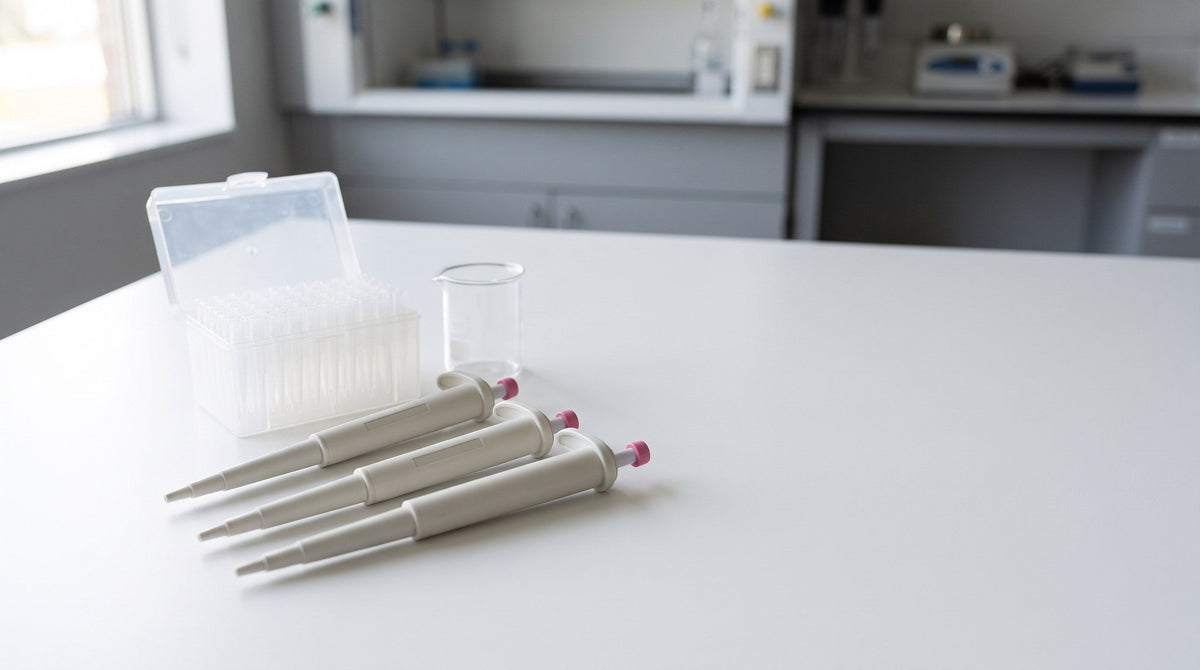
A micropipette moves a measured liquid volume, usually between 0.5 µl and 5 ml, and the right one is the pipette whose range brackets the volume you actually dispense. Pick by volume range first, then fixed or adjustable, then single-shot or repeat dispensing, and finally by who will verify it and how. This guide walks through those four choices using the Globe Scientific Diamond, Diamond Pro, Diamond Jr. and RV-Pette lines that ERE lists.
In this guide
- Which micropipette range do you need?
- Should you buy a fixed-volume or an adjustable pipettor?
- What do the Diamond, Diamond Pro, Diamond Jr. and RV-Pette lines offer?
- When is a transfer pipette or a pipette pump the better tool?
- How is a pipette calibrated and checked?
- How do you choose a pipette, step by step?
- Frequently Asked Questions
Which Micropipette Range Do You Need?
Choose the smallest range whose upper limit is at or above your target volume, because a pipette is only specified inside its range. A 15 µl dispense belongs on a 2–20 µl pipette, not on a 10–100 µl one, where 15 µl sits near the bottom of the span. The table maps typical working volumes to the adjustable ranges ERE lists on the Diamond Pipettors and the Diamond Pro.
| Volume you dispense | Adjustable range to choose | Diamond part no. | Diamond Pro part no. |
|---|---|---|---|
| Up to 10 µl | 0.5–10 µl | GS-3301-10 | GS-3311-10 |
| Above 10, up to 20 µl | 2–20 µl | GS-3301-20 | GS-3311-20 |
| Above 20, up to 50 µl | 5–50 µl | GS-3301-50 | GS-3311-50 |
| Above 50, up to 100 µl | 10–100 µl | GS-3301-100 | GS-3311-100 |
| Above 100, up to 200 µl | 20–200 µl | GS-3301-200 | GS-3311-200 |
| Above 200 µl, up to 1 ml | 100–1000 µl | GS-3301-1000 | GS-3311-1000 |
| Above 1 ml, up to 5 ml | 1000–5000 µl | GS-3301-5000 | GS-3311-5000 |
Most benches end up with three or four ranges rather than one. If your protocol spans 5 µl to 900 µl, that is typically the 5–50, 20–200 and 100–1000 µl pipettes between them.
Should You Buy a Fixed-Volume or an Adjustable Pipettor?
Buy fixed-volume when one volume is dispensed all day, and adjustable when the volume changes between methods. A fixed pipettor has nothing to dial, so it cannot be set to the wrong volume, and the Diamond line lists fixed volumes of 5, 10, 15, 20, 25, 30, 40, 50, 100, 200, 300, 500 µl and 1, 2, 3 and 5 ml (part numbers GS-3302-5 to GS-3302-5000). The Diamond Pro line lists a shorter fixed set (GS-3312-5 to GS-3312-5000).
Adjustable pipettors earn their place where several methods share a bench. The Diamond record lists a two-step plunger that allows both forward and reverse pipetting depending on the liquid. Forward pipetting is the default for aqueous samples; reverse pipetting is the usual technique for viscous or foaming liquids.
What Do the Diamond, Diamond Pro, Diamond Jr. and RV-Pette Lines Offer?
Each line answers a different job. Here is how the ERE records separate them.
- Diamond Pipettors: the general-purpose line. The record lists an autoclavable tip cone and lower section, a streamlined tip ejector for narrow-necked tubes, color coding by range, a certificate of calibration, a recalibration tool kit and a one-year warranty. Calibration is done in an ISO 17025 facility.
- Diamond Pro: the same feature set with a soft elastomer grip. The record says the padding reduces thumb stress and limits the transfer of body heat to the pipette, which suits long pipetting sessions.
- Diamond Jr. Pipettors: fixed-volume, half the size of a standard pipettor, listed at 5, 10, 20, 25, 35, 50 and 100 µl.
- RV-Pette Repeat Volume Pipettor: fills a disposable tip once and dispenses many times. The record lists 29 volumes between 1 µl and 5000 µl, up to 48 dispensing steps per fill, and intervals as fast as one second. It works with Globe dispenser syringe tips.
For plate work, the Vaccu-Pette/96 pipetting device is a sterile, disposable 96-channel device that aspirates or dispenses all wells in under ten seconds when connected to a 30 ml or larger syringe. ERE's records do not currently list an electronic or an adjustable multichannel micropipette; if you need one, send the channel count and volume range in a quote request.
The full range is in the pipettors collection.
When Is a Transfer Pipette or a Pipette Pump the Better Tool?
Use a transfer pipette when you move liquid in the milliliter range and accuracy is not the goal, and a pipette pump when you fill glass or plastic volumetric pipettes. Transfer pipettes are the right tool for moving a sample, not for measuring one. The general-purpose transfer pipettes are flexible polyethylene, listed at 3, 5 and 7 ml with graduation marks of 1 to 3 ml, so they indicate a volume rather than guarantee it.
Pipette pumps fill graduated pipettes. The Fast Release Pipette Pump II is listed at 2, 10 and 25 ml. Its record describes single-handed operation with glass or plastic pipettes, a thumb wheel to draw liquid to volume, and a fast-release lever to empty. For larger transfers, the SteriWare jumbo pipettes start at 80 ml.
How Is a Pipette Calibrated and Checked?
The reference method is gravimetric: you weigh the water a pipette delivers and convert mass to volume. ISO 8655-6:2022 is the gravimetric reference procedure for piston-operated pipettes, and the balance used must meet minimum requirements that depend on the nominal volume, according to a Mettler Toledo summary of the standard. NIST describes the same gravimetric principle in Selected Procedures for Volumetric Calibrations (NISTIR 7383), and publishes its measurement procedures through the NIST Office of Weights and Measures.
The balance requirement is where small-volume pipettes get expensive to verify. Using the figures in that summary:
| Nominal volume (top of the range) | Balance resolution needed | Which Diamond ranges fall here |
|---|---|---|
| 0.5 µl to under 20 µl | 0.001 mg (single-channel) | 0.5–10 µl, plus fixed 5, 10 and 15 µl |
| 20 µl to under 200 µl | 0.01 mg | 2–20, 5–50 and 10–100 µl, plus fixed 20 to 100 µl |
| 200 µl to 10 ml | 0.1 mg | 20–200, 100–1000 and 1000–5000 µl, plus fixed 200 µl to 5 ml |
The same summary notes that pipette calibration is usually performed by a specialized service provider, which is why many labs send the smallest pipettes out and verify larger ones on a bench balance. Our laboratory balance guide explains readability classes in detail. The same summary notes that ISO 8655 calibration methods require at least 10 repeated measurements per tested volume, and that the balance itself needs its own calibration program.
The Diamond and Diamond Pro records state that each pipettor ships with a certificate of calibration, a recalibration tool kit and a one-year warranty, and that calibration is done in an ISO 17025 facility. How often to re-verify is a risk decision for your quality system; the vendor summary above cites calibration of one to four times a year, with routine bench checks in between, and your SOP sets the actual interval.
Labs that already run a centrifuge, mixer or shaker on the same bench can pair this with our guides to the laboratory centrifuge and the vortex mixer.
How Do You Choose a Pipette, Step by Step?
- Write down the volumes you dispense, smallest and largest, per method.
- Assign each volume to the smallest range that contains it using the table above.
- Decide fixed or adjustable: one repeated volume suits fixed; changing volumes suit adjustable.
- Check for repeat dispensing: if you dispense the same volume 20 or more times from one source, look at the RV-Pette.
- Plan verification: decide who calibrates, how often, and whether you own a balance fine enough for the smallest range.
- Confirm tips and accessories at quote time, since tips are a recurring item.
Need help choosing a pipette?
Send us your volumes and we will match ranges, fixed or adjustable models and tips, with delivery across Canada.
→ Request a Quote · 1-888-287-EREC · Browse pipettors · sales@ereinc.com
Frequently Asked Questions
What is the difference between a pipette and a micropipette?
A pipette is any tool that transfers liquid; a micropipette is a piston-operated pipette for volumes in the microliter range. ERE lists micropipettes as adjustable and fixed-volume pipettors from 0.5 µl up to 5000 µl.
How do I choose the right micropipette volume range?
Choose the smallest range whose upper limit is at or above your target volume. For example, 15 µl belongs on a 2–20 µl pipette rather than a 10–100 µl one.
Should I buy fixed-volume or adjustable pipettors?
Fixed-volume suits one repeated volume because nothing can be set wrongly; adjustable suits changing methods. Both are available in the Diamond line.
How are pipettes calibrated?
By the gravimetric method of ISO 8655-6: water delivered by the pipette is weighed and converted to volume. For pipettes under 20 µl nominal volume the balance must read to 0.001 mg, which is why small pipettes are often calibrated by a service provider.
Does ERE sell multichannel or electronic pipettes?
ERE's records currently list single-channel pipettors, the RV-Pette repeat pipettor and the Vaccu-Pette/96 plate device, but no electronic or adjustable multichannel micropipette. Send us your requirement through the quote form.
Related articles
- Laboratory Balance Buyer's Guide for Canada
- Laboratory Centrifuge Guide: Choose by Tube, g-Force and Rotor
- Vortex Mixer Guide: Choose by Duty, Orbit and Tube Format
- Orbital Shaker Guide: Choose by Orbit, Speed and Load
Lire en français : Micropipette : guide de choix par plage de volume et étalonnage pour les laboratoires canadiens