
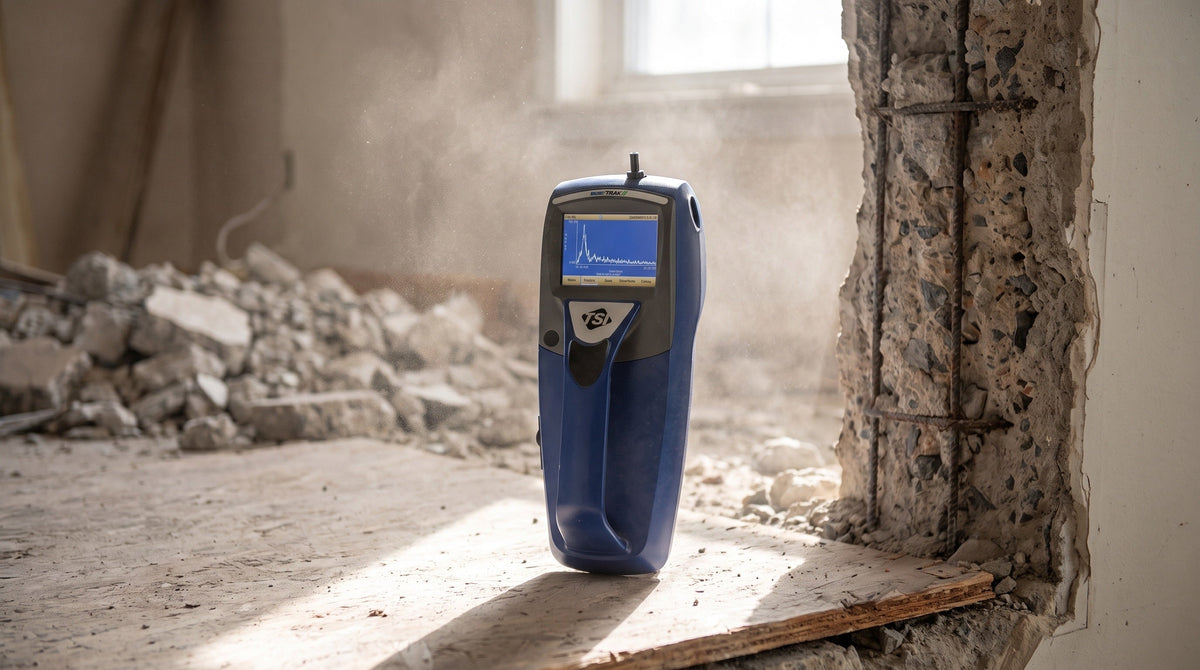
A DustTrak is a light-scattering photometer: it reads airborne dust in real time, but it estimates mass from scattered light and does not weigh anything. A filter weighed on a balance, as in NIOSH Method 0600, remains the gravimetric reference. So use the photometer to find, screen and trend exposures, and the filter to document them. This guide compares the two ERE lists, the TSI DustTrak II 8532 and the Gilian Dustlight, and shows where each fits next to the Air Sampling collection.
In this guide
- What Does a DustTrak Actually Measure?
- Does a Real-Time Dust Monitor Replace Gravimetric Sampling?
- Which Real-Time Dust Monitors Does ERE List?
- How Accurate Is a Photometer on Your Dust?
- When Is a Real-Time Monitor the Right Tool?
- How Do You Choose Between the Two, Step by Step?
- Frequently Asked Questions
What Does a DustTrak Actually Measure?
It measures scattered laser light and reports it as an aerosol mass concentration, updated continuously. ERE's record for the DustTrak II Model 8532 calls it a handheld, battery-operated, data-logging laser photometer with real-time readings from 0.001 to 150 mg/m³. A sheath air system isolates the optics chamber, and the record lists PM1, PM2.5, respirable and PM10 size fractions.
The size fractions come from the kit: the record lists an impactor kit with PM1, PM2.5, PM4 and PM10 impactors, a 10-mm nylon Dorr-Oliver cyclone, a zero filter, sheath air HEPA filters, TrakPro data analysis software, a calibration certificate and a 2-year warranty. The manufacturer's spec sheet and user manual are linked on the product page.
Does a Real-Time Dust Monitor Replace Gravimetric Sampling?
No. A photometer shows when and where dust rises; a gravimetric sample gives the weighed mass for the period. NIOSH Method 0600 describes the reference procedure for respirable dust: a personal pump pulls air through a cyclone and a tared filter, and the filter is weighed after sampling (NIOSH NMAM 0600).
| Real-time photometer (DustTrak, Dustlight) | Gravimetric (NIOSH 0600) | |
|---|---|---|
| Result | Live concentration trend, data-logged | One mass-based average for the sampling period |
| What is measured | Scattered light, converted to mass | Dust mass on a weighed filter |
| Equipment | The monitor and its filters or impactors | Pump, 10-mm nylon cyclone at 1.7 L/min (or Higgins-Dewell 2.2, aluminum 2.5), tared 5-µm PVC filter, 0.001 mg balance |
| Time to answer | Immediate | Sample 45 min to 8 h, then lab weighing |
| Best use | Finding high-exposure tasks, checking controls | Reference measurement |
Method 0600 gives a working range of 0.5 to 10 mg/m³ for a 200-L sample and notes that its header lists OSHA 5 mg/m³ and ACGIH 3 mg/m³ for respirable particulates not otherwise regulated. Check the limit that applies in your jurisdiction. The practical pattern is to screen with the photometer, then run filters on the tasks it flags. For the filter side, see our guides to respirable dust cyclones, air sampling cassettes and air sampling pumps.
Which Real-Time Dust Monitors Does ERE List?
ERE lists two on the Air Sampling collection. Prices are quoted on request.
| TSI DustTrak II 8532 | Gilian Dustlight | |
|---|---|---|
| Format | Handheld, with carrying case | Personal, 149 g (5.25 oz) |
| Technique | Laser photometer, sheath air | Laser photometry |
| Size fractions on record | PM1, PM2.5, respirable, PM10 | PM1, PM2.5, PM4 (respirable), PM10 |
| Range on record | 0.001 to 150 mg/m³ | 0 to 10,000 µg/m³ |
| Power | Rechargeable 3600 mAh Li-ion | Li-ion 1700 mAh: up to 7 h continuous, 20 h standard, 40 h eco |
| Logging | Manual and programmable data logging | Traffic-light display, audible warning, digital display |
| Applications on record | Occupational hygiene surveys, IAQ investigations, point-source monitoring, engineering control evaluations | Construction sites and workshops; complements gravimetric sampling |
| Kits | One configuration | Single-device starter kit or 6-pack with hard carry case |
Three things the records do not say. Neither gives an accuracy figure against filters. The Dustlight record states it meets ISO 7708 and OSHA standards, which describes the product design; it does not make a photometer reading a gravimetric result. And the DustTrak record does not name the calibration aerosol, so ask for it before you compare readings with filters.
How Accurate Is a Photometer on Your Dust?
It depends on the dust. A light-scattering instrument converts scattering to mass using a calibration, and the real conversion changes with particle size, composition and humidity. In a field comparison against filters in a desert environment, a DustTrak DRX tracked PM2.5 and PM10 with high precision but deviated from the filter result: roughly 2x overestimation for the fine fraction and about 20% underestimation for the coarse one. A constant correction factor improved accuracy, and a humidity-adjusted one improved it further (Javed and Guo, Aerosol and Air Quality Research, 2021).
That study used the DRX model outdoors, so do not transfer its factors to a DustTrak II on your site. What transfers is the method: run a filter alongside the photometer on your own dust, derive a site factor, and re-check it when the process or the humidity changes.
When Is a Real-Time Monitor the Right Tool?
Use it when you need an answer in minutes rather than days. The DustTrak record lists these uses:
- Industrial and occupational hygiene surveys: walk the plant and find the tasks that spike.
- Indoor air quality investigations: locate the source and watch the time pattern.
- Point-source location monitoring: find where dust escapes a process.
- Baseline trending and screening: establish what normal looks like.
- Engineering control evaluations: compare readings before and after a hood, enclosure or extraction change.
The Dustlight record adds an on-worker use: immediate feedback by light and sound so a task can be corrected before filter results return. Use a filter whenever the number must stand as the reference measurement.
How Do You Choose Between the Two, Step by Step?
- Decide what the reading is for. Screening and control checks suit a photometer; a reference number needs a weighed filter.
- Pick the format. Area walk-throughs and point-source work suit the handheld DustTrak II; one reading per worker suits the wearable Dustlight.
- Match the size fraction. Respirable work needs the respirable (PM4) channel or cyclone; ambient or IAQ work looks at PM1, PM2.5 or PM10.
- Check the range. The 8532 is rated to 150 mg/m³ and the Dustlight to 10,000 µg/m³ (10 mg/m³); compare both with your expected levels.
- Plan the filter run. Pair the photometer with a pump, cyclone and cassette so you can derive a site factor.
- Plan the upkeep. Zero-filter checks, battery cycles and calibration; ERE lists both as service eligible.
If you are weighing these against your task list, request a quote and we will return a specific recommendation.
Need a real-time dust monitor?
ERE Inc. has served Canadian industrial and environmental buyers for 30+ years. Tell us the task, the dust and whether you need an area or a personal reading, and we will quote the matching monitor and the filter-side kit.
→ Request a Quote | 1-888-287-EREC | Browse Air Sampling | sales@ereinc.com
Frequently Asked Questions
What does a DustTrak measure?
It measures scattered laser light and reports an aerosol mass concentration in real time. ERE's record for the DustTrak II 8532 lists a range of 0.001 to 150 mg/m³ and PM1, PM2.5, respirable and PM10 size fractions.
Is a DustTrak reading the same as a gravimetric result?
No. A photometer estimates mass from scattered light, while gravimetric sampling weighs dust on a filter. A field study found a DustTrak DRX overestimated the fine fraction by about 2x against filters.
What is the difference between the DustTrak II and the Gilian Dustlight?
The DustTrak II 8532 is a handheld monitor for surveys and area work. The Dustlight is a 149 g personal monitor with traffic-light and audible alerts.
Do I still need filter sampling?
Yes, where you need a reference measurement. NIOSH Method 0600 weighs respirable dust on a filter behind a cyclone, and the Dustlight record says its photometer complements gravimetric sampling.
Is the 8532 available to rent or service?
ERE's records mark both monitors service eligible. Ask us about rental availability and calibration when you request a quote.
Related articles
- Respirable Dust Cyclone Buyer's Guide for Canada
- Air Sampling Cassette Types Compared
- Air Sampling Pumps Buyer's Guide
Lire en français : Moniteurs d'aérosols DustTrak : photomètre en temps réel ou gravimétrie au Canada