
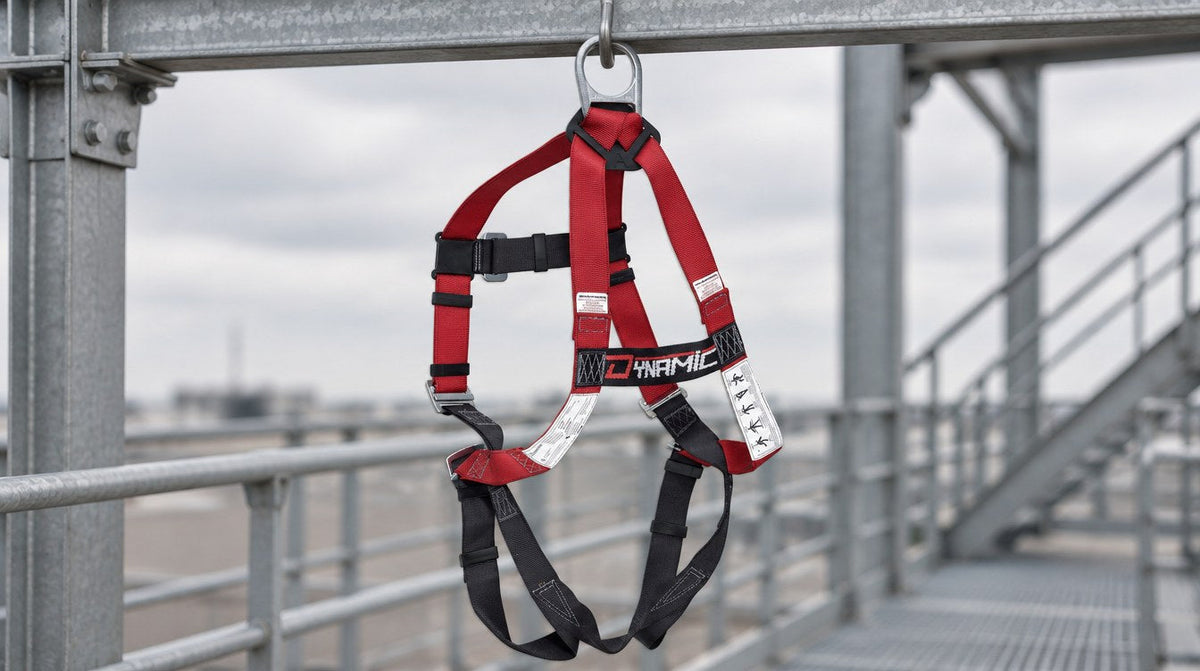
A fall protection system is a chain of five parts: an anchor, a full-body harness, a connecting device (a shock-absorbing lanyard or a self-retracting lifeline), the connectors between them, and a rescue plan. Choose the parts as a set, because the system is only as strong as its weakest link and each part is certified to its own CSA Z259 standard.
What equipment makes up a fall protection system?
A personal fall arrest system has five jobs to cover: hold the worker's body, connect the worker to a safe point, absorb or limit the fall energy, attach to an anchor that can take the load, and get the worker down if a fall happens. Each job maps to a category of equipment.
| Job | Equipment | Guide |
|---|---|---|
| Hold the body | Full-body harness | CSA Z259.10 harness classes |
| Connect and limit the fall | Shock-absorbing lanyard, self-retracting lifeline (SRL), rope grab | Lanyards, SRLs, rope grabs |
| Join the parts | Carabiners and snap hooks | Gate types and ratings |
| Reach a safe point | Roof, beam and strap anchors, horizontal lifelines | Roof anchors, beam anchors, anchor straps, horizontal lifelines |
| Get the worker down | Davit arm, tripod, rescue winch | Davit arm vs tripod |
Tools carried at height are a separate drop-hazard problem: see tool tethers and tool lanyards.
Which standards apply to Canadian fall protection equipment?
Equipment sold for Canadian worksites is normally certified to the CSA Z259 series, with one standard per component type. Use CSA Group for the standard text and your provincial OHS regulation for when fall protection is required and what program surrounds it.
The CCOHS falls overview summarizes the hazard and the usual order of controls: remove the exposure or guard it first, and use personal fall arrest where a fall is still possible. Confirm the certification marking on every component and read the manufacturer's instructions for the combination you plan to use.
How do you choose a harness, lanyard or SRL for the job?
Start from the work: how far the worker can fall, how much they move, and what is overhead. A short, fixed work position suits a shock-absorbing lanyard; frequent movement or limited fall clearance often points to an SRL, which locks quickly when it senses a fall.
- Harness: match the class and the number and position of D-rings to the task (fall arrest, positioning, suspension or retrieval). Fit and adjustment matter as much as the class.
- Lanyard: fixed-length or adjustable, with an energy absorber that limits the force on the body.
- SRL: a retracting line that keeps slack out of the system and reduces free fall; some types are built for leading-edge work and say so on the label.
- Rope grab: for a vertical lifeline where the worker moves up and down a rope.
Always check the working-load range on the label against the worker's weight plus tools.
Which anchor is strong enough?
The anchor must be rated for the system and installed or chosen for the structure it sits on. Anchorage strength requirements differ by use and province, so follow the strength figures in the product literature and your provincial regulation rather than a rule of thumb.
For a steel beam, a beam anchor or anchor strap is typical; for a roof, a roof anchor; for a long run, a horizontal lifeline, whose deflection under load is part of your clearance calculation.
Why is a rescue plan part of the equipment list?
Arresting a fall is not the end of the incident: a worker hanging in a harness needs to be brought down promptly, and the equipment and trained people for that must be in place before the work starts. Plan the rescue method with the same care as the anchor.
For confined spaces and tanks, rescue hardware such as a davit arm or tripod is compared in our davit arm vs tripod guide. Pair the equipment with your site rescue procedure and training.
How do you inspect and retire fall protection equipment?
Inspect every component before each use, and have it formally inspected on the schedule set by the manufacturer and your employer's program. Remove from service any component that has arrested a fall, and any with cuts, burns, chemical damage, corrosion, a sticking gate or an illegible label.
- Keep a record per component, not just per kit.
- Do not mix components from different manufacturers unless the instructions for each allow it.
- Check the service-life limit given in the manufacturer's instructions.
How do you build a complete kit for your crew?
Write down the tasks, heights, anchor points and rescue method, then buy against that list: one harness per worker, the connecting device each task needs, the anchors the structure requires and the rescue gear for the site. Browse the full fall protection collection, or send us the task list and we will match the parts.
Frequently asked questions
What is the minimum equipment for fall arrest?
A certified anchor, a full-body harness and a connecting device with a way to limit the fall force (an energy-absorbing lanyard or an SRL), joined by certified connectors, plus a rescue plan.
Can I mix harnesses and lanyards from different brands?
Only if each manufacturer's instructions permit it. Compatibility of connectors, D-rings and ratings must be confirmed, not assumed.
Which is better, a lanyard or an SRL?
Neither is better in general. A lanyard suits a fixed work position with enough clearance; an SRL suits movement and tighter clearance. Check the fall clearance for your task against the product's rated specifications.
Does ERE sell fall protection equipment?
Yes, the fall protection collection lists harnesses, lanyards, SRLs, anchors and connectors from several brands. Availability varies by model, so request a quote and we will confirm stock and lead time.
Need help specifying a fall protection system?
ERE Inc. has supplied environmental and safety equipment from Montreal for 30+ years. Tell us the task, the height and the anchor point, and we will match the system.
→ Request a Quote | 1-888-287-EREC | Browse Fall Protection | sales@ereinc.com
Lire en français : Équipement antichute : les cinq parties d'un système et comment choisir au Canada