
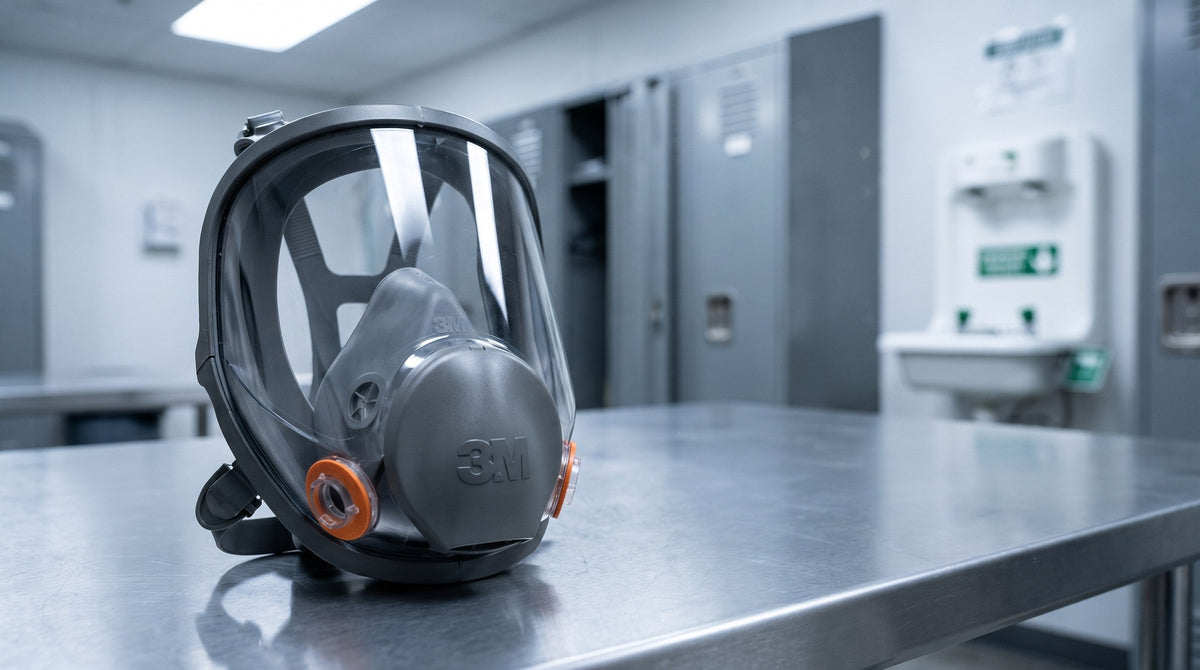
A full-face respirator is a tight-fitting, air-purifying mask that covers the face from above the eyes to below the chin, so it protects the eyes as well as the airway. Choose one over a half-mask when the hazard irritates or damages the eyes, when splash or mist is possible, or when your hazard assessment calls for a higher assigned protection factor. The filters and cartridges still have to match the contaminant, and the mask still has to be fit tested to the person. This guide shows how to decide, what to check before issuing one, and what ERE carries for the 3M 6000 Series.
In this guide
- What does a full-face respirator protect against?
- Full-face or half-mask: which should you choose?
- When is a full-face respirator not enough?
- How do you match cartridges and filters?
- How do you choose, step by step?
- How are full-face respirators fit tested and checked?
- What 3M full-face options does ERE carry?
- Frequently Asked Questions
What Does a Full-Face Respirator Protect Against?
It protects against airborne particulates, gases and vapours, depending on the filter or cartridge fitted, and it shields the eyes and face from irritating or splashing contaminants. The facepiece carries the seal and the lens; the cartridges or filters do the air cleaning.
The Canadian Centre for Occupational Health and Safety (CCOHS) lists the full facepiece, covering the face from above the eyes to below the chin, as one of the tight-fitting forms of air-purifying respirator, and notes in its respirator selection fact sheet that respirators with a full facepiece also protect the eyes from exposure to irritating chemicals. The 3M 6000 Series record at ERE describes a silicone faceseal and polycarbonate lens, an approximate weight of 411 g (0.9 lb), NIOSH approval, and ANSI Z87.1 high-impact eye and face protection.
Full-Face or Half-Mask: Which Should You Choose?
Choose a half-mask when the hazard is a particulate or vapour that does not irritate the eyes and the exposure sits well inside the protection a half-mask offers. Choose a full-face mask when eye or face exposure is a concern, or when you need more protection than a half-mask gives. If you are still on the half-mask side of the decision, our half-mask respirator guide covers cartridge matching in detail.
| Question | Half-mask | Full-face |
|---|---|---|
| Covers | Nose to below the chin | Above the eyes to below the chin |
| Eye and face protection | None; wear separate eye protection | Built-in lens (the 3M 6000 Series lens is listed to ANSI Z87.1) |
| Eye-irritating gases or vapours | Eyes exposed unless sealed goggles are worn | Eyes covered by the facepiece |
| Assigned protection factor | Lower | Higher; the 3M 6000 Series record lists 10x PEL with a qualitative fit test and 50x PEL with a quantitative one |
| Fit test method | Qualitative or quantitative | Quantitative only (CCOHS) |
| Typical use | Dusts, fumes, low-level vapours | Mists, splash risk, irritant gases, higher concentrations |
Assigned protection factors differ by jurisdiction and by the edition of CSA Z94.4 that your regulator cites, so confirm the figure that applies to you rather than relying on a product sheet alone.
When Is a Full-Face Respirator Not Enough?
When the atmosphere is oxygen-deficient or immediately dangerous to life or health (IDLH), an air-purifying respirator of any kind is the wrong tool. CCOHS lists the IDLH conditions as including a known contaminant at an IDLH concentration, an unknown contaminant at an unknown concentration, an untested confined space, an oxygen-deficient atmosphere, firefighting, and contaminants at or above 20% of their lower explosive limit.
Those situations call for supplied-air equipment. A powered unit is the next step for long shifts or higher workloads; see our PAPR guide. CCOHS also reminds employers that respirators should not be the first choice: they are for when elimination, substitution, engineering or administrative controls cannot be implemented or are not fully effective, while controls are being installed or repaired, and for emergencies or temporary situations. For tests that tell you what is in the air before anyone enters, a portable gas detector is the usual companion.
How Do You Match Cartridges and Filters?
Match the cartridge to the contaminant named on the safety data sheet (SDS), then add a particulate filter if there is also dust, mist or fume. CCOHS says it is very important to use the right filter or cartridge for the chemicals or substances present: filters trap particles, and cartridges contain material that adsorbs gases and vapours.
ERE lists two 3M cartridge families that fit the 6000 Series full facepiece:
- 3M 60921, 60923 and 60926 combination cartridge/filters, P100: 60921 is organic vapour, 60923 is organic vapour/acid gas, and 60926 is multi-gas/vapour, each with a permanently attached P100 prefilter rated at least 99.97% efficient against solid and liquid aerosols including oils. Bayonet connection, sold in pairs, NIOSH colour coding magenta/olive.
- 3M 6006 multi-gas/vapour cartridge: approved for organic vapours, chlorine, chlorine dioxide, hydrogen chloride, sulfur dioxide, hydrogen fluoride, hydrogen sulfide, ammonia, methylamine and formaldehyde, per the product record. Bayonet connection, sold in pairs, for 3M 6000, 7000 and FF-400 series facepieces.
The mask record also names 3M 2000 Series filters and the 7093 P100 filter as compatible, plus the 3M dual airline systems. Cartridges have a service life: CCOHS tells users to check end-of-service-life indicators and shelf-life dates before each use and to know how to determine when a filter has reached its limit. A multi-gas cartridge is not approved for every gas, so read the approval list against your contaminant.
How Do You Choose a Full-Face Respirator, Step by Step?
Work through the hazard first and the mask second. CCOHS says choosing a respirator is complicated and should be done by an experienced safety professional or occupational hygienist who knows the workplace; the steps below are the order that person would follow.
- Identify and measure the hazard. Is it a particulate, a gas or vapour, or both? What is the concentration against the occupational exposure limit, and is any condition IDLH?
- Check the controls. Confirm ventilation, enclosure or substitution have been considered first.
- Pick the facepiece and APF. If the eyes are at risk or the multiple of the exposure limit exceeds what a half-mask allows, go full-face. Maximum use concentration is the APF times the exposure limit (CCOHS).
- Pick the cartridge or filter from the SDS, then fit test and train the wearer.
How Are Full-Face Respirators Fit Tested and Checked?
They are fit tested quantitatively, and the wearer does a seal check every time the mask goes on. CCOHS states that the qualitative method, which relies on tasting or smelling a test agent, cannot be used to test full-face respirators, while a quantitative test measures leakage with a machine and works for any tight-fitting respirator. Our fit testing guide explains both methods. ERE does not currently list a quantitative fit-test instrument.
The seal check is quick. CCOHS describes it in its wearing a respirator fact sheet: block the inlets, inhale gently and hold for at least five seconds, and the facepiece should collapse slightly; for the positive check, block the exhalation valve and exhale gently, and the facepiece should puff out slightly. CCOHS also says workers with beards, long sideburns or stubble may not wear a tight-fitting respirator because hair breaks the seal, that eyeglass frames can break it too, and that a respirator should be inspected for cracks, tears, distortion and valve condition before each use. If prescription eyewear is a problem with a full-face mask, ask your supplier about the options before issuing it.
What 3M Full-Face Options Does ERE Carry?
ERE carries the 3M Full Facepiece 6000 Series in three sizes: Small (6700), Medium (6800) and Large (6900). The product record lists NIOSH approval, a silicone faceseal with polycarbonate lens, and use with 3M 2000 Series filters, the 7093 P100 filter, 6000 Series cartridges or 3M dual airline systems, against a variety of gases, vapours and particulates according to the NIOSH approvals. Technical data sheets and user instructions are linked on the product page. Live pricing and availability are on the product page; ask us if you need a quantity or a size mix.
For the wider range, including half-masks, filters and fit-test kits, see the respiratory protection collection. Eye protection to wear with a half-mask is covered in our safety glasses guide.
Need help specifying a full-face respirator?
ERE Inc. has been Canada's environmental equipment specialist for 30+ years. Send us the contaminant, the head count and the sizes you need and we will quote the mask and matching cartridges.
→ Request a Quote | 1-888-287-EREC | Browse Respiratory Protection | sales@ereinc.com
Frequently Asked Questions
What is a full-face respirator?
A tight-fitting air-purifying respirator that covers the face from above the eyes to below the chin. It cleans the air through filters or cartridges and also protects the eyes from irritating chemicals, according to CCOHS.
Is a full-face respirator better than a half-mask?
It is better when the eyes need protection or when a higher assigned protection factor is required. For low-level dust or vapour that does not irritate the eyes, a half-mask is often enough. The hazard assessment decides.
Can a full-face respirator be used in an oxygen-deficient atmosphere?
No. An air-purifying respirator only cleans the air that is there. For oxygen-deficient or IDLH atmospheres you need supplied-air equipment.
How is a full-face respirator fit tested?
With a quantitative fit test. CCOHS states that qualitative fit testing cannot be used on full-face respirators.
Do I need to be clean-shaven to wear one?
Yes, where the facepiece seals. CCOHS says beards, long sideburns and even stubble can break the seal and leave the respirator leaking.
Which cartridge goes on a 3M 6000 Series full facepiece?
Choose by contaminant: for example 60921 for organic vapour, 60923 for organic vapour and acid gas, 60926 or 6006 for multi-gas, with a particulate filter where dust or mist is present. Read the approval list for the exact gases.
Related articles
- Half-Mask Respirator: How to Match Cartridges and Filters to the Hazard
- Powered Air-Purifying Respirator (PAPR): How It Works and How to Choose
- Qualitative vs Quantitative Respirator Fit Test
- Safety Glasses: How to Read CSA Z94.3 and Choose in Canada
Lire en français : Respirateur facial complet : quand le choisir plutôt qu'un demi-masque au Canada