
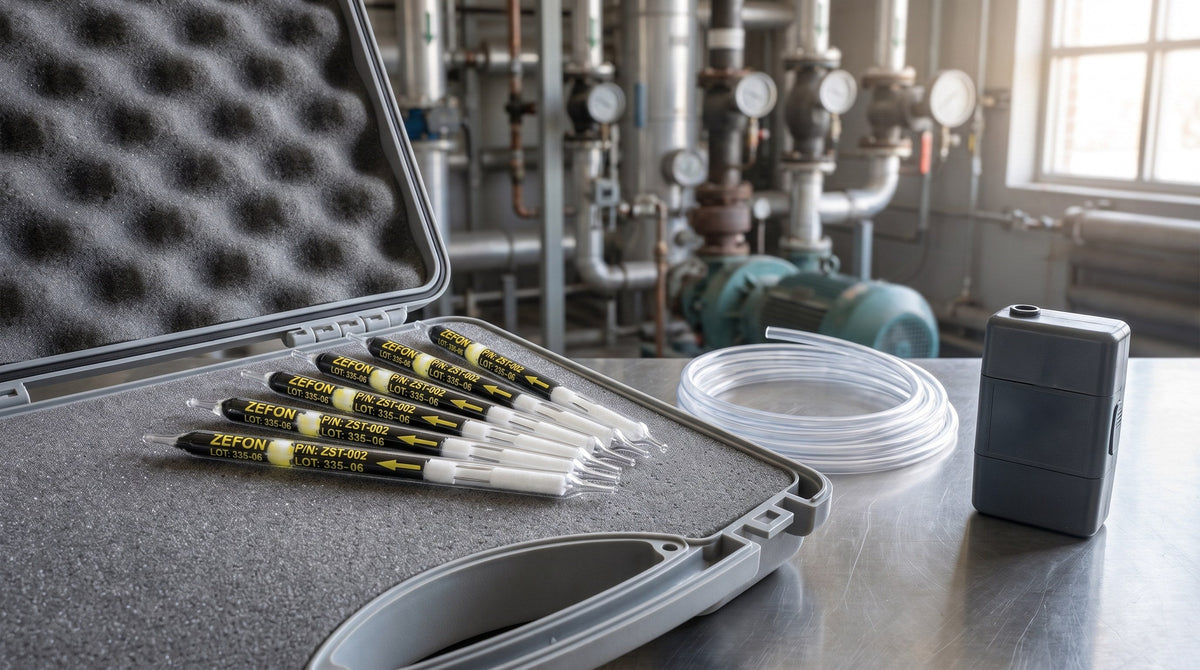
A sorbent tube is a sealed glass tube packed with a solid adsorbent: a pump pulls air through it, the adsorbent traps the vapours you are after, and a lab measures what was collected. Three choices decide whether the result is usable: the sorbent (set by your target compound and its method, not by preference), the tube size and loading (which sets how much air the tube can take before the compound breaks through to its backup section), and the flow rate and volume you sample at. This guide walks through each one using what NIOSH methods specify for charcoal, silica gel and XAD-2, and shows where the 14 Zefon® sorbent tube part numbers that ERE lists fit.
In this guide
- What is a sorbent tube, and when is it the right sampler?
- Which sorbent do you need: charcoal, silica gel or XAD?
- Which tube size and loading should you choose?
- What flow rate and sample volume should you use?
- What does the backup section tell you about breakthrough?
- How do you sample, store and ship a sorbent tube?
- What else do you need besides the tube?
What Is a Sorbent Tube, and When Is It the Right Sampler?
A sorbent tube is a collection medium, not a reader: it holds the sample until a lab desorbs it and measures it. Use one when you need a time-weighted or task-based result for a specific vapour, such as a shift-average benzene exposure, together with a laboratory report you can put in front of a regulator or a client.
That separates it from three things it is often confused with. A gas detection tube changes colour on the spot and gives an immediate reading; a Tedlar bag holds a grab sample of a gas; and particles are collected on filters and cassettes. The tubes in this guide are solvent-desorbed: the lab extracts the sorbent with a solvent (carbon disulfide for the NIOSH 1501 charcoal tube) and runs the extract on a gas chromatograph. Thermal-desorption tubes are a different family with their own analyzers and sit outside this guide.
NIOSH methods are US methods, so confirm which one your Canadian lab, jurisdiction or client actually references. In Quebec, the IRSST's Guide d'échantillonnage des contaminants de l'air en milieu de travail (8th edition, version 8.2, updated December 2025, in French) covers sampling strategy, sampling instruments and techniques, and sampling and analysis by substance. Whichever reference applies, your lab's method sheet has the final word on the tube.
Which Sorbent Do You Need: Charcoal, Silica Gel or XAD?
The sorbent has to be the one your method names for your compound; there is no general-purpose tube. Charcoal is the common choice for organic vapours such as aromatic hydrocarbons, silica gel for polar compounds such as amines, and XAD resins for semi-volatile compounds such as PAH vapours. The NIOSH examples below show what each looks like in a real method, next to the Zefon® part numbers ERE lists.
| Sorbent | What a NIOSH method collects with it | Tube the method specifies | Zefon® part numbers ERE lists |
|---|---|---|---|
| Coconut shell charcoal | Aromatic hydrocarbons: benzene, toluene, ethylbenzene, xylenes, styrene and related compounds (NIOSH 1501) | 100 mg front / 50 mg back, 6 mm OD × 7 cm | ZE-ZST-001 (100/50 mg, 6 × 70 mm), 001B (1,000 per box), 002 (400/200 mg, 8 × 110 mm), 002B (1,000 per box), 003 (800/200 mg, 10 × 110 mm) |
| Silica gel | Aliphatic amines: diethylamine and dimethylamine (NIOSH 2010) | 150 mg front / 75 mg back, 6 mm OD × 7 cm | ZE-ZST-050 (150/75 mg, 6 × 70 mm), 051 (100/50 mg, 6 × 70 mm), 054 (520/360 mg, 8 × 110 mm), 058 (1,040/260 mg, 10 × 110 mm), 060 (specially cleaned, 400/200 mg, 7 × 110 mm) |
| XAD-2 | PAH vapours, behind a PTFE filter (NIOSH 5506) | Washed XAD-2, 100 mg front / 50 mg back | ZE-ZST-080 (100/50 mg, 8 × 110 mm) |
| XAD-7, Chromosorb, Microlite | Methods that name them | Check your method | ZE-ZST-090 (XAD-7, 100/50 mg, 6 × 110 mm), 020 (Chromosorb, 100/50 mg, 8 × 110 mm), 040 (Microlite, one 200 mg section, 6 × 70 mm) |
All 14 part numbers are glass-sealed, and Zefon's product description says they are designed to meet NIOSH specifications for tube dimensions, sorbent quality, particle size, divider composition and pore size. Two cautions. NIOSH 5506 specifies washed XAD-2, so confirm the cleaning grade and tube dimensions with your lab before assuming a tube with the same loading is acceptable. And NIOSH 2010 notes that its silica gel method was evaluated only in dry air, with reduced capacity possible at high humidity.
Which Tube Size and Loading Should You Choose?
Start with the size your method validated, then think about capacity. The standard NIOSH charcoal tube is 6 mm OD × 7 cm with 100 mg/50 mg of sorbent. Larger tubes (8 × 110 mm and 10 × 110 mm in the Zefon range, carrying up to 800 mg in the charcoal front section and 1,040 mg in silica gel) hold more sorbent, which generally lets them take more air before a compound breaks through. But a method's validated volume belongs to the tube it was validated on, so a bigger tube is a change to raise with your lab, not a free upgrade.
How much a tube can take also depends on the compound. NIOSH 1501 publishes breakthrough data for its 100 mg/50 mg charcoal tube:
| Compound | Flow rate (L/min) | Recommended sample volume (L) | Breakthrough volume (L) at the concentration shown |
|---|---|---|---|
| Benzene | up to 0.20 | 5 to 30 | over 45 at 149 mg/m³ |
| Toluene | up to 0.20 | 1 to 8 | 12 at 2,294 mg/m³ |
| Ethylbenzene | up to 0.20 | 1 to 24 | 35 at 917 mg/m³ |
| Xylenes (o-, m-, p-) | up to 0.20 | 2 to 23 | 35 at 870 mg/m³ |
| Styrene | under 1.00 | 1 to 14 | 21 at 1,710 mg/m³ |
NIOSH states the minimum and maximum volumes at the OSHA TWA, so treat them as planning numbers. It also warns that interactions between analytes can reduce breakthrough volumes, and that high humidity does too.
What Flow Rate and Sample Volume Should You Use?
Sample volume is flow rate multiplied by time, and the method sets the window. NIOSH 1501 calls for 0.01 to 0.2 L/min for aromatic hydrocarbons; NIOSH 2010 calls for 0.01 to 1.0 L/min and 3 to 30 L for amines on silica gel; NIOSH 5506 calls for 2 L/min and 200 to 1,000 L for PAHs on a filter plus XAD-2 tube. Three worked examples:
- Toluene, full shift. NIOSH's 8 L maximum spread over 480 minutes is about 0.017 L/min (17 mL/min), above the 0.01 L/min minimum the method recommends. At 0.20 L/min the same 8 L is used up in 40 minutes.
- Benzene, full shift. 0.05 L/min for 480 minutes collects 24 L, inside the 5 to 30 L range.
- PAHs. At 2 L/min, 200 to 1,000 L means 100 to 500 minutes of sampling, which needs a pump that can hold 2 L/min against the resistance of the filter and tube.
Every method above starts the same way: calibrate the pump with a representative tube in line, because the tube adds resistance to the flow you set. Low-flow work is where pump choice matters most, so see our air sampling pump buyer's guide, or the rental guide if the job is short. To run two tubes at once at independent flow rates, the Zefon® Gemini® Twin Port Sorbent Tube Sampler controls each port separately, down to 0.001 L/min, and works with a pump that can pull 1.5 L/min at 25 inches of water backpressure. Zefon's product description notes that running duplicate tubes at different flow rates protects against breakthrough when the concentration is higher than expected.
What Does the Backup Section Tell You About Breakthrough?
The small back section is a breakthrough check. Most tubes hold two sections separated by a foam plug: the front section collects the compound, and the smaller back section catches whatever the front could not hold. In the NIOSH 1501 tube the front holds 100 mg and the back 50 mg, with a 2 mm urethane foam plug between them, and the lab desorbs and analyzes the two sections in separate vials.
The rule is simple: if the back section holds more than a tenth of what the front holds, NIOSH 1501 says to report breakthrough and possible sample loss. Some of the compound may have escaped, so the reported concentration may read low. The fix is a shorter sample, a lower flow rate or a higher-capacity tube, agreed with your lab, followed by a resample.
Humidity matters too. NIOSH 1501 notes that high humidity may reduce breakthrough volumes, and NIOSH 2010 notes that silica gel may have reduced capacity at high humidity and was evaluated only in dry air. If you are sampling in a humid process area, talk to your lab about a shorter sample or a larger tube before you start.
How Do You Sample, Store and Ship a Sorbent Tube?
Calibrate, break the tips only at the last moment, sample at a known flow, cap, keep it cold and send blanks. The steps below follow NIOSH 1501, 2010 and 5506; your lab's method sheet takes precedence.
- Confirm the tube and the flow window with your lab. Ask which method the lab will run and which tube, flow rate and sample volume it specifies.
- Calibrate the pump with a representative tube in line. NIOSH 1501, 2010 and 5506 all start this way, because the tube adds resistance to the flow you set.
- Break both ends just before sampling. Break the sealed glass tips immediately before sampling, then connect the tube to the pump with flexible tubing. Fit it the way its label indicates, so the smaller back section sits downstream of the front section, nearest the pump.
- Sample at a known flow for the planned time. Record the flow rate and the start and stop times so the lab can turn the mass it measures into an air concentration.
- Cap the tube with plastic caps and pack it securely. NIOSH 1501 specifies plastic caps, not rubber.
- Keep it cold and ship it with blanks. NIOSH 1501 gives 30 days at 5 °C for aromatic hydrocarbons, NIOSH 2010 calls for refrigerated shipping with bagged refrigerant, and NIOSH 5506 calls for wrapping the tube in aluminum foil and shipping it with refrigerant. Submit field blanks with every set: 10% of samples in NIOSH 1501, 2 to 10 per set in NIOSH 2010 and 3 to 10 per set in NIOSH 5506.
Leave the extraction to the lab. NIOSH 1501 desorbs the charcoal in carbon disulfide, which it describes as toxic and extremely flammable, and it flags benzene as a suspect carcinogen. Both are handled in a fume hood.
What Else Do You Need Besides the Tube?
A tube is one part of the sampling train: a pump that holds the specified flow, flexible tubing, a holder (or the Gemini if you want two tubes on one pump), a way to check the flow, and a laboratory to analyze the sample. ERE supplies the sampling side from its Air Sampling collection. Send us the target compound, the method reference and the sample duration, and we will match the tube, holder and pump, and confirm what can be sourced if your method names a tube that is not on the product page.
Need help choosing a sorbent tube?
ERE Inc. has been Canada's environmental equipment specialist for 30+ years. Tell us the target compound, the method reference and the sample duration, and we will match the tube, holder and pump.
→ Request a Quote | 1-888-287-EREC | Browse Air Sampling | sales@ereinc.com
Frequently Asked Questions
What is the difference between a sorbent tube and a gas detection tube?
A sorbent tube collects a sample for a laboratory to analyze, which gives a time-weighted result you can document. A gas detection tube changes colour in the field and gives an immediate spot reading. They answer different questions, so choose by whether you need a lab result or a reading now.
How long can a sorbent tube sample be stored?
It depends on the analyte and the method. NIOSH 1501 reports 30 days at 5 °C for aromatic hydrocarbons on charcoal, NIOSH 2010 says stability on silica gel was not determined and calls for refrigerated shipping, and NIOSH 5506 lists stability as unknown and says to protect PAH samples from heat and UV light. Ask your lab for its hold time and ship the tube cold.
Can I use a bigger tube to sample for longer?
Only if your method or lab allows it. Capacity depends on the sorbent mass and on the compound: on the 100 mg/50 mg charcoal tube in NIOSH 1501, toluene breaks through at 12 L while benzene holds past 45 L. A method's validated volume applies to the tube it was validated on, so agree any change with the lab first.
What flow rate should I use for a sorbent tube?
The method sets it. NIOSH 1501 specifies 0.01 to 0.2 L/min for aromatic hydrocarbons, NIOSH 2010 specifies 0.01 to 1.0 L/min for amines on silica gel, and NIOSH 5506 specifies 2 L/min for PAHs. Calibrate the pump with a representative tube in line before you sample.
Related articles
- Air Sampling Pumps: Buyer's Guide for Environmental & Occupational Hygiene Professionals in Canada
- Air Sampling Pump Rental in Canada: What to Rent, When to Buy
- Air Sampling Cassette Types Compared: Air-O-Cell vs. Allergenco-D vs. Micro5 vs. PCM
- Tedlar Gas Sampling Bags: How to Choose the Right Size, Film and Valve in Canada
- Gas Detection Tubes: A Buyer's Guide for Canada
Lire en français : Tubes sorbants pour l'échantillonnage de l'air : comment choisir le sorbant, la taille du tube et le débit au Canada