
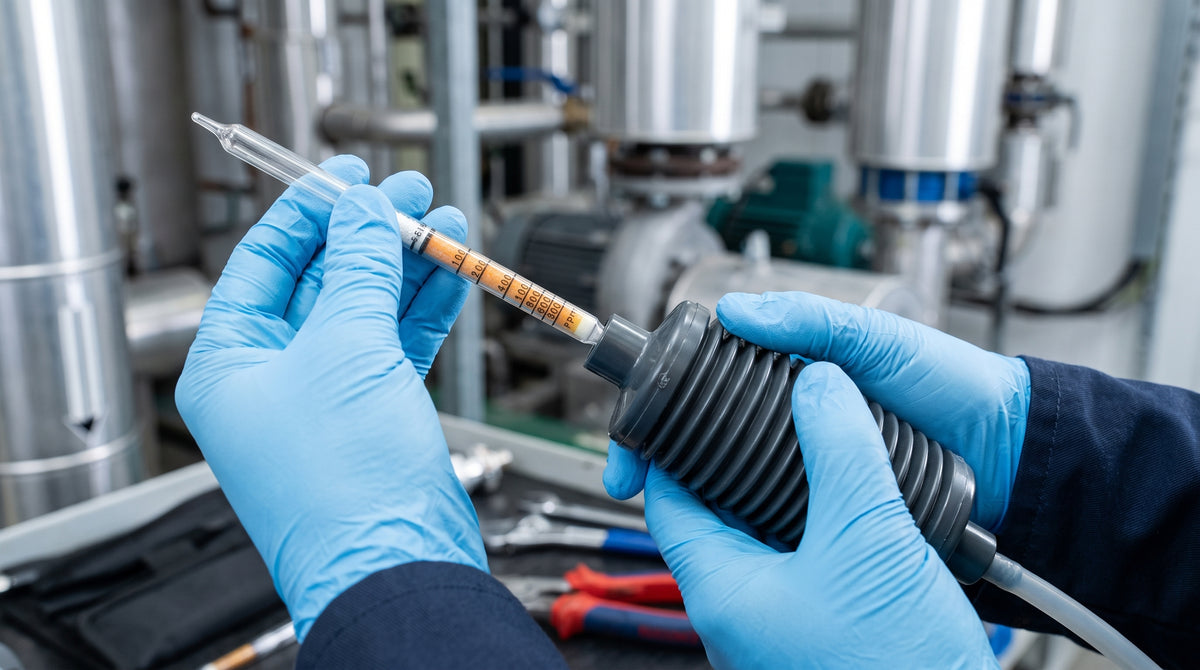
Gas detection tubes are glass or plastic tubes filled with a chemical reagent that changes color when a specific gas passes through it — you break both tips, draw a measured air sample through with a hand pump, and read the concentration off the stain length against a printed scale. ERE Inc. stocks the two brands most Canadian industrial hygiene and safety teams standardize on: Dräger and Sensidyne.
Table of contents
- What Are Gas Detection Tubes and How Do They Work?
- Which Gas Detection Tube Brand Do You Need: Dräger or Sensidyne?
- How Do You Take a Reading With a Detector Tube?
- Should You Use a Detector Tube or an Electronic Gas Detector?
- Which Gases Can Detector Tubes Measure?
- How Accurate Are Gas Detection Tubes?
- Do You Need a Hand Pump, and Which One?
- Frequently Asked Questions
What Are Gas Detection Tubes and How Do They Work?
A gas detection tube is a sealed glass tube packed with a reagent that reacts with one target gas (or a narrow family of related gases) by changing color. A calibrated hand pump draws a fixed air sample through the tube; the length of the color-change stain corresponds to gas concentration, read directly off a printed ppm scale on the tube itself. There's no sensor to drift, no battery to charge, and no calibration gas cylinder to keep current — the tube itself is the calibrated measuring device, used once and discarded.
ERE stocks tubes and pumps from our gas detection tubes & pumps collection, covering the two systems most Canadian industrial hygiene, confined-space, and emergency-response teams already carry.
Which Gas Detection Tube Brand Do You Need: Dräger or Sensidyne?
Both brands measure the same way and read the same ppm scale format; the practical difference is catalogue breadth and how your team already standardizes calibration and training records. The table below compares what ERE stocks from each.
| Brand | System | Coverage | Best for |
|---|---|---|---|
| Dräger | DrägerTubes® | 500+ substances across 160+ short-term tube types, sold under one bulk SKU with individual gas-specific variants | Teams that already run Dräger pumps/instruments and want one vendor for tubes across a broad substance list |
| Sensidyne | Single-gas colorimetric tubes | Individually listed SKUs per gas — ammonia, benzene, carbon monoxide, formaldehyde, hydrogen sulfide, and dozens more | Teams that want to order exactly the gas(es) they test for without navigating a 160-item catalogue |
Both run on the same style of hand pump (see the pump section below), so mixing brands across your kit is common in the field.
How Do You Take a Reading With a Detector Tube?
Snap both tips off the tube, seat it in the pump with the arrow pointing toward the pump, and pull the specified number of full strokes — then read the stain length against the tube's printed scale. The full sequence:
- Select the correct tube for the gas you're testing, and confirm the tube's printed range covers your expected concentration.
- Break both tips using the pump's built-in tip-breaker, then insert the tube into the pump with the flow-direction arrow pointing into the pump.
- Pull the specified number of full, complete strokes at the rate printed on the tube's instruction insert — a partial or rushed stroke under-samples the air and reads low.
- Read the concentration where the color-change stain ends on the tube's printed ppm scale, then discard the tube — each tube is single-use.
Test in a well-ventilated area for your own safety before assuming a space is safe to enter, and always follow the specific tube's manufacturer insert — stroke count and volume vary by tube type.
Should You Use a Detector Tube or an Electronic Gas Detector?
Use a tube when you need to confirm one specific gas at one specific point in time; use an electronic detector when you need continuous, multi-gas, or broad-spectrum monitoring. The two aren't competitors — most industrial hygiene and confined-space programs carry both.
ERE's portable gas detectors continuously monitor LEL/O2/CO/H2S (or more) for as long as you're in a space, with an audible alarm the moment a threshold is crossed — that's what you wear on your body during entry. A tube, by contrast, answers one narrow question well: "exactly how much benzene is in this specific sample, right now?" — useful for pre-entry spot checks, leak-source pinpointing, or confirming a specific substance an electronic sensor doesn't carry a channel for. For broad-spectrum VOC screening rather than a single named compound, our photoionization detector (PID) guide covers the third tool in this family — a PID gives a fast total-VOC number across hundreds of compounds but can't tell you which one, where a tube confirms identity and concentration for one substance at a time. If you need a laboratory result rather than a spot reading, a pump with a sorbent tube collects a time-weighted sample for analysis: see our sorbent tubes guide.
Which Gases Can Detector Tubes Measure?
Between DrägerTubes® and ERE's Sensidyne line, the combined catalogue covers several hundred distinct gases and vapors. Some of the most commonly ordered single-gas Sensidyne tubes:
| Target gas | Common application |
|---|---|
| Ammonia | Refrigeration leak checks, agricultural/livestock facilities, wastewater treatment |
| Benzene | Petroleum, tank farms, remediation sites with known BTEX contamination |
| Carbon monoxide | Confined-space pre-entry checks, combustion equipment rooms, parking garages |
| Formaldehyde | Indoor air quality investigations, manufacturing off-gassing checks |
| Hydrogen sulfide | Sewer/lift station entry, oil & gas, pulp & paper |
Need a substance not listed here? The DrägerTubes® system alone covers over 500 individual substances — tell us the target gas and expected range and we'll confirm the correct tube.
How Accurate Are Gas Detection Tubes?
Detector tube systems typically achieve an accuracy within roughly ±25% of the true reading, which is why they're used for spot-check and pre-entry screening rather than continuous compliance-grade monitoring. That's a wider tolerance than a calibrated electronic sensor, but it's more than adequate for the yes/no and rough-magnitude questions tubes are built to answer — "is this space safe enough to enter" or "which line is the leak coming from."
Reading accuracy also depends on technique: full, steady pump strokes at the correct rate, reading the stain boundary at eye level, and using the tube within its stated shelf life all matter. For confined-space work specifically, CCOHS's confined space guidance sets out the standard atmospheric-testing sequence — oxygen first, then combustibles, then toxics — that a tube-based toxic-gas check like these fits into alongside your electronic detector's O2/LEL readings. Broader occupational exposure-limit context for the substances tubes commonly test for is available through Health Canada's occupational health and safety program.
Do You Need a Hand Pump, and Which One?
Yes — a detector tube is inert glass without a pump; the pump is what draws the calibrated air sample through it. ERE stocks the Sensidyne AP-20S gas detection pump, a bellows-style hand pump with a built-in tip-breaker and stroke counter, compatible with both Sensidyne and Dräger tube systems. One pump serves your whole tube kit regardless of brand, so most teams buy one pump and stock tubes for whatever gases their work requires.
Browse the full range in our gas detection tubes & pumps collection, or pair tubes with a wearable multi-gas monitor from our portable gas detectors collection for continuous coverage during entry. If the sample has to be analyzed in a lab rather than read on site, a gas sampling bag is one option; see our Tedlar bag buyer's guide.
Frequently Asked Questions
How long do gas detection tubes last before they expire?
Most tubes carry a shelf life of one to two years from the date of manufacture, printed on the box — check the expiry date before use, since an expired reagent can under-react and give a falsely low reading.
Can you reuse a gas detection tube?
No. Each tube is single-use — once air has passed through and the reagent has reacted, the tube is spent and must be discarded, even if the stain doesn't reach the top of the printed scale.
Do gas detection tubes need calibration?
No — each tube is manufactured and calibrated as a single-use measuring device, unlike an electronic sensor that needs periodic bump testing and calibration. That's a key reason tube kits stay in service alongside electronic detectors: no calibration gas cylinder or docking station required.
What's the difference between a short-term tube and a long-term (dosimeter) tube?
A short-term tube gives one spot reading in a single pumping cycle (seconds to a couple of minutes). A long-term dosimeter tube stays in place for hours to measure cumulative exposure over a work shift — ERE's catalogue is built around the short-term spot-check tubes most field teams use day to day; ask us if your program needs long-term dosimetry.
Can one hand pump be used with both Dräger and Sensidyne tubes?
Yes — the Sensidyne AP-20S pump ERE stocks is compatible with both tube systems, so a single pump covers your whole kit regardless of which brand's tubes you're carrying for a given gas.
Related articles
- Portable Gas Detectors: A Buyer's Guide for Canada
- Photoionization Detectors (PID): A Buyer's Guide for Canada
- Confined Space Gas Monitoring Requirements in Canada
- Bump Test vs. Calibration: What's the Difference?
Lire en français : Tubes de détection de gaz : guide d'achat pour le Canada
Need help choosing the right gas detection tube?
ERE Inc. has supplied environmental and industrial hygiene equipment to Canadian consultants and facility teams for 30+ years, stocking both Dräger and Sensidyne tube systems.
→ Request a Quote | 1-888-287-EREC | Browse Gas Detection Tubes & Pumps | sales@ereinc.com