
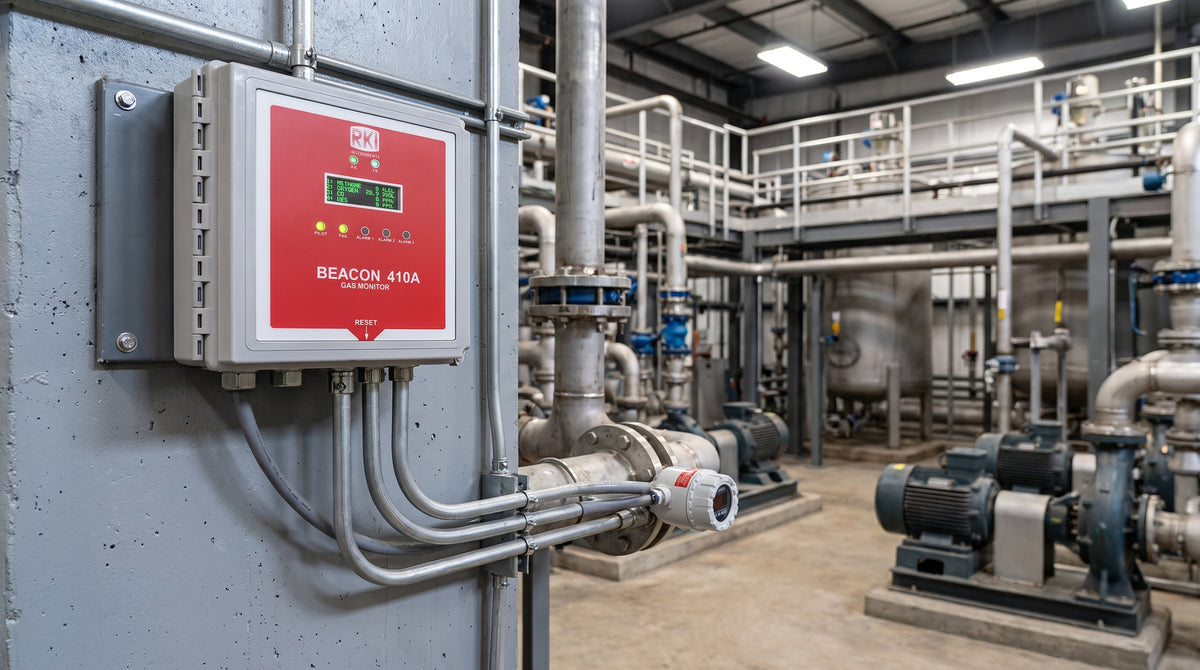
A fixed gas detection system is a permanently mounted detector wired to a controller that continuously watches one or more locations for combustible, toxic, or oxygen-deficient atmospheres — no one has to be present, and no one has to remember to carry it. ERE Inc. stocks RKI Instruments' Beacon controller line (1 to 8 channels) plus point, sample-draw, VOC, and benzene-specific sensors from RKI and Ion Science.
Table of contents
- What Is a Fixed Gas Detection System and How Does It Work?
- Which RKI Beacon Controller Do You Need?
- Point Detector or Sample-Draw Transmitter — Which Sensor Type Fits Your Application?
- Do You Need VOC or Benzene-Specific Monitoring?
- Should You Choose Fixed or Portable Gas Detection?
- How Do You Install and Wire a Fixed Gas Detection System?
- Are Fixed Gas Detectors Required by Regulation in Canada?
- Frequently Asked Questions
What Is a Fixed Gas Detection System and How Does It Work?
A fixed gas detection system pairs a sensor or transmitter mounted at a specific hazard location with a controller that reads it continuously and triggers a local alarm — and often a relay output to a horn, strobe, or building management system — the moment gas concentration crosses a programmed threshold. Unlike a portable detector a worker clips to their belt before entering a space, a fixed system stays at one point around the clock: a pump room, a tank farm perimeter, a confined-space entry, a digester headspace.
Every fixed system in ERE's fixed gas detectors collection follows the same basic architecture — a sensor or transmitter that measures gas concentration, wired (directly or via 4-20 mA) to a controller that displays the reading, holds the alarm setpoints, and drives the relay outputs.
Which RKI Beacon Controller Do You Need?
The number of separate points you need to monitor from one panel decides which Beacon controller fits — RKI's Beacon line scales from a single channel up to eight, and every model accepts the same direct-connect RKI sensors or any 4-20 mA transmitter, so growing from one zone to four doesn't mean re-wiring your sensor type.
| Controller | Channels | Power | Relay rating | Best for |
|---|---|---|---|---|
| Beacon 110 | 1 | 115/220 VAC or 24 VDC | 10 A, 3 relays | A single point — one pump room, one storage area |
| Beacon 200 | 2 | 110–240 VAC or 24 VDC | 10 A per channel | Two related points on one controller |
| Beacon 410A | 4 | 115/220 VAC or 24 VDC | Up to 3 relays/channel + RS-485 Modbus + 4-20 mA | Four zones with digital data logging |
| Beacon 800 | 8 | 85–264 VAC or 24 VDC | 3 A per channel | Large multi-zone facilities centralizing up to 8 points on one panel |
All four are housed in a weatherproof NEMA 4X enclosure and carry RKI's standard 3-year sensor warranty. Browse the full range in the fixed gas detectors collection.
Point Detector or Sample-Draw Transmitter — Which Sensor Type Fits Your Application?
A direct-mount point sensor is the right call when the hazard location is accessible for wall or ceiling mounting; a sample-draw transmitter is the right call when the point you need to monitor is inside a duct, a vessel headspace, or somewhere a sensor can't physically sit.
- RKI PS-2 — a stand-alone single-point monitor with its MOS sensor on a 30 ft cable, built for solvent vapor around degreasers, hydrogen in battery rooms, and natural gas near landfills or basements.
- RKI OX-600 — a dedicated oxygen-deficiency monitor covering 0–25.0% volume O2 with a tri-colour display, powered from 115 VAC, 24 VDC, or batteries — common at confined-space entry points and purge rooms.
- RKI GD-70D — a smart sample-draw transmitter with plug-and-play sensors that retain their own calibration data for tool-free field hot-swapping, output over 4-20 mA, PoE, or LonWorks, and integrate directly with any Beacon controller above.
Wastewater and digester applications are a common enough use case that RKI builds dedicated hardware for it: an explosion-proof tri-sensor head for wastewater treatment plants, and a purpose-built digester gas monitor for biogas and anaerobic digestion processes.
Do You Need VOC or Benzene-Specific Monitoring?
The point and sample-draw sensors above cover the standard four-gas set — combustibles (LEL), oxygen, and common toxics like CO and H2S. Petrochemical, tank farm, and fenceline applications that need continuous volatile organic compound or benzene-specific monitoring need a PID-based fixed monitor instead.
- Ion Science Falco 2 — a UL-certified, ATEX/IECEx-rated fixed VOC monitor built for harsh environments (-40°C to +50°C, 0–100% RH), available in detection ranges from 0.001–10 ppm up to 1–3,000 ppm depending on the lamp and range ordered. The pumped model draws a sample through a line, making it suitable for underground vaults or confined spaces the sensor itself can't sit inside.
- Ion Science Titan 2 — a benzene-specific fixed monitor covering 0.02–20 ppm (±50 ppb or 10%, whichever is greater) with a one-minute measuring cycle and IP65 protection, purpose-built for oil & gas, bulk storage, chemical processing, and asphalt production fenceline compliance.
Both use Ion Science's PID sensing technology — the same principle behind ERE's handheld photoionization detectors (PID), just built for permanent, continuous installation instead of a worker carrying it through a survey.
Should You Choose Fixed or Portable Gas Detection?
It isn't either/or — a fixed system watches an unattended location continuously, while a portable detector protects the specific worker who enters a space. Most Canadian facilities running a confined-space or process-safety program run both at once.
For the worker walking into the space, see ERE's portable gas detectors buyer's guide. For a single-substance spot check rather than continuous monitoring — confirming exactly how much of one gas is present at one point in time — see our gas detection tubes guide. And for the regulatory side of entering a permit-required space at all, see confined space gas monitoring requirements in Canada.
How Do You Install and Wire a Fixed Gas Detection System?
Installation comes down to four steps: pick the controller by channel count, place the sensor at the right height for the gas you're watching, wire it in, then set and test the alarms before commissioning.
- Select your controller by channel count. Match the number of monitored zones to a Beacon model — 1, 2, 4, or 8 channels, from the table above.
- Choose sensor type and mounting height. Mount near the expected leak source, at the height appropriate to the gas's density relative to air — lighter gases like methane are typically monitored near the ceiling, heavier gases like H2S or combustible vapors nearer the floor. Confirm against the specific sensor's datasheet.
- Wire the sensor to the controller. Direct-connect RKI sensors wire straight to the Beacon's terminal block; sample-draw transmitters like the GD-70D, or 4-20 mA devices like the Falco 2 and Titan 2, wire through their analog or digital output.
- Set alarm thresholds and bump-test before commissioning. Configure the low and high alarm levels on the controller, wire the relay outputs to your horn, strobe, or BMS, and bump-test the complete loop — sensor through to alarm output — before putting the system into service.
Fixed sensors need the same ongoing bump testing and calibration as portable detectors do. See ERE's instrument calibration services guide for what a Canadian facility needs to keep a fixed system's calibration current.
Are Fixed Gas Detectors Required by Regulation in Canada?
CCOHS's confined space guidance calls for continuous atmospheric monitoring in permit-required confined spaces where conditions can change during occupancy — a fixed system mounted at the hazard is how many Canadian facilities meet that requirement at a permanent location, with a portable detector covering the worker during entry. The occupational exposure limits these systems alarm against — for CO, H2S, and the other gases in RKI's detectable-gas list — trace back to Health Canada's occupational health and safety program, which provincial regulators reference when setting their own workplace exposure standards.
Frequently Asked Questions
What's the difference between a fixed and a portable gas detector?
A fixed detector watches one location continuously and unattended; a portable detector is worn by a person entering a space. Most confined-space programs need both — the fixed system covers the location, the portable covers the individual.
How many gases can one Beacon controller monitor?
It depends on channel count: the Beacon 110 monitors one point, the Beacon 200 two, the Beacon 410A four, and the Beacon 800 up to eight — each channel wired to its own sensor or transmitter, which can be a combustible, toxic, or oxygen sensor for that specific point.
Do fixed gas detectors need calibration?
Yes. Both direct-connect sensors and sample-draw transmitters need periodic bump testing and calibration on a schedule set by the sensor manufacturer and your facility's safety program — see ERE's calibration services guide for what that involves.
Can a fixed gas detector be wired into a building's alarm system or BMS?
Yes. Every controller in this range provides relay outputs that can trigger a building's horn or strobe circuit, and the Beacon 410A and GD-70D add 4-20 mA or digital (Modbus/PoE) outputs that can feed a BMS or PLC directly.
What's the difference between a point sensor and a sample-draw transmitter?
A point sensor, like the PS-2 or OX-600, sits directly at the hazard location. A sample-draw transmitter, like the GD-70D, pulls air from a duct or a hard-to-reach point through a sample line to a remotely mounted sensor.
Related articles
- Portable Gas Detectors: A Buyer's Guide for Canada
- Photoionization Detectors (PID): A Buyer's Guide for Canada
- Gas Detection Tubes: A Buyer's Guide for Canada
- Confined Space Gas Monitoring Requirements in Canada
Lire en français : Détecteurs de gaz fixes : guide d'achat pour le Canada
Need help specifying a fixed gas detection system?
ERE Inc. has supplied environmental and industrial safety equipment to Canadian facilities for 30+ years, stocking RKI Instruments and Ion Science fixed detection hardware.
→ Request a Quote | 1-888-287-EREC | Browse Fixed Gas Detectors | sales@ereinc.com