
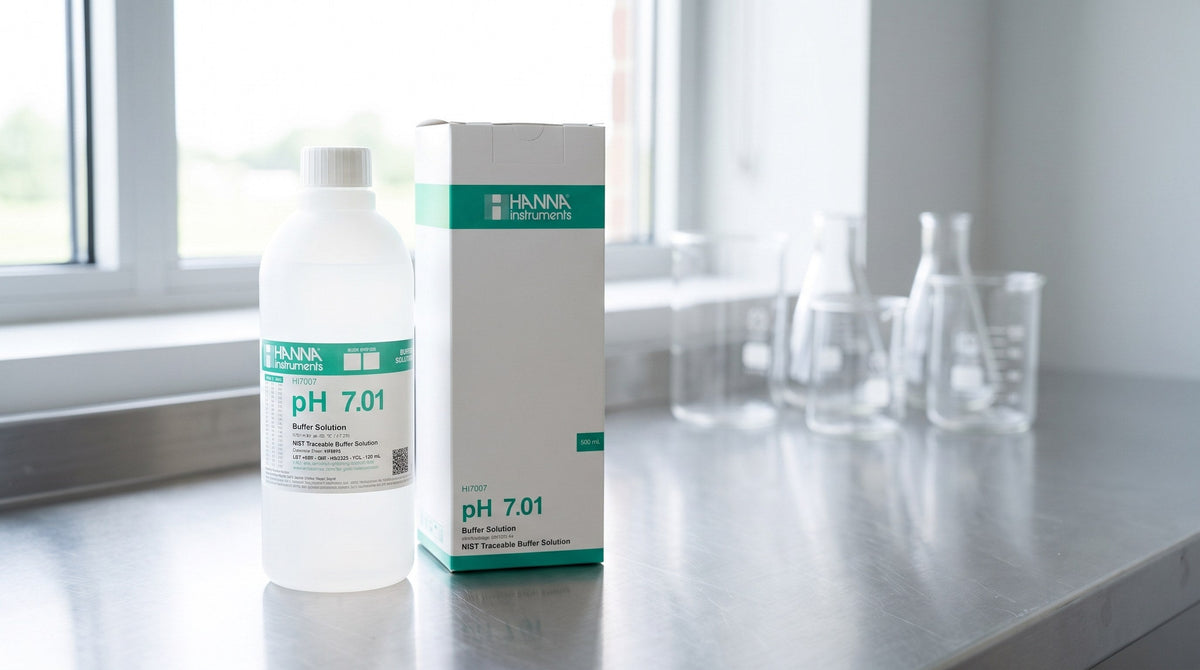
A pH buffer solution is a liquid of known, stable pH that you use to set and check a pH meter. For most water work in Canada, calibrate with pH 7.01 first, then add pH 4.01 or pH 10.01 so that the two points bracket the pH you expect to measure.
Which pH buffer solutions do you need for a pH meter?
You need pH 7.01 plus one more buffer on the side of neutral where your samples sit. The Hanna Instruments pH Calibration Solutions range covers the three common points, 4.01, 7.01 and 10.01, and each is made to ±0.01 pH at 25 °C and is NIST-traceable according to the manufacturer.
| Your samples | Buffers to use | Typical work |
|---|---|---|
| Acidic water (below pH 7) | 7.01 and 4.01 | Acid mine drainage, industrial process water, some groundwater |
| Near neutral to mildly alkaline | 7.01 and 10.01 (or 4.01 and 7.01 if you also see acidic samples) | Surface water, drinking water, municipal wastewater |
| Wide or unknown range | 4.01, 7.01 and 10.01 | Site screening, mixed projects, QA verification |
That logic follows the U.S. EPA's field procedure, which says to calibrate the pH meter with the buffers that bracket the expected pH range, with buffers commonly at pH 4, 7 and 10 (EPA Region 4 SESD operating procedure, English only).
What does "NIST-traceable" mean on a buffer bottle?
It means the buffer's value can be traced back to a national reference material through documented comparisons. For pH, NIST maintains primary standards such as SRM 185g, potassium hydrogen phthalate, that commercial buffers are compared against (NIST certificate, English only).
Per the product record, Hanna's solutions are manufactured under ISO 3696 / BS 3978 conditions with Class A glassware and high-purity salts. Certificates of analysis are available on request from ERE, and FDA-approved bottles can be requested for food and pharma sites. If your lab is audited, ask for the certificate for the lot you buy rather than relying on the label alone.
Which format should you buy: sachets or bottles?
Buy 20 mL sachets for field kits and occasional use, and 500 mL, 1 L or 1 US gallon bottles for labs that calibrate every day. ERE stocks all four formats for each of the three values.
| Format | ERE part numbers (4.01 / 7.01 / 10.01) | Best for |
|---|---|---|
| 20 mL sachet, 25 per box | HA-70004P / HA-70007P / HA-70010P | Field sampling, no contamination between uses |
| 500 mL bottle | HA-7004L / HA-7007L / HA-7010L | Portable meter users, small labs |
| 1 L bottle | HA-7004/1L / HA-7007/1L / HA-7010/1L | Busy labs, treatment plant benches |
| 1 US gallon | HA-7004/1G / HA-7007/1G / HA-7010/1G | High-volume sites, bench and process checks |
Each solution carries a temperature reference chart on the bottle, which matters because buffer values shift with temperature. Safety data sheets for the 4.01, 7.01 and 10.01 solutions are linked on the product page.
How do you calibrate a pH meter with buffer solutions?
Calibrate with a fresh portion of each buffer, starting at pH 7.01, rinsing the electrode between solutions. This is the sequence the EPA field procedure describes.
- Pour fresh buffer into clean containers. Never return used buffer to the bottle.
- Note the buffer temperature and enter or select the matching value from the bottle chart if your meter does not compensate automatically.
- Immerse the electrode in pH 7.01 and calibrate. Rinse with deionized water and blot dry.
- Calibrate the second point (4.01 or 10.01) that brackets your samples. Rinse again.
- Verify by reading one buffer as a sample. The EPA procedure accepts ±0.2 pH for general work and ±0.1 pH for regulatory work such as drinking water; outside that, recalibrate, and replace the electrode if it still fails.
- Run a post-use check against a buffer at the end of the day and log it in the field book.
For electrode choice and meter formats, see our pH meter buyer's guide for Canada.
When do you need more than 4.01, 7.01 and 10.01?
You need other standards when accuracy or a different parameter demands them. ERE's calibration solutions collection includes:
- Millesimal pH solutions with ±0.002 pH accuracy for high-precision benches.
- Sample preparation solutions (HI7051 / HI70960) for soil and solid or semi-solid pH.
- Conductivity and TDS calibration solutions, covered in our TDS meter guide and portable conductivity meter guide.
- ORP test and pretreatment solutions, see the ORP meter guide.
- Turbidity and ISE calibration standards for those meters.
Buffers are a consumable: plan one set per calibration cycle, and replace any bottle that is past its expiry or visibly contaminated. For multiparameter meters, see the water quality meters buyer's guide.
Need help choosing pH buffers or standards?
ERE Inc. has been Canada's environmental equipment specialist for 30+ years. Tell us your meter and the water you test, and we will quote the right buffers and formats.
→ Request a Quote | 1-888-287-EREC | Browse Calibration Solutions | sales@ereinc.com
Frequently Asked Questions
How often should I calibrate a pH meter?
Calibrate before each day of use, and again if the meter was turned off, unless the maker says it holds calibration. The EPA field procedure also calls for a post-use check at the end of the day.
Can I reuse pH buffer solution?
Do not pour used buffer back into the bottle. Use a fresh portion each time so the bottle stays uncontaminated; single-use sachets remove the question in the field.
Why is my pH 7.01 buffer reading different from the label?
Buffer values change with temperature, and the label value is stated at 25 °C. Check the temperature chart on the bottle, then confirm the electrode is clean and not due for replacement.
Do I need pH 4.01, 7.01 and 10.01 all together?
Not always. Two points that bracket your expected sample pH are enough for most work; use all three for wide or unknown ranges and for QA checks.
What size pH buffer should I buy?
Sachets for field kits; 500 mL for portable users; 1 L or 1 US gallon for labs that calibrate daily.
Related articles
- pH Meter Buyer's Guide for Canada
- ORP Meter Buyer's Guide for Canada
- TDS Meter Buyer's Guide for Canada
- Portable Conductivity Meter Buyer's Guide
Lire en français : Solutions tampons pH : guide des étalons 4,01, 7,01 et 10,01