
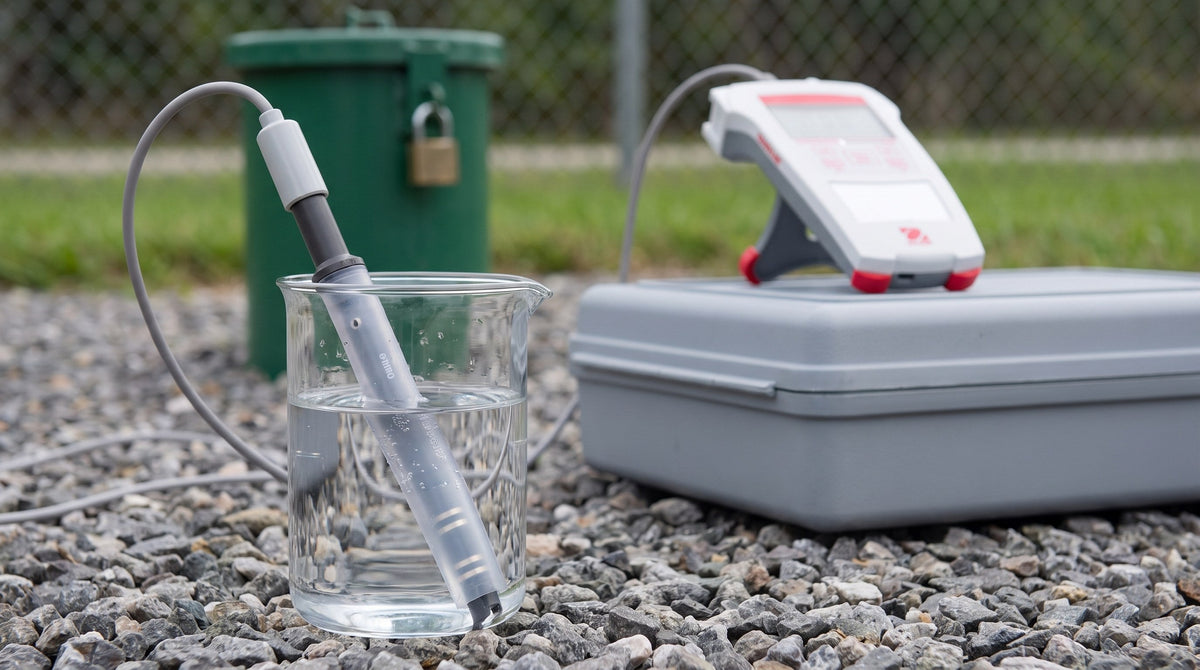
A portable conductivity meter measures how readily water carries an electrical current, which tracks the dissolved ions in it. For field work the buying decision comes down to four specifications: measuring range (of the probe, not just the display), probe design, temperature compensation and calibration standards. This guide compares the field instruments ERE carries, from handheld EC/TDS meters and multiparameter meters to a groundwater tape meter and a downhole logger.
In this guide
- What a portable conductivity meter measures
- Conductivity vs TDS vs salinity
- Choosing the measuring range
- Four-pole vs two-electrode probes
- Temperature compensation
- Calibration standards
- Handheld, multiparameter, tape meter or logger
- When a bench meter is better
- Taking a reliable field reading
- Where conductivity fits in site work
What Does a Portable Conductivity Meter Measure?
A portable conductivity meter measures the ability of water to pass an electrical current, reported in microsiemens or millisiemens per centimetre (µS/cm or mS/cm). Dissolved salts and other inorganic chemicals conduct current, so conductivity rises as salinity rises, according to the U.S. EPA's conductivity indicator page.
The same page gives field teams two cautions. Organic compounds such as oil conduct current poorly, so conductivity is not a hydrocarbon screen. And conductivity increases with temperature: the warmer the water, the higher the reading. It also notes that each water body tends to hold a relatively constant conductivity range, so once you have a baseline, a sudden change can flag a discharge or other disturbance.
What Is the Difference Between Conductivity, TDS and Salinity?
Conductivity is the direct measurement; total dissolved solids (TDS) and salinity are calculated from it. The meter converts the conductivity reading into mg/L of TDS or a salinity value using a conversion factor, so two meters can report different TDS for the same sample if they use different factors.
Report conductivity when you need a defensible, method-based number, and treat TDS or salinity as a convenience readout. Record which meter and setting produced it. The Ohaus Starter 300C reads conductivity and TDS (0.1 mg/L to 199.9 g/L). The Ohaus Starter 400M adds pH, salinity (0 to 99.9 psu) and resistivity.
Which Measuring Range Do You Need?
Choose a meter and probe whose usable range covers both ends of your samples: low-conductivity groundwater and surface water at one end, brackish, saline or impacted water at the other. The number to check is the probe's specified range, because it is not always the same as the meter's display range.
Meter range vs probe range
The Starter 300C displays 0.0 µS/cm to 199.9 mS/cm with 0.01 µS/cm resolution. The STCON3 four-pole probe supplied with the ST300C and ST300C-G kits is specified for 70 µS/cm to 200 mS/cm. Ask which probe a quote includes: the ST300C-B is the meter alone, and the probe is not included.
Other ERE instruments in this space list their ranges as follows:
- The Heron Conductivity+ (Series 1702) Version 2 measures conductivity up to 250,000 µS.
- The Solinst Model 3001 Levelogger 5 LTC autoranges from 0 to 100,000 µS/cm.
- The Ohaus Starter electrodes are sold separately (conductivity, pH, ORP, dissolved oxygen and temperature types, with 1 to 5 m cables), so a probe can be matched to the range you work in.
How Do Four-Pole and Two-Electrode Conductivity Probes Differ?
A four-electrode (four-pole) cell uses one pair of electrodes to drive current and another pair to sense voltage, which generally makes the reading less sensitive to fouling and polarization on the electrode surfaces than a two-electrode cell. That is why four-electrode sensors are common in wide-range field instruments: the Ohaus STCON3 probe, the Heron Conductivity+ probe and the Levelogger 5 LTC platinum sensor are all four-electrode designs. Two-electrode cells are simpler and remain widely used, including at the low-conductivity end.
Why Does Temperature Compensation Matter for Field Readings?
Because conductivity rises as water warms, a raw reading in a cold monitoring well is not comparable to one taken in a warm sample bottle. EPA Method 120.1 reports specific conductance at 25 °C: samples are preferably analyzed at 25 °C, otherwise the result is temperature-corrected and reported at 25 °C. The method also states that temperature variations and corrections are the largest source of potential error.
Choose a meter that measures sample temperature at the probe and applies automatic temperature compensation (ATC) to 25 °C. The Starter 300C measures 0 to 100 °C at 0.1 °C resolution alongside conductivity, and ERE's product page lists it with ATC. The Levelogger 5 LTC pairs its conductivity sensor with a platinum RTD, and the Heron Conductivity+ reports temperature in the same drop as conductivity and water level.
How Should You Calibrate a Portable Conductivity Meter?
Calibrate against a traceable standard that brackets your samples, and do it before each day's use. EPA Method 120.1 states that the instrument must be standardized with a potassium chloride (KCl) solution before daily use and that the conductivity cell must be kept clean.
- Standards: Hanna Instruments conductivity calibration solutions are NIST-traceable KCl standards in 84, 1413 and 12880 µS/cm, each with a temperature correction chart and a 5-year unopened shelf life, in 20 mL sachets and 500 mL bottles.
- Kits: the ST300C and ST300C-B Ohaus kits include 1413 µS/cm and 12.88 mS/cm standards (20 mL bottles).
- Choice of standard: pick the one closest to your expected sample value, and use a second standard if your samples span a wide range.
- Temperature: the standards change with temperature too, so use the chart on the bottle.
Handheld Meter, Multiparameter Meter, Tape Meter or Logger: Which Fits the Job?
Handheld meters suit spot checks and sample screening, multiparameter meters suit a full field-parameter set, a tape meter profiles conductivity down a well, and a logger records continuously. The table compares the instruments ERE carries.
| Instrument | Format | Reads | Key specs | Best for |
|---|---|---|---|---|
| Ohaus Starter 300C | Handheld | Conductivity, TDS, temperature | 0.0 µS/cm to 199.9 mS/cm; TDS 0.1 mg/L to 199.9 g/L; 0 to 100 °C; four-pole probe | Spot checks, sample screening |
| Ohaus Starter 400M | IP67 multiparameter | pH, conductivity, TDS, salinity, resistivity, temperature | 1,000-record memory; micro-USB; rechargeable battery (40 h); 0.35 kg | Full field-parameter sets |
| Hanna Instruments edge | Slim digital meter (pH, EC and DO models) | Conductivity (edge Conductivity model) | 12 mm thick; under 250 g | Portable, carry-anywhere use |
| Heron Conductivity+ (1702) | Groundwater tape meter | Conductivity, temperature, static water level | Up to 250,000 µS; IP68 four-electrode probe; 30 to 300 m cable lengths | Profiling and saltwater-intrusion surveys down a well |
| Solinst Levelogger 5 LTC | Downhole datalogger | Water level, temperature, conductivity | 0 to 100,000 µS/cm; 100,000 data sets; 8-year battery | Continuous well monitoring |
When Is a Bench Meter the Better Choice?
A bench meter is the better choice when samples come back to the lab. EPA Method 120.1 allows conductance analysis in the field or the laboratory, and says that if analysis is not completed within 24 hours of collection the sample should be filtered through a 0.45 micron filter and stored at 4 °C. For that workflow ERE carries the Ohaus Aquasearcher AB23EC bench meter (0.0 µS/cm to 199.9 mS/cm, 0.01 µS/cm resolution, ±1 % of reading ±3 LSD, 99-item memory). A portable meter gives an in-situ reading, so the holding-time question does not arise.
How Do You Take a Reliable Field Conductivity Reading?
Calibrate first, rinse the probe, immerse it fully, wait for a stable reading and record the temperature with the result. The USGS National Field Manual for the Collection of Water-Quality Data provides documented methods and protocols for measuring field parameters. A practical sequence:
- Calibrate. Standardize with a KCl standard that brackets the expected range, and record the standard, its lot and the temperature.
- Rinse. Rinse the probe with deionized water, then with a small portion of the sample.
- Immerse. Cover the sensing area completely and release any trapped air bubbles.
- Stabilize. Wait for the reading to settle, then record conductivity and sample temperature.
- Report the basis. State whether the value is temperature-compensated to 25 °C or a raw reading.
- Re-check. Rinse and store the probe as the manual directs, and re-check against a standard if readings drift or the sample range changes.
Where Does Conductivity Fit in Site and Groundwater Work?
Conductivity is a fast screening parameter. Record a baseline per well or water body, then track deviations. ERE's product copy for the Heron Conductivity+ lists saltwater-intrusion monitoring, contamination profiling and aquifer surveys as its uses, and it pairs naturally with the manual water level meters and water level data loggers already used in monitoring programs. For a wider parameter set, see our water quality meter guide.
Remember the limit: conductivity flags dissolved ions, not petroleum. For free product use an oil-water interface meter, and for vapours a photoionization detector.
For our full range of field water-quality meters, probes and calibration standards, see the Water Quality Instrumentation collection. Multi-brand supply means one quote can cover the meter, the probe and the standards.
Need help choosing a conductivity meter?
ERE Inc. has been Canada's environmental equipment specialist for 30+ years. Tell us your sample range and workflow and we will match the meter, probe and calibration standards.
→ Request a Quote | 1-888-287-EREC | Browse Water Quality Instrumentation | sales@ereinc.com
Frequently Asked Questions
Can a conductivity meter also read TDS?
Yes. Most portable meters calculate TDS from the conductivity reading using a conversion factor, so confirm the factor and record it with the result. The Ohaus Starter 300C reads conductivity and TDS from a single four-pole probe.
How often should a portable conductivity meter be calibrated?
EPA Method 120.1 calls for standardizing the instrument with a potassium chloride solution before daily use. Re-check against a standard if readings drift, the probe is replaced or you move to a very different conductivity range.
Can conductivity detect oil or hydrocarbon contamination?
Not reliably. EPA notes that organic compounds such as oil conduct electricity poorly, so conductivity mainly flags dissolved ions. Use a photoionization detector for vapours or an oil-water interface meter for free product.
Should I buy a handheld meter or a conductivity logger?
Buy a handheld meter for spot checks, calibration and sample screening. Choose a logger such as the Solinst Levelogger 5 LTC when you need continuous water level, temperature and conductivity records from a well.
Related articles
- Water Quality Meters for Environmental Work: A Buyer's Guide for Canada
- Turbidimeter Selection Guide for Environmental Monitoring in Canada
- Water Level Meters: A Buyer's Guide for Canadian Groundwater Monitoring
- Water Level Data Loggers: A Buyer's Guide for Canadian Groundwater Monitoring
- Solinst Levelogger 5 Groundwater Monitoring Guide
Lire en français : Conductimètres portables : comment choisir un appareil pour la surveillance de l'eau sur le terrain au Canada