
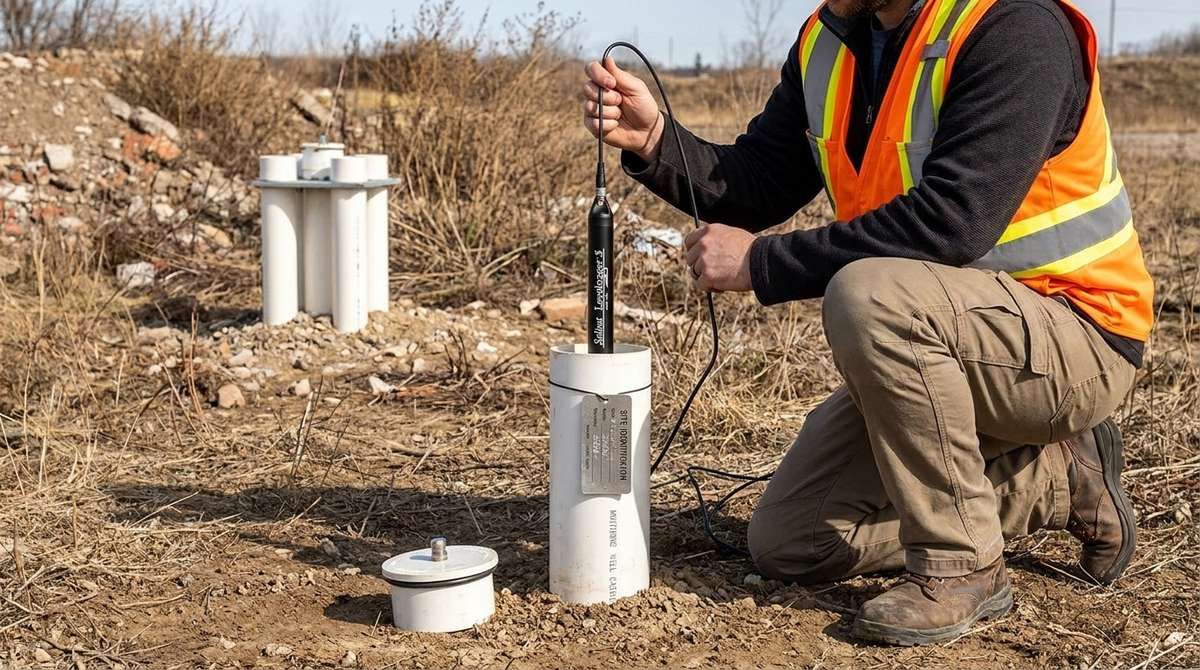
The Solinst Levelogger 5 is a submersible water level and temperature datalogger that records groundwater measurements automatically, eliminating the need for repeated manual site visits. Choosing the right model — Standard, Junior, LTC, or Barologger 5 — comes down to three variables: the depth to water, whether conductivity data is needed, and how you plan to correct for barometric pressure changes. This guide covers all four models, deployment procedure, and Canadian field applications for Phase II ESA and long-term monitoring programs.
What Is the Solinst Levelogger 5?
The Solinst Levelogger 5 (Model 3001) is a submersible datalogger manufactured by Solinst Canada Ltd. in Georgetown, Ontario. It records absolute water pressure and temperature at user-configured intervals from 0.125 seconds to 99 hours, storing up to 150,000 data sets in non-volatile memory. Communication occurs via a single-eye optical interface — either a USB Direct Read Cable or Bluetooth via the App Interface accessory — for programming and data export.
Because the Levelogger 5 measures absolute pressure — the combined weight of the water column above the sensor plus the atmosphere above the water surface — raw readings include both groundwater head and barometric pressure. Accurate water level data requires subtracting the barometric component using a simultaneously deployed Solinst Barologger 5.
How the Levelogger 5 differs from older Solinst models
The Levelogger 5 replaces the Levelogger Edge (4th generation). Key improvements include a redesigned optical interface for faster data transfer, updated firmware installed via Levelogger Software, and compatibility with the Solinst App Interface for Bluetooth field deployment. The titanium housing and sensor specifications are unchanged from the Edge series, preserving backwards compatibility with existing well installations and deployment hardware.
Which Solinst Levelogger 5 Model Do You Need?
Levelogger 5 Standard (Model 3001)
The Levelogger 5 Standard records water level and temperature. Titanium housing, 150,000-record memory, and a rated battery life of 10 years (at 1-minute intervals) make it the right choice for long-term monitoring well deployments — Phase II ESA groundwater programs, municipal observation wells, and pump test monitoring where loggers may remain in place for multiple years between service visits.
Levelogger 5 Junior
The Levelogger 5 Junior uses a stainless steel housing, reduced memory (40,000 records), and a shorter battery life. It is appropriate for shorter-term deployments or applications where instrument unit cost must be minimized and retrieval intervals are short enough to manage battery and memory limits. For monitoring programs extending beyond two to three years, specify the Standard Levelogger 5 instead.
Levelogger 5 LTC (Level + Temperature + Conductivity)
The Levelogger 5 LTC adds a conductivity sensor alongside water level and temperature, enabling a single instrument to capture both hydraulic head and water quality data. Specify the LTC for:
- Saltwater intrusion monitoring in coastal aquifers
- Mine drainage and acid rock drainage (ARD) monitoring where conductivity tracks leachate fronts
- BTEX or dissolved solids correlation studies where a single multi-parameter logger is required
- Any site where O. Reg. 153/04 or site-specific remediation objectives require conductivity alongside water level
Barologger 5 (Barometric Compensation — Not Optional)
The Barologger 5 is a specialized Levelogger 5 variant that records atmospheric pressure at surface rather than in-water pressure. Atmospheric pressure in Canada can fluctuate by 1-2 kPa between passing pressure systems — equivalent to 10-20 cm of apparent water level change in an absolute-pressure logger. Without barometric compensation, a weather front crossing your site will appear as a groundwater recharge or drawdown event in your record.
One Barologger 5 compensates all Levelogger 5 units within the same barometric zone (typically several kilometres on open terrain). Deploy it at surface in a vented well or monitoring tube. Compensation is applied automatically during data download in Levelogger Software by linking the Barologger 5 log to each Levelogger 5 dataset.
What Depth Range Does the Levelogger 5 Come In?
The Levelogger 5 is available in four pressure ranges. The range refers to the maximum water column height above the sensor, not total well depth or static depth to water.
| Model | Range above sensor | Typical application |
|---|---|---|
| M5 | 5 m (16.4 ft) | Shallow water table wells, surface water, tidal zones |
| M30 | 30 m (98.4 ft) | Standard Phase II ESA monitoring wells — water table aquifers |
| M100 | 100 m (328 ft) | Deep bedrock wells, municipal supply wells |
| M200 | 200 m (656 ft) | Very deep fractured rock, geothermal monitoring |
The M30 range is correct for the large majority of Phase II ESA work in Ontario, Quebec, British Columbia, and Alberta, where monitoring wells are typically drilled to bedrock at 15-25 m depth and water table sits 5-20 m below grade. Order M100 or M200 only when your well completion report confirms depth to water exceeding 30 m or 100 m, respectively.
How Does Barometric Compensation Work?
Barometric efficiency describes how much of an atmospheric pressure change transfers to water level change in a given aquifer. In unconfined (water table) aquifers, barometric efficiency is near zero — the water surface equilibrates freely with the atmosphere through the unsaturated zone. In confined aquifers, barometric efficiency ranges from 40% to 80% depending on aquifer compressibility: a 1 kPa atmospheric drop raises the measured water level by 0.4-0.8 kPa equivalents — a real signal that must be stripped to observe true trends.
Levelogger Software 4.x performs Levelogger Barometric Compensation (LBC) automatically when the Barologger 5 log is linked to Levelogger 5 data during download. The compensated water level formula is:
Compensated water level = Absolute logger pressure − Barometric pressure + Sensor elevation offset
For confined aquifer sites, a secondary Barometric Efficiency (BE) correction can be applied in the software to further isolate true hydraulic head from residual barometric signal, per the methodology in ASTM D7242 (Standard Guide for Correction of Borehole Water Levels Measured with Submerged Pressure Transducers for Barometric Pressure Changes).
How Do You Deploy a Solinst Levelogger 5?
Follow this sequence for a standard Phase II ESA monitoring well installation:
- Measure static depth to water (DTW) with a water level meter before deployment — confirms the sensor will remain submerged throughout the monitoring period
- Select deployment depth: at least 0.5 m below minimum expected water level, but above the well screen bottom to prevent sediment fouling
- Configure the logger in Levelogger Software: set start time, logging interval (15 minutes is standard for Phase II ESA; 1-5 minutes for pump tests), and recording mode
- Attach the logger to a Solinst Levelogger 5 deployment option — direct-read cable, suspension wire, or wireline — and secure with a deployment snap
- Lower the assembly to target depth and record the reference measurement point elevation for compensation
- Install a Solinst Levelogger Well Cap to seal the well surface while passing the cable — required on paved surfaces or high-traffic sites to secure against vibration and unauthorized access
- Deploy the Barologger 5 at surface in a vented tube within the same barometric zone
- Synchronize start times across all loggers on the project before initiating logging
For projects requiring in-field data download without a laptop, the Solinst App Interface connects via Bluetooth to iOS or Android devices running the free Levelogger app. The Solinst Readout Unit (SRU) Model 4001 provides a dedicated handheld LCD display for spot water level and temperature readings without data download.
For the complete range of Solinst Levelogger 5 accessories including suspension wire, direct-read cable, and well cap systems, see Solinst Levelogger 5 accessories at ERE.
Key Applications in Canada
Phase II Environmental Site Assessment
Phase II ESA under Ontario Regulation 153/04, the Quebec Règlement sur la protection et la réhabilitation des terrains, and BC's Contaminated Sites Regulation Part 4 requires groundwater level monitoring in observation wells across the site. Levelogger 5 M30 units record water table fluctuations continuously over weeks to months, generating the hydrographs required for hydraulic head analysis, groundwater flow direction determination, and contaminant transport modelling without requiring repeated manual measurements.
Pump Testing and Aquifer Characterization
Slug tests and constant-rate pumping tests per ASTM D4050 require high-frequency water level measurement in both the pumping well and observation wells. At intervals of 0.125 seconds to 1 minute, the Levelogger 5 captures drawdown and recovery curves at the resolution required for Theis, Cooper-Jacob, and Neuman analytical models.
Long-Term Groundwater Monitoring Programs
Environmental compliance monitoring programs under CCME groundwater quality guidelines often require multi-year records at remediation sites. The Levelogger 5's 10-year battery life at standard logging intervals enables deployment in remote wells with infrequent service visits, eliminating annual retrieval for battery replacement and associated mobilization costs.
Surface Water and Stage Monitoring
Deployed at stream gauging stations, constructed wetlands, stormwater management ponds, or retention basins, the Levelogger 5 M5 or M30 records continuous water stage data for stormwater compliance and pre/post-construction wetland hydrology assessments.
For the full Solinst Levelogger 5 product range including all four model types, depth ranges, accessories, and deployment hardware, visit the water quality instrumentation collection at ERE.
Does the Solinst Levelogger 5 Require Special Software?
Yes. Levelogger Software 4.x (free download from Solinst Canada Ltd.) is required to program the logger, configure start conditions and logging intervals, download and export data, and apply barometric compensation. The software runs on Windows and exports data as CSV, Excel, or XLE (Solinst's proprietary format).
For field staff working without a Windows laptop, the App Interface enables Bluetooth programming and download from iOS or Android devices. Note that barometric compensation and full data processing still require Levelogger Software on Windows — the app is a field data transfer tool, not a replacement for desktop software.
Need Solinst Levelogger 5 pricing or model selection help?
ERE Inc. has supplied environmental instrumentation to Canadian consultants, engineering firms, and government agencies for over 30 years. Our technical team can confirm the right model and depth range for your site before you order.
→ Request a Quote | 1-888-287-EREC | Browse Water Quality Instruments | sales@ereinc.com
Frequently Asked Questions
Can one Barologger 5 compensate multiple Levelogger 5 units on the same site?
Yes. One Barologger 5 deployed at surface within the same barometric pressure zone can compensate all Levelogger 5 units on the project. Download the Barologger 5 data file and link it to each Levelogger 5 dataset in Levelogger Software during post-processing. One Barologger 5 per project area (typically within several kilometres on flat terrain) is sufficient; only projects spanning significantly different elevation bands or separated by topographic barriers require additional units.
What is the difference between the Levelogger 5 and the Levelogger 5 LTC?
The standard Levelogger 5 records water pressure (converted to water level) and temperature only. The Levelogger 5 LTC adds a conductivity sensor, recording water level, temperature, and specific conductance in microsiemens per centimetre. Choose the LTC when your monitoring program requires tracking dissolved solids, salinity, or water quality changes alongside water table fluctuations — for example, saltwater intrusion monitoring, acid mine drainage tracking, or multi-parameter compliance monitoring where a single instrument must capture both head and conductivity at each location.
How accurate is the Solinst Levelogger 5?
Per Solinst's published specifications, the Levelogger 5 M30 range has a stated accuracy of ±0.05% of full scale, which equals ±15 mm over a 30 m range. Resolution is 0.001% of full scale, or approximately 0.3 mm. These specifications meet the precision requirements for detecting subtle groundwater trends in long-term monitoring programs and for aquifer testing per ASTM D4050 and ASTM D7242.
How do you download data from a Levelogger 5 in the field?
Data downloads via a USB Direct Read Cable connected to Levelogger Software on a Windows laptop, or wirelessly via the Solinst App Interface (Bluetooth to iOS or Android using the free Levelogger app). For quick field confirmation of water level and temperature without data download, the Solinst Readout Unit (SRU) Model 4001 displays current readings on an LCD screen.
Is the Solinst Levelogger 5 suitable for chemically impacted groundwater?
The standard Levelogger 5 and LTC use a titanium housing, which is resistant to a wide range of environmental conditions including BTEX-impacted groundwater, low pH leachate, and moderate chloride concentrations. The Levelogger 5 Junior uses a stainless steel housing and should be reserved for clean freshwater applications. For aggressive chemistry — high concentrations of chlorinated solvents, strong acids or bases, or brine — confirm material compatibility with ERE before deployment.
Related articles
- Water Quality Meters for Environmental Work: A Buyer's Guide for Canada
- Phase II ESA Equipment Checklist for Canadian Consultants
- Environmental Sampling Equipment Guide for Canada
- Groundwater Bailers: Types, Materials and Selection Guide
Lire en français : Guide Solinst Levelogger 5 : surveillance des eaux souterraines au Canada