
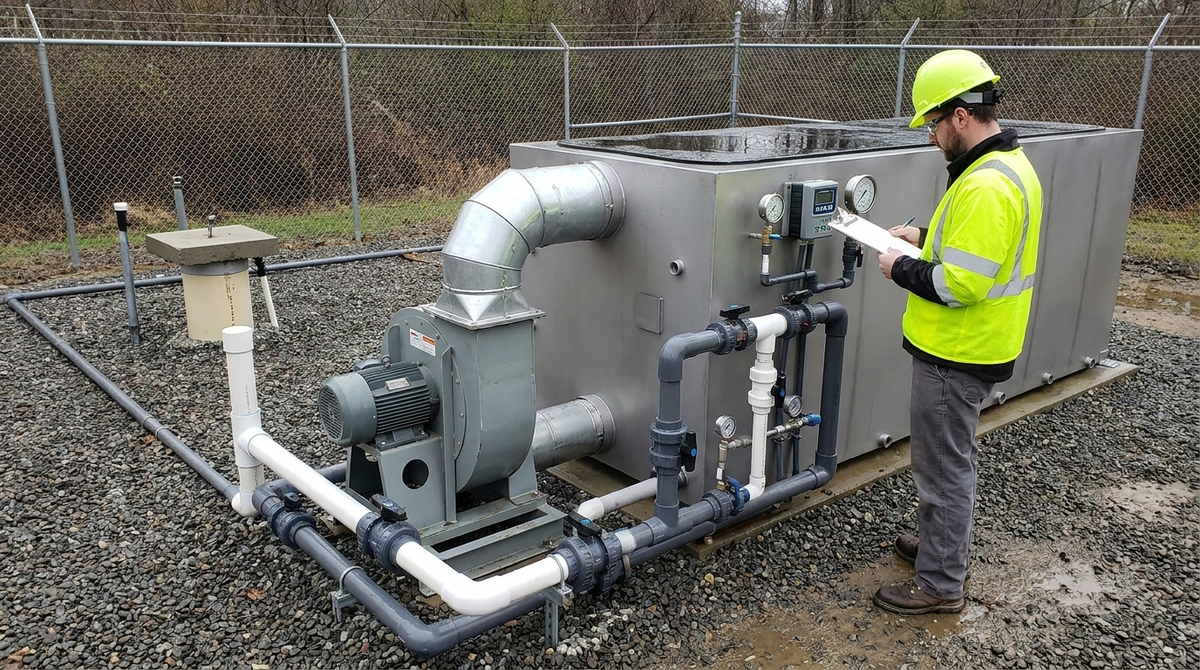
Air stripping removes volatile organic compounds (VOCs) from contaminated groundwater by transferring dissolved contaminants from the water phase into a stream of air. For Canadian sites impacted by BTEX, TCE, PCE, MTBE, or TCA, a properly sized air stripper — like ERE's VOCease™ system — achieves up to 99.9% VOC removal at lower cost than carbon adsorption or chemical oxidation at moderate to high influent concentrations.
What Is Air Stripping?
Air stripping is a mass-transfer process that exploits Henry's Law: VOCs dissolved in water have a thermodynamic tendency to partition into the gas phase when put in contact with air. By contacting contaminated groundwater with a stream of clean air — either by bubbling air through the water (diffused aeration) or cascading water through packing material — dissolved VOCs are transferred to the air stream and removed from the water phase.
When Air Stripping Is the Right Technology
Air stripping is the preferred treatment choice when:
- The site has petroleum hydrocarbon or chlorinated solvent contamination (BTEX, TCE, PCE, MTBE, TCA, vinyl chloride)
- Influent VOC concentrations are moderate to high (generally >0.1 mg/L) — granular activated carbon becomes uneconomical at high mass loadings; air stripping cost does not scale the same way
- The site requires continuous pump-and-treat over months or years
- A portable, relocatable system is needed across multiple extraction wells or site phases
VOC Strippability: Henry's Law Constants
| Compound | H (atm·m³/mol, 25°C) | Strippability |
|---|---|---|
| Benzene (BTEX) | 5.5 × 10⁻³ | Excellent |
| Toluene (BTEX) | 6.6 × 10⁻³ | Excellent |
| Ethylbenzene (BTEX) | 8.7 × 10⁻³ | Excellent |
| Xylenes (BTEX) | 4.9–7.4 × 10⁻³ | Excellent |
| TCE (trichloroethylene) | 9.9 × 10⁻³ | Excellent |
| PCE (tetrachloroethylene) | 1.8 × 10⁻² | Excellent |
| TCA (1,1,1-trichloroethane) | 1.7 × 10⁻² | Excellent |
| Vinyl Chloride | 2.7 × 10⁻² | Excellent |
| MTBE | 5.5 × 10⁻⁴ | Moderate — higher A:W ratio required |
| H₂S | pH-dependent | Good at low pH |
| Ammonia | pH-dependent | Moderate — raise pH above 10 first |
Canadian consultants: CCME Tier 1 and Tier 2 remediation criteria for BTEX and chlorinated solvents (PN 1476, updated CEQG) are achievable with properly designed air stripping in most groundwater matrices. Define your target effluent concentration from the applicable CCME or provincial guideline before sizing the system.
Sizing an Air Stripper: Key Parameters
Over-sizing wastes capital and operating cost. Under-sizing means missing target effluent criteria and failing regulatory inspection. The following parameters drive the design.
1. Groundwater Flow Rate (Q)
The extraction well pumping rate, expressed in GPM (US gallons per minute) or m³/hr. This sets the minimum hydraulic throughput the air stripper must handle at steady state.
2. Influent and Target Effluent Concentrations
Pull your Phase II ESA analytical data or monitoring well results. The ratio of influent concentration (Cin) to required effluent concentration (Cout) determines how many transfer units (NTUs) you need. Typical Cout targets are CCME Tier 1 criteria — often in the µg/L range for chlorinated solvents (e.g., TCE Tier 1 = 0.005 mg/L for groundwater used as drinking water).
3. Air-to-Water Ratio (A:W)
The A:W ratio is the volumetric ratio of air supplied to water treated. Higher ratios improve removal efficiency but increase blower size and energy consumption. Typical design ranges:
- BTEX and TCE/PCE: A:W = 20:1 to 50:1 is typically sufficient for >99% removal
- MTBE: A:W = 75:1 to 150:1 may be required due to the lower Henry's constant
- H₂S: Lower pH below 6 first; A:W = 10:1 to 30:1
4. Temperature Correction
Henry's Law constants decrease with lower temperature — Canadian groundwater typically runs 8–12°C, significantly below the 25°C used in standard reference tables. Apply a temperature correction factor (typically 0.6–0.75× at 10°C vs 25°C) and add a ~20% design buffer to your A:W ratio for year-round performance in cold climates.
Worked Sizing Example
| Parameter | Value |
|---|---|
| Contaminant | Benzene (BTEX site) |
| Extraction rate (Q) | 50 GPM |
| Influent concentration (Cin) | 5 mg/L |
| Target effluent (Cout) | 0.001 mg/L (CCME Tier 1) |
| Required removal efficiency | 99.98% |
| Design A:W ratio (temperature-corrected) | 50:1 |
| Required airflow | 50 GPM × 8.34 lb/gal ÷ 0.075 lb/ft³ × 50 ≈ 280 cfm → ER-VOC-4 or ER-VOC-6 depending on baffle configuration |
Site-specific conditions matter: iron and manganese in groundwater can foul diffusers, TDS affects mass transfer, and required treatment train (vapor treatment, discharge permits) all affect final model selection. Contact ERE for a site-specific sizing review.
ERE's VOCease™ Packaged Air Stripper
The VOCease™ Water Treatment Air Stripper is ERE's engineered packaged solution for pump-and-treat remediation programs. It uses a high-strength stainless steel baffled tank fitted with patented stainless steel diffusers — designed to resist fouling by biological activity — to strip VOCs at up to 99.9% efficiency. A sight glass allows real-time visual monitoring of the stripping process without stopping operation.
VOCease™ Model Specifications
| Model | Max Airflow | Dimensions (W × H × L) | Typical Application |
|---|---|---|---|
| ER-VOC-3 | 175 cfm | 34″ × 34.5″ × 45.5″ | Low to moderate extraction rates (10–25 GPM); compact footprint |
| ER-VOC-4 | 250 cfm | 34″ × 34.5″ × 57.5″ | Moderate flow; higher A:W ratios or MTBE treatment |
| ER-VOC-6 | 350 cfm | 34″ × 34.5″ × 81.5″ | Higher extraction rates or demanding removal targets (>99.9%) |
How the VOCease™ System Works
Contaminated groundwater is pumped into the tank and travels in a snake-like path through baffled compartments, maximizing air-water contact time in each zone. Air is injected by the blower through the patented stainless steel diffusers, which create fine bubbles that efficiently strip VOCs from the water phase. Treated water exits the system by gravity or pump discharge, meeting your target effluent concentration. Stripped VOC vapors exit through a rear vent — either discharged to atmosphere where concentrations are below applicable thresholds, or connected to an ERE UltraSorber™ Air Treatment Media vapor-phase carbon unit for additional vapor capture.
Portable Design — Rental Available
The VOCease™ is engineered for rapid deployment, inspection, and relocation. Rental units are available — ideal for Phase II ESA pilot testing, interim remedial measures (IRM) requiring quick mobilization, or short-duration pump-and-treat campaigns. ERE deploys VOCease™ systems across Canada and the USA.
Browse ERE's full line of remediation and treatment systems, or contact us to configure a VOCease™ for your site parameters.
Need an air stripper for your Canadian contaminated site?
ERE Inc. sizes, supplies, and deploys VOCease™ air stripping systems for pump-and-treat programs across Canada. We match the system to your extraction rate, VOC profile, and CCME or provincial effluent targets — available for rental or purchase.
→ Request a Quote | 1-888-287-EREC | Browse Remediation Equipment | sales@ereinc.com
Air Stripping in the Canadian Regulatory Framework
Most contaminated site work in Canada is guided by the CCME Canadian Environmental Quality Guidelines (CEQG) for soil and groundwater, which set Tier 1 and Tier 2 remediation criteria for petroleum hydrocarbons and chlorinated solvents. For most BTEX and chlorinated-solvent sites, these criteria are attainable using air stripping as the primary treatment technology.
Provincial Oversight
- Quebec (MELCCFP): The Règlement sur la protection et la réhabilitation des terrains (RPRT) governs contaminated site remediation and sets groundwater quality criteria for Schedule B substances including BTEX and chlorinated solvents. Air stripping is widely accepted for Quebec pump-and-treat programs.
- Ontario (MECP): O. Reg. 153/04 (Records of Site Condition) establishes Table 2 and Table 3 groundwater standards. Air stripping is an approved technology under Part XV.1 remediation plans and is eligible for risk assessment-based approaches.
- Alberta (AEP): Environmental Protection and Enhancement Act (EPEA) guidance sets Tier 1 criteria for petroleum hydrocarbons and chlorinated solvents. Air stripping is recognized as a Best Available Technology for pump-and-treat programs under the Remediation Certificate framework.
Frequently Asked Questions
What VOCs can an air stripper remove?
Any volatile organic compound with a Henry's Law constant above approximately 0.01 atm·m³/mol is a candidate for air stripping. In practice, this includes all BTEX compounds (benzene, toluene, ethylbenzene, xylenes), chlorinated solvents (TCE, PCE, TCA, vinyl chloride, 1,2-DCE), fuel oxygenates (MTBE at higher A:W ratios), H₂S, and radon. Ammonia can be stripped at elevated pH. Compounds with low Henry's constants — such as phenols, PAHs, and metals — are not suited to air stripping alone and require different treatment technologies.
How is the air-to-water (A:W) ratio determined?
The A:W ratio is derived from the Henry's Law constant of the target contaminant at actual site groundwater temperature, the required removal efficiency (Cin/Cout), and the number of transfer units (NTU) in the stripping system. A preliminary A:W estimate uses the stripping factor R = H′/(A:W), targeting R > 5 for efficient mass transfer. ERE engineers apply site-specific temperature corrections and add a safety factor before recommending a final A:W ratio and VOCease™ model.
Does the vapor exhaust stream require treatment?
It depends on influent concentrations and local air quality discharge limits. At low influent VOC concentrations, the diluted exhaust vapor typically meets atmospheric discharge criteria without further treatment. At higher concentrations (generally above 500 µg/m³ in the exhaust stream), a vapor-phase carbon unit such as the ERE UltraSorber™ Air Treatment Media should be installed downstream to capture stripped VOCs before discharge. ERE specifies whether vapor treatment is required based on your site analytical data and the applicable air quality guidelines for your province.
Related articles
- Soil and Groundwater Remediation Equipment Guide for Canada
- Phase II ESA Equipment Checklist for Canadian Environmental Consultants
- Industrial Water Filtration Systems Guide for Canada
Lire en français : Stripper d'air pour eaux souterraines contaminées aux COV : guide de dimensionnement