
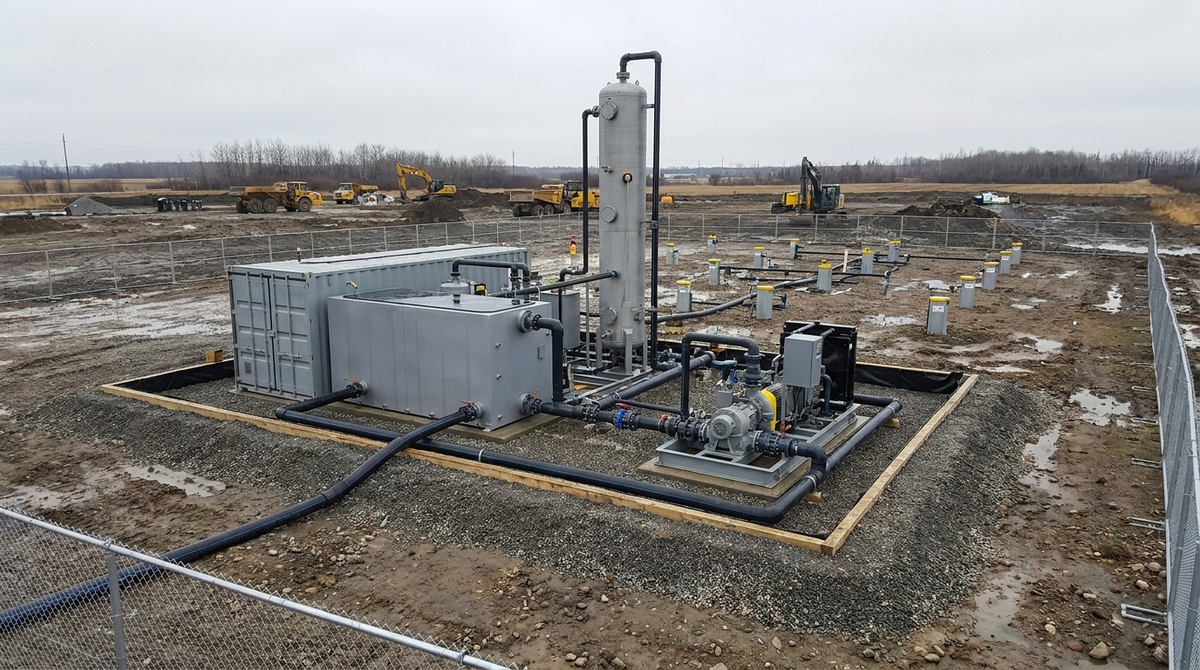
Selecting the right remediation technology for a contaminated site in Canada depends on the contaminant type, site geology, regulatory target, and timeline — not on a single preferred method. ERE Inc. supplies mobile treatment systems, bioremediation products, air stripping units, and soil washing equipment to environmental consultants and engineering firms across Canada, available for rental or purchase to match any project budget.
What Remediation Technology Does Your Site Need?
Technology selection starts with the contaminant class and phase distribution. Volatile organic compounds (VOCs) in soil — petroleum hydrocarbons, chlorinated solvents like TCE and PCE — respond well to soil vapor extraction. VOCs dissolved in groundwater respond to pump-and-treat with air stripping. Non-volatile organics and metals require different approaches: chemical oxidation, bioremediation, or soil washing depending on mobility. The table below maps common contamination scenarios to primary technologies.
| Contaminant Class | Primary Technology | ERE Equipment |
|---|---|---|
| VOCs in soil (petroleum, chlorinated solvents) | Soil Vapor Extraction (SVE) / Dual-Phase | Dulex™ System |
| VOCs dissolved in groundwater | Pump-and-treat + air stripping | VOCease™ Air Stripper, WaterPod™ |
| Petroleum hydrocarbons (LNAPL) | Dual-phase extraction + oil/water separation | Dulex™ + OlioSep™ |
| Nutrients, BTEX in groundwater | In-situ bioremediation | OxyDfuse™, BIIO™ |
| NAPL, metals, inorganics | ISCO + monitoring | OxyClean Advanced™ |
| Hydrocarbon-impacted soil (ex-situ) | Soil washing with surfactant | AD20™ Degreaser |
"Remedial technologies shall be selected on the basis of site-specific factors including contaminant type, concentration, and spatial distribution, soil and hydrogeological conditions, and risk reduction potential." — Environment and Climate Change Canada, Site Remediation Technologies Reference Manual
Does SVE Work for Your Site? Soil Vapor Extraction and Dual-Phase Extraction Explained
Soil vapor extraction (SVE) applies negative pressure to the vadose zone through extraction wells, volatilizing contaminants into the vapor phase for surface treatment. SVE is effective when soil permeability allows vapor transport (typically K > 10⁻⁴ cm/s) and when contaminants have Henry's Law constants above 10⁻⁵ atm·m³/mol — a threshold met by most petroleum fuels and chlorinated solvents. Effectiveness drops sharply in fine-grained, heterogeneous, or saturated soils.
Dual-phase extraction (DPE) combines SVE with simultaneous groundwater extraction through a single well casing. It is the preferred approach when LNAPL (light non-aqueous phase liquid) is present at or near the water table or when the smear zone spans the capillary fringe. ERE's Dulex™ Multiphase Extraction System handles both vapor and liquid streams in a single skid-mounted unit — deployable by flatbed, reducing mobilization costs versus assembling a multi-component field train. The extracted groundwater then feeds into an oil/water separator for free-phase oil removal before further treatment.
When the site needs vapor extraction only — no groundwater co-extraction — ERE's EvacuSol™ Soil Vapour Extraction system is the simpler, lower-cost option: a dedicated regenerative-blower unit built for low-flow / high-vacuum vadose-zone extraction, sized from 0.5 HP through 10 HP and rated Explosion Proof, Division 1 & 2, Class 1 for Group D hazardous atmospheres.
For our full Treatment Systems inventory — including the Dulex™ and mobile containerized units — see the Treatment Systems collection.
How Does Pump-and-Treat Work for Contaminated Groundwater?
Pump-and-treat (P&T) remains the most widely used active groundwater remediation technology at dissolved-phase plume sites in Canada. Extraction wells draw contaminated groundwater to surface; the water is treated above-grade to below applicable CCME groundwater quality guidelines or site-specific standards; then it is re-injected, discharged to sewer with municipal approval, or used for dust suppression. P&T does not eliminate the source — it contains and shrinks the plume over time while source treatment runs in parallel.
Treatment train configuration depends on what is dissolved in the extracted water:
- VOCs (benzene, toluene, TCE, PCE): air stripping is the standard first step — for a complete breakdown of system types, sizing, and off-gas treatment, see the air stripping VOC removal guide. ERE's VOCease™ Water Treatment Air Stripper is a packed-tower or tray-tower unit rated for flow rates from 1 to 100+ US GPM. Off-gas may require carbon polishing depending on local air emissions requirements.
- Petroleum hydrocarbons with LNAPL carry-over: add an oil/water separator upstream of the air stripper.
- Metals (iron, manganese, arsenic): add pH adjustment (PH-200™) and filtration through an appropriate filtration media — Filox™ for iron and H₂S, activated alumina for arsenic and fluoride.
- High-volume or complex plumes: ERE's WaterPod™ 500 and WaterBox™ 100 are containerized 30-ft treatment trains that integrate multiple unit operations in a weatherproof enclosure — deployable within 24 hours of site mobilization.
What Is a Packaged Groundwater Treatment System?
A packaged groundwater treatment system bundles the extraction pumps, filtration vessels, and instrumentation a pump-and-treat project needs into one pre-assembled, deployable unit — instead of a field-built train of separate tanks, housings, and piping strung together on site. ERE builds four packaged groundwater treatment systems, sized from small dewatering jobs to high-volume remediation:
- WaterBox™ 100 — ERE's flagship system: a fully self-contained treatment plant inside a 30 ft marine-grade insulated container, rated up to 200 GPM in parallel or 100 GPM in series, built around four 61" FRP Type 60 tanks and two 4-bag stainless housings. Made in Canada.
- WaterPod™ 500 — a smaller mobile groundwater treatment system sized for mid-flow extraction and dewatering projects that don't need a full 30 ft container.
- 3POD™ — a compact, cage-mounted groundwater treatment system with three quick-connect filtration vessels (GAC or multi-media), built-in submersible pumps, and a water meter — crane- or forklift-portable. Made in Canada.
- DualPods™ — a two-vessel cage-mounted configuration for smaller flows than the 3POD™, same quick-connect philosophy.
All four are available for rental as well as purchase — see "Does ERE Offer Rental Remediation Systems?" below for lead times and mobilization logistics.
Browse the full Groundwater Filtration collection for inline filters and filter housings sized for low-flow extraction wells.
Can In-Situ Bioremediation Replace Active Pumping?
In-situ bioremediation (ISBR) stimulates indigenous microorganisms — or introduces specialized cultures — to degrade contaminants within the aquifer or soil matrix. Compared to P&T, ISBR eliminates surface treatment infrastructure and can achieve regulatory closure at lower life-cycle cost, but it requires favorable geochemical conditions and a longer timeline (typically 2–7 years). Most petroleum hydrocarbon sites in Canada are amenable to aerobic bioremediation when sufficient oxygen is delivered to the contaminated zone.
Aerobic Bioremediation: Oxygen Delivery Systems
Oxygen delivery is the rate-limiting step for aerobic ISBR. ERE distributes two complementary systems:
- OxyDfuse™ Oxygen Diffusion Cells: passive in-well diffusion chambers that continuously release dissolved oxygen into the surrounding aquifer without pumping. One cell handles a radius of influence of approximately 3–5 m; arrays are sized to cover the plume width. No surface power or infrastructure required after installation.
- OxyClean Advanced™ 18SR: slow-release percarbonate formulation that generates oxygen in situ over a 12–18 month period. Injected as a slurry through temporary injection points. Also available as OxyClean Advanced™ 14FR for rapid oxygen demand (initial slug injection where fast response is needed).
Bioaugmentation: Adding Microbial Cultures
When indigenous microbial populations are insufficient — common at chlorinated solvent sites where dechlorinating bacteria are absent — bioaugmentation with site-specific cultures is required. BIIO™ Remediation High Grade Bacteria (Custom Biologicals) is a concentrated mixed-culture inoculant compatible with both aerobic and anaerobic conditions, formulated for injection through conventional direct-push tooling. Nutrient amendments using NutriBIIO™-S slow-release fertilizer support culture establishment during the first growing season.
Browse the Bioremediation collection for the complete lineup of oxygen-release compounds, microbial cultures, and nutrient products.
When Should You Use In-Situ Chemical Oxidation (ISCO)?
ISCO delivers a chemical oxidant directly into the contaminated zone to destroy organic contaminants by chemical reaction rather than biological degradation. ISCO is faster than bioremediation (weeks vs. years for the oxidant reaction itself) and reaches recalcitrant compounds — PCE, DNAPL ganglia, high-concentration petroleum hot spots — that bioremediation handles slowly. It is not a standalone remedy: ISCO treats a defined volume of contamination; P&T or natural attenuation handles the dissolved-phase tail after oxidant injection. Common oxidants used in Canada include sodium persulfate, potassium permanganate, and calcium peroxide.
OxyClean Advanced™ products serve as a calcium peroxide-based ISCO reagent — the fast-releasing 14FR formulation delivers an oxidant pulse for hot-spot treatment, while the 18SR formulation provides sustained peroxide generation. Both are compatible with injection through 1-inch direct-push rods and require no specialized handling equipment beyond standard PPE.
What About Ex-Situ Soil Treatment?
When excavation is the chosen remedy — either because in-situ options are constrained by tight soil, shallow bedrock, or permit timelines — ex-situ soil washing using a surfactant can reduce hydrocarbon concentrations in excavated material before disposal or reuse. ERE's AD20™ Red Label Degreaser is a concentrated industrial surfactant used in rotary wash plants to mobilize petroleum hydrocarbons from coarse-textured soils. Soil washing is regulated as a treatment process under provincial environmental protection acts; confirm your jurisdiction's Class 2 Regulation or equivalent before site application.
See the Soil Washing collection for available soil treatment products.
Does ERE Offer Rental Remediation Systems?
Yes. Most of ERE's mobile treatment systems — including the VOCease™ Air Stripper, WaterPod™ 500, WaterBox™ 100, and DualPods™ — are available for rental as well as purchase. Rental suits short-duration projects (6–18 months), pilot test programs, and emergency spill response where capital outlay approval is not practical. ERE handles mobilization logistics across Canada and provides startup commissioning support. Contact the rental team via the quote form or by phone to confirm availability and lead time for your project start date.
For related water treatment topics, see our guides on industrial water filtration systems and oil/water separators for groundwater extraction. For sampling equipment used during Phase II site assessment and remediation monitoring, see the Phase II ESA equipment checklist.
Need remediation equipment for your project?
ERE Inc. has supplied environmental and remediation equipment to Canadian consultants and engineering firms for 30+ years. We carry rental and purchase inventory for SVE, pump-and-treat, bioremediation, and air stripping applications — deployable anywhere in Canada on short notice.
→ Request a Quote | 1-888-287-EREC | Browse Treatment Systems | sales@ereinc.com
Frequently Asked Questions
What is the most common remediation technology used at petroleum-contaminated sites in Canada?
Pump-and-treat combined with air stripping is the most widely deployed active remediation technology at petroleum hydrocarbon plume sites in Canada. Where VOC concentrations in extracted groundwater are the primary concern, a packed-tower air stripper removes dissolved benzene, toluene, and other BTEX compounds to below CCME or provincial discharge criteria. Monitored natural attenuation is used at low-risk, stable plume sites where active remediation is disproportionate to the risk.
How long does soil vapor extraction take to remediate a site?
SVE systems typically run for 6 months to 5 years, depending on soil permeability, contaminant mass, extraction well spacing, and clean-up targets. Sites with permeable, sandy soil and low residual contamination reach closure faster. Dense fine-grained soils take longer and often require a complementary technology to address rebound. Canadian consultants generally propose a pilot test period of 3 to 6 months before committing to a long-term operating plan.
Can bioremediation achieve regulatory closure at chlorinated solvent sites in Canada?
Yes, but only at sites where complete reductive dechlorination to ethene is demonstrated, requiring organohalide-respiring bacteria and a carbon source. Bioaugmentation with a dechlorinating culture plus electron donor is well-established and has achieved CCME Tier 1 groundwater targets at many Canadian sites. Sites with high DNAPL saturation may require ISCO to reduce source mass before biological degradation can proceed to closure.
Which regulation governs contaminated site cleanup in Canada?
Canada does not have a single federal contaminated sites regulation for private lands. Cleanup obligations arise under provincial legislation — in Quebec, the Environment Quality Act and the RLREP; in Ontario, O. Reg. 153/04. The CCME Canadian Environmental Quality Guidelines (CEQGs) provide the national standard reference for soil and groundwater quality targets, adopted or adapted by most provinces.
Does ERE provide site assessment equipment as well as remediation systems?
Yes. ERE supplies both Phase II ESA sampling equipment (bailers, groundwater pumps, soil augers, gas detectors, water quality meters) and Phase III remediation systems (air strippers, treatment pods, bioremediation products). The instrument rental program covers gas detectors and water quality instrumentation for project-duration use. Contact our technical team for a complete equipment list for your project scope.
Related articles
- Air Stripping for VOC Removal: Systems Guide for Canada
- Industrial Water Filtration Systems: A Guide for Canada
- Oil/Water Separators: Complete Industrial Guide for Canada
- Phase II ESA Equipment Checklist for Canadian Consultants
- Environmental Sampling Equipment Guide for Canada
Lire en français : Équipement de remédiation des sols et eaux souterraines : guide pour le Canada