
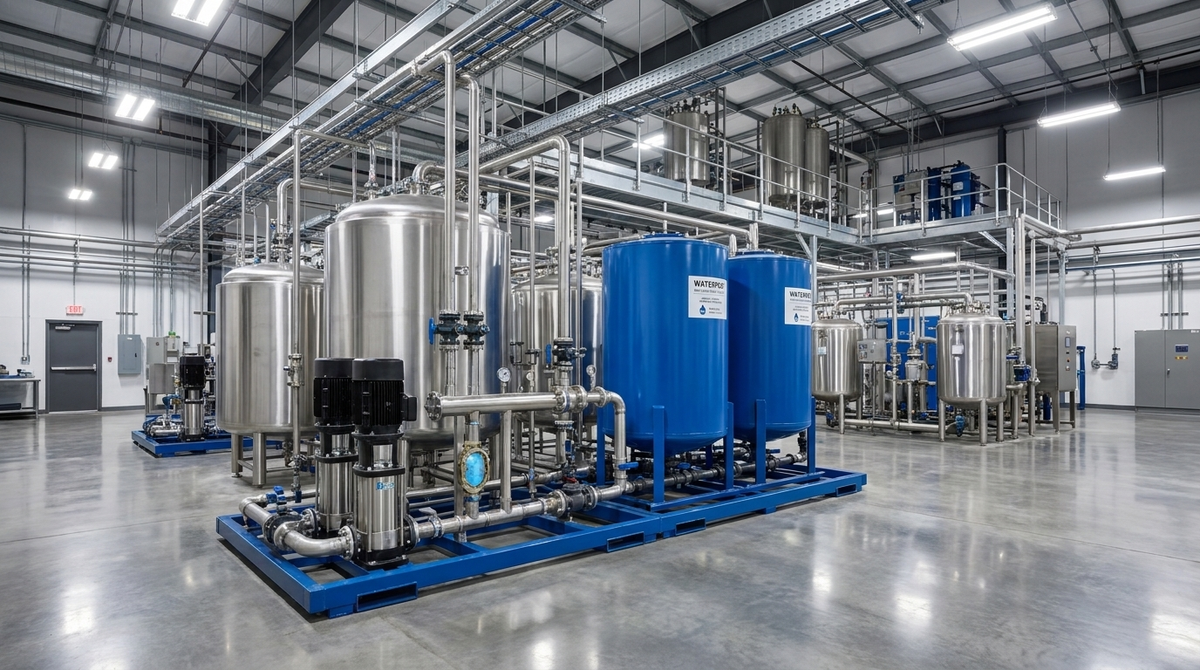
Industrial water filtration is not a single system — it's a stack of unit operations matched to your water chemistry, application, and effluent destination. A mining site treating acid rock drainage needs completely different technology than a food plant polishing process make-up water, even if both operate at 500 GPM. This guide covers the six main filtration technologies used in Canadian industrial applications, the regulatory requirements that shape effluent design, and the decision criteria for selecting the right system for your site.
Why Industrial Water Filtration Requirements Differ from Municipal or Residential Systems
Municipal and residential water treatment handles relatively consistent source water and delivers it to a single end use: potable supply. Industrial water filtration must handle source water that varies widely — in turbidity, pH, dissolved metals, oil content, and biological load — and it must meet multiple different effluent standards depending on where the treated water goes. Environment and Climate Change Canada's Industrial Water Survey tracks over 9 billion cubic metres of water intake annually across Canadian manufacturing sectors, a volume that demands purpose-designed filtration systems rather than scaled-up residential equipment.
Key Variables That Drive Industrial System Design
Four variables determine which filtration technologies apply to a given industrial situation. Getting these defined before specifying equipment avoids costly over- or under-sizing.
- Suspended solids load: Process water from manufacturing operations typically carries 50 to 5,000 mg/L total suspended solids (TSS) — ten to one hundred times the TSS in municipal supply water. Multimedia and bag filtration vessels must be sized for realistic peak TSS, not average inlet conditions.
- Flow rate and continuity: Industrial processes often run at continuous flows of 100 to 10,000+ GPM. This requires multi-vessel configurations and backwash capacity that residential or light-commercial filters don't address.
- Contaminants of concern: Dissolved metals, hydrocarbons, suspended solids, and extreme pH values (below 4 or above 10) each require a dedicated removal mechanism. A system designed for TSS alone will fail if the site also has dissolved iron or oil contamination.
- Effluent destination: Water reused in-process needs to meet internal quality specs for the next unit operation. Water discharged to a receiving environment is governed by provincial environmental regulations: Quebec's Règlement sur les rejets dans les eaux municipales (RREM), Ontario Regulation 347, and federal requirements under the Metal and Diamond Mining Effluent Regulations (MDMER) for mining operations.
The Six Main Industrial Water Filtration Technologies
Industrial filtration systems are built from a toolkit of established technologies, each with a defined removal mechanism and performance envelope. Understanding what each does — and what it cannot do — is prerequisite to system selection.
1. Sand and Multimedia Filtration
Sand and multimedia filtration is the workhorse of industrial water treatment for suspended solids and turbidity removal. A multimedia bed — typically anthracite over silica sand over garnet — stratifies by particle size and removes TSS down to approximately 10–20 microns at filtration rates of 3 to 7 gallons per minute per square foot (GPM/ft²) of vessel cross-section. Pressure vessel designs handle flows from under 10 GPM for small equipment streams up to several thousand GPM for continuous process applications. Backwash with clean water or air scour regenerates the bed typically every 24–72 hours depending on solids loading. Multimedia filtration is almost always the first stage in a multi-technology train — it protects downstream media (carbon beds, resin) from solids fouling that shortens their service life.
2. Activated Carbon Filtration
Granular activated carbon (GAC) removes dissolved organics, chlorine, chloramine, taste and odour compounds, and many volatile organic compounds (VOCs) through adsorption. Service flow rates for GAC contactors are typically 2–5 GPM/ft² with empty bed contact times (EBCT) of 5 to 15 minutes for effective organic removal. One critical limitation that field teams frequently overlook: activated carbon does not remove dissolved metals — iron, manganese, lead, arsenic, and other metals pass through a carbon bed unchanged. If the water chemistry includes both organics and dissolved metals, a metals-removal stage must precede or follow the carbon contactor. Carbon is commonly used for dechlorination ahead of reverse osmosis membranes, for organic polishing in food-grade process water, and for VOC reduction in pump-and-treat groundwater remediation systems.
3. Iron and Manganese Removal Media
Dissolved iron and manganese are common in groundwater sources across Canada, particularly in well water and shallow aquifer systems in the Canadian Shield and Prairie provinces. Concentrations above 0.3 mg/L for iron and 0.05 mg/L for manganese (Health Canada Guidelines for Canadian Drinking Water Quality) cause staining, taste problems, and fouling of downstream equipment. Filox is a high-capacity catalytic oxidation medium that oxidizes dissolved ferrous iron and manganous manganese to their insoluble forms, which are then filtered out. Filox handles iron concentrations up to 15 mg/L and manganese up to 3 mg/L, and is rated for service flows up to 7.5 GPM/ft². Birm is a lower-density alternative for lighter iron/manganese loads (iron below 10 mg/L) that uses dissolved oxygen rather than a chemical regenerant. ERE distributes Filox media and carries both media through the filtration media collection.
4. pH Adjustment Systems
Process water outside the pH range of approximately 6.5 to 8.5 will damage downstream equipment, fail provincial discharge standards, and interfere with the performance of every other treatment technology in the train. Calcite contactors are a passive, chemical-free option for mildly acidic water (pH 5.5–6.8): water flows upward through a calcium carbonate bed and gains alkalinity and hardness naturally. For water with lower pH or higher flow rates, chemical dosing systems with metering pumps — sodium hydroxide for acidic streams, sulfuric or hydrochloric acid for alkaline streams — provide precise pH correction. ERE's pH-200 system packages the dosing pump, pH controller, and contact tank into a compact skid-mounted unit suited for process streams from 1 to 50 GPM where accurate pH control is required before discharge or reuse. Acid rock drainage from mining operations, which typically arrives at pH 2–4, requires larger-scale lime dosing systems before any filtration stage can operate effectively.
5. Bag and Cartridge Filtration for Final Polishing
Bag and cartridge filters are depth or surface filtration devices for final polishing at 0.5 to 200 microns. They are almost always positioned downstream of a coarser pre-treatment stage — multimedia filtration or a settling tank — and their role is to bring the effluent to a specification that multimedia filtration alone cannot reach. Bag filters (P1/P2 sizing, typically 7″ or 4.5″ diameter) offer high dirt-holding capacity per vessel and low differential pressure drop, making them well-suited for higher-TSS polishing duties. Cartridge filters in melt-blown polypropylene or pleated polyester provide finer nominal ratings (1–50 microns) and compact footprints for lower-flow applications or where tight micron specifications apply. ERE distributes industrial filter bags, filter cartridges, and bag filter housings in single, duplex, and multi-bag configurations. For a detailed selection guide, see Industrial Filter Bags: Complete Selection Guide for Canada.
6. Ultrafiltration, Reverse Osmosis, and UV Disinfection
Ultrafiltration (UF) membranes remove bacteria, viruses, and colloidal particles at 0.01–0.1 micron, producing a turbidity-free permeate that is near sterile. Reverse osmosis (RO) membranes remove dissolved salts, heavy metals, and most organics, producing permeate conductivity typically below 50 µS/cm. Both are high-performance technologies for process water requiring pharmaceutical-grade purity, boiler makeup water with very low hardness specifications, or desalination of brackish or high-TDS groundwater. ERE does not distribute UF or RO systems directly, but we regularly supply and service the pre-treatment stages — multimedia filtration, carbon, and bag filtration — that protect RO membranes from fouling and extend their service life. A well-designed pre-treatment train is the single most important factor in RO membrane longevity. For a complete guide to industrial RO system selection and pre-treatment design, see the industrial reverse osmosis water treatment guide. For final microbial disinfection downstream of filtration and RO, ERE distributes Luminor RAINIER and VIQUA commercial UV disinfection systems — see the commercial UV water disinfection sizing guide for dosing, UVT, and pre-filtration requirements.
How Do You Select an Industrial Water Filtration System?
System selection is an engineering exercise, not a catalog choice. Every selection decision traces back to five inputs: inlet water quality, required effluent quality, flow rate, site constraints, and chemical handling capability. Missing or estimated values for any of these inputs will produce an undersized, oversized, or wrong-technology system.
Step 1: Characterize Inlet Water Quality
A full water chemistry analysis is non-negotiable before specifying any filtration system. The minimum analytical suite for industrial water treatment selection includes: pH, total dissolved solids (TDS), total suspended solids (TSS), turbidity (NTU), iron, manganese, hardness (as CaCO₃), chemical oxygen demand (COD), and any site-specific contaminants of concern (oils, heavy metals, specific organics). Hanna Instruments portable meters and field test kits can screen pH, TDS, and iron on-site, but a certified laboratory analysis is required for the full suite and for regulatory submissions. ERE rents and sells Hanna water quality instruments for field screening applications.
Step 2: Define the Required Effluent Quality
Effluent quality requirements come from two sources: internal process specifications (what the next unit operation needs) or provincial and federal discharge limits (what the regulator allows). Canadian discharge standards vary by province and receiving environment. Key regulatory instruments include: Quebec's RREM (municipal sewer discharge limits for TSS, pH, BOD), Ontario Regulation 347 (waste management, including effluent from remediation sites), British Columbia's Municipal Wastewater Regulation, and the federal MDMER for mining operations. The federal Fisheries Act sets a national baseline: no deposit of a deleterious substance to waters frequented by fish — which catches any industrial discharge to natural watercourses regardless of province. Design to the most stringent applicable standard, not the average.
Step 3: Establish Flow Rate and Continuity Requirements
Flow rate sizing must account for peak operating flow, not average flow. Undersizing to average flow results in increased differential pressure, bypass, and bed channeling in media vessels, and reduced dirt-holding capacity in bag and cartridge filters. For continuous processes, design for peak sustained flow plus 10–20% margin. For intermittent or batch processes — tank washdowns, periodic equipment cleaning, spill response — size for the maximum instantaneous flow the source can deliver. Duty/standby vessel configurations are standard practice for continuous processes where downtime for backwash or cartridge changeout would stop production.
Step 4: Assess Site and Installation Constraints
Fixed-facility installations with concrete pads, electrical service, and drainage can accommodate large-footprint systems with automated controls and chemical feed. Mobile or trailer-mounted applications — remediation pump-and-treat systems, temporary construction dewatering, emergency response — require compact, skid-mounted configurations with gravity drain or self-contained secondary containment. ERE's complete systems (DualPods, 3POD, pH-200) are designed for fast mobilization and field operation in Canadian climate conditions.
Industrial Water Filtration by Application Sector
The filtration technology train changes significantly between industries, driven by the specific contaminants each sector generates. The following section outlines the typical system configurations and contaminants of concern for the industrial sectors ERE most commonly serves across Canada.
Oil and Gas: Produced Water Treatment
Produced water from oil and gas operations contains dissolved hydrocarbons, suspended solids, naturally occurring radioactive material (NORM), high TDS, and scale-forming ions. Before disposal to a licensed disposal well or surface discharge, produced water typically requires: oil/water separation, followed by multimedia filtration for TSS removal, followed by bag filtration to the 10–25 micron specification required for injection well protection. Solids loading in produced water can exceed 500 mg/L TSS during upset conditions, so robust pre-filtration with frequent backwash or high-capacity bag housings is essential.
Mining: Acid Rock Drainage and Mine Water
Acid rock drainage (ARD) is generated when sulphide-bearing rock is exposed to air and water during mining operations. ARD is characterized by pH values of 2–4, dissolved metals (iron, zinc, copper, arsenic, cadmium), and elevated TSS. The standard treatment train for ARD in Canadian mines operating under the MDMER includes: pH adjustment with hydrated lime to precipitate dissolved metals, followed by a settling pond or clarifier, followed by multimedia filtration for residual TSS, and final polishing via bag or cartridge filtration before discharge. Health Canada's metal-specific effluent limits under MDMER set the target concentrations for system design.
Food and Beverage: Process Water Quality
Process water for food production must meet Health Canada's Guidelines for Canadian Drinking Water Quality as a minimum — and in many cases more stringent internal specifications set by HACCP plans or customer audits. Typical concerns include chlorine removal ahead of fermentation tanks (carbon filtration), particulate removal for ingredient water (cartridge filtration at 1–5 microns), iron and manganese removal for well-water sources (Filox or Birm), and pH correction for boiler makeup and CIP systems. Sanitary-grade filter housings with polished 316L stainless interiors are standard for contact-surface applications in food processing.
Manufacturing: Cooling Tower and Process Water
Cooling tower blowdown water contains concentrated dissolved salts, biocides, corrosion inhibitors, and suspended solids from atmospheric exposure. Before discharge to the municipal sewer (regulated under provincial pre-treatment bylaws tied to RREM or equivalent), blowdown typically requires: pH correction, TSS reduction via multimedia or bag filtration, and in some jurisdictions, heavy metal reduction. Boiler makeup water requires softening (cation resin) and potentially deaeration to prevent scale and corrosion. Process rinse water from metal finishing operations may carry dissolved metals — nickel, chrome, copper — that require dedicated precipitation and filtration before any discharge authorization applies.
Environmental Remediation: Pump-and-Treat Systems
Pump-and-treat is the standard containment and treatment approach for contaminated groundwater plumes at sites undergoing remediation under provincial environmental legislation (Quebec's Loi sur la qualité de l'environnement, Ontario's Environmental Protection Act). Extracted groundwater typically contains dissolved petroleum hydrocarbons, chlorinated solvents, or dissolved metals — or combinations of all three. The filtration train for pump-and-treat commonly includes: multimedia filtration for iron ochre and particulates, activated carbon for dissolved organics and VOC reduction, and pH adjustment where the plume is acidic. Systems must be sized for long-run operation (months to years), so media change-out intervals and backwash frequency directly affect operating cost over the project life.
Does ERE Ship Industrial Water Filtration Systems Outside Quebec?
Yes — ERE ships filtration media, filter housings, and complete packaged systems to every province from our Montreal facility, with the same technical support and quote turnaround regardless of destination. The equipment doesn't change by province; the discharge regulation you design against does.
Quebec
Discharge to municipal sewer falls under the RREM; discharge to surface water needs a certificate of authorization (CA) under the Loi sur la qualité de l'environnement. Same-facility pickup is available on stocked filter bags, cartridges, and media for Montreal-area and broader Quebec sites.
Ontario
Ontario Regulation 347 governs effluent from waste management and remediation sites, and municipal sewer-use bylaws set the local numeric limits for TSS, pH, and oil and grease. ERE ships to Ontario facilities via standard freight, typically 1–2 business days from Montreal.
New Brunswick, Nova Scotia & Prince Edward Island
Environmental approvals across the Maritimes run through each province's own regulator — New Brunswick's Department of Environment and Local Government, Nova Scotia Environment and Climate Change, and PEI's Department of Environment, Energy and Climate Action — but the federal Fisheries Act baseline against depositing a deleterious substance to fish-bearing waters applies everywhere. ERE regularly supplies pulp and paper, seafood processing, and mining operations across New Brunswick, Nova Scotia, and Prince Edward Island with filtration media, bag and cartridge housings, and packaged treatment systems.
Wherever your facility is, the selection process in this guide — characterize inlet water, define effluent targets against your provincial regulator, size for peak flow — doesn't change. Request a quote with your water analysis and we'll confirm freight and lead time for your location.
What ERE Supplies for Industrial Water Filtration Systems
ERE Inc. has been supplying environmental and industrial equipment across Canada for 30+ years, with a catalogue that covers every stage of the industrial water filtration train. We stock and distribute from our Montreal facility with bilingual technical support for Quebec and national accounts.
The industrial water filtration and treatment systems collection covers complete packaged systems including DualPod and 3POD multi-vessel configurations and the pH-200 skid-mounted pH correction system. For filtration media selection, the filtration media collection includes Filox catalytic oxidation media for iron and manganese, RhinoSand zeolite for multimedia beds, activated carbon in granular and catalytic grades, activated alumina for fluoride and arsenic, and mixed-bed ion exchange resin. For a detailed breakdown of media selection by contaminant, see Water Filtration Media: Types, Applications & Selection Guide.
Bag filtration equipment includes both industrial filter bags in P1 and P2 sizes across a full range of materials (polypropylene, polyester, nylon, 1–200 micron) and bag filter housings in single-bag through multi-bag configurations, carbon steel and stainless steel, rated to 150 PSI. Cartridge filtration equipment — melt-blown polypropylene and pleated polyester in 2.5″ and 4.5″ formats — is available through the filter cartridges collection.
ERE does not represent a single manufacturer. Our multi-brand approach means we can specify Filox where it's the right medium and recommend an alternative where it isn't — the same applies to housings, vessels, and packaged systems. If you need a water analysis reviewed or a system sized for your application, our technical team handles industrial water filtration projects from groundwater remediation to food-grade process water.
Specify your industrial water filtration system with ERE.
ERE Inc. has supplied water filtration equipment and systems across Canada for 30+ years — from individual filter media and housings to complete skid-mounted treatment systems. Send us your water analysis, flow rate, and effluent target and we'll spec the right system.
→ Request a Quote | 1-888-287-EREC | Browse Water Filtration Systems | sales@ereinc.com
Frequently Asked Questions
What is the difference between process water filtration and effluent treatment?
Process water filtration prepares water for use inside a manufacturing or industrial operation — removing contaminants that would damage equipment, affect product quality, or interfere with a process reaction. Effluent treatment prepares water for discharge to a receiving environment (municipal sewer, river, or land) and must meet provincial and federal discharge limits. The two functions often use similar technologies, but the effluent design is driven by regulatory targets (TSS limits, pH range, metal concentrations) while process filtration is driven by internal quality specs for the next unit operation.
Can a single filtration system handle all industrial water treatment needs?
Rarely. Industrial water treatment almost always requires a series of unit operations — a treatment train — because no single filtration technology removes all contaminants. Multimedia filtration removes suspended solids but not dissolved metals or organics. Activated carbon removes organics but not metals or TSS. Iron removal media handles dissolved iron and manganese but not chlorinated solvents. The correct approach is to characterize the inlet water fully, define the target effluent quality, and then design a sequential train where each stage prepares the water for the next.
What Canadian regulations apply to industrial water discharge?
Key regulatory instruments include: Quebec's Règlement sur les rejets dans les eaux municipales (RREM) for discharge to municipal sewer; Ontario Regulation 347 for waste management and effluent from remediation; British Columbia's Municipal Wastewater Regulation; the federal Metal and Diamond Mining Effluent Regulations (MDMER) for mining operations; and the federal Fisheries Act, which sets a national baseline prohibiting deposit of a deleterious substance to fish-bearing waters. Provincial environmental ministries (Quebec's MELCCFP, Ontario's MECP, Alberta's AEP) issue site-specific effluent approvals that may be more stringent than the baseline regulations.
How do I size a bag filter housing for my application?
Bag filter housing sizing depends on three parameters: flow rate, inlet TSS concentration, and target change-out interval. A single P2 bag housing handles approximately 50–100 GPM at typical industrial TSS levels with a bag change interval of 24–72 hours. Higher TSS loads or longer change-out targets require multi-bag housings (2, 4, or 8 bags) or a pre-filtration stage to reduce solids load before the bag filter. ERE's technical team can size housing configurations from your flow rate and water analysis — submit a quote request with those details.
Related articles
- Water Filtration Media: Types, Applications & Selection Guide
- Industrial Filter Bags: Complete Selection Guide for Canada
- Industrial Reverse Osmosis Water Treatment: Canada Guide
- Commercial UV Water Disinfection Systems: Sizing and Selection Guide for Canada
- Soil & Groundwater Remediation Equipment: Canada Guide
Lire en français : Systèmes de filtration d'eau industrielle : types, applications et guide de sélection pour le Canada