
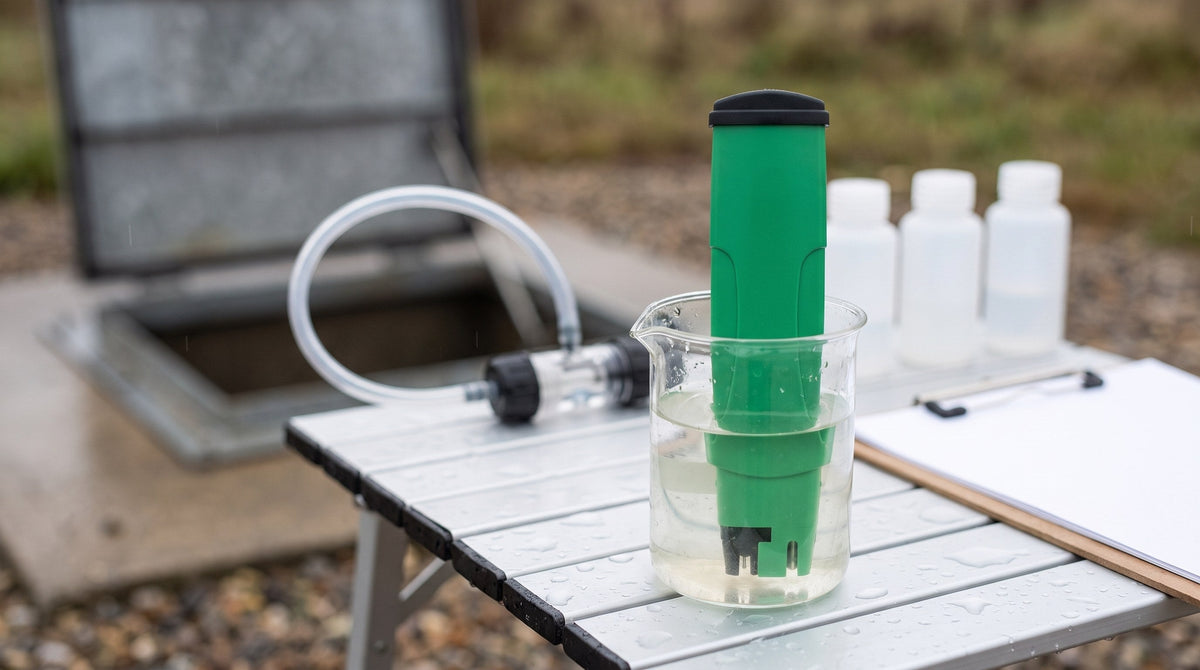
An ORP meter measures the oxidation-reduction (redox) potential of water in millivolts, using a platinum sensing electrode read against a reference electrode. For field work the buying decision comes down to four things: the format (pocket tester, portable meter or bench), whether you want ORP alone or with pH and temperature, the electrode and its reference, and how you will verify that the reading is true. This guide compares the ORP instruments ERE carries from Hanna Instruments and Ohaus, and draws on the U.S. Geological Survey's field manual and EPA's low-flow sampling guidance for taking a reading you can defend.
In this guide
- What an ORP meter measures
- What an ORP reading can and cannot tell you
- Where environmental teams use ORP
- Pocket, portable or bench: the ORP meters ERE carries
- Can a pH meter measure ORP?
- Choosing an ORP electrode
- Calibrating and verifying an ORP meter
- Why ORP readings are slow or unstable
- Taking a reliable field reading
- Test solutions, cleaning and spares
What Does an ORP Meter Measure?
An ORP meter measures the voltage between a platinum sensing electrode and a reference electrode placed in the same sample, and shows it in millivolts. A higher, more positive reading means a more oxidizing sample and a lower, more negative reading means a more reducing one. The U.S. Geological Survey's National Field Manual section on reduction-oxidation potential defines ORP, expressed as Eh, as a measure of the equilibrium potential, relative to the standard hydrogen electrode, developed at the interface between a noble metal electrode and an aqueous solution containing electroactive redox species. In practice the potential is read in millivolts from a potentiometer, such as a pH meter, and corrected for the potential of the reference electrode. Hanna's HI9829 manual describes the same arrangement: the voltage between the platinum ORP sensor and a silver/silver chloride reference electrode.
Two consequences shape every buying decision. First, the number depends on the reference electrode. Hanna's manual gives an example: its 470 mV test solution reads 470 mV at 25 °C against the Ag/AgCl reference, which would be 675 mV against the standard hydrogen electrode (add 205 mV), and the manual notes that this arithmetic is correct only at the standard temperature. Second, pH influences ORP significantly, according to Ohaus, which is why most buyers pair ORP with a pH reading.
What Can an ORP Reading Tell You, and What Can It Not?
An ORP reading tells you which way a sample is leaning and lets you track change over time, but it is not a concentration and it is not proof of equilibrium. The USGS says Eh measurement "may show qualitative trends but generally cannot be interpreted as equilibrium values." It adds that the platinum electrode method is valid only when the redox species are electroactive and present at about 10⁻⁵ molal or higher, and that redox species in natural waters generally do not reach equilibrium with metal electrodes. Many elements with more than one oxidation state do not behave reversibly at platinum, and some systems give mixed potentials.
The practical rule is to treat ORP as a comparison tool: the same site, the same electrode system, the same procedure, read again over time. A single ORP number pulled from a well or a tank and compared with a number from a different instrument is the reading most likely to mislead.
Where Do Environmental Teams Use ORP Meters?
Groundwater sampling is the clearest field use. EPA's low-flow (minimal drawdown) ground-water sampling procedure, by Puls and Barcelona, lists redox potential among the indicator parameters monitored in-line during purging, alongside pH, conductivity, dissolved oxygen and turbidity, and recommends a flow-through cell to establish how long each parameter takes to stabilize. Our peristaltic pump guide covers the pump side of that setup.
The second use is water and wastewater work. Ohaus's Starter electrode guide pairs its gel-filled plastic ORP electrode with surface water, drinking water and pool or circulating cooling water, and its refillable glass ORP electrode with wastewater, seawater and process solutions such as fermentation broth. Ohaus also describes ORP as a way to monitor sanitizer effectiveness electronically. Your permit or process sets the target value; the meter only reports the potential.
Which ORP Meter Format Should You Choose: Pocket Tester, Portable Meter or Bench?
Choose a pocket tester for spot checks, a portable meter with a separate probe when you also need pH and a longer cable or a replaceable electrode, a multiparameter meter when ORP is one of several parameters logged together, and a bench meter when you need the finest resolution in the lab. The table compares the ORP instruments ERE carries, using manufacturer figures.
| Instrument | Format | ORP range | Resolution / accuracy | Also reads |
|---|---|---|---|---|
| Hanna HA-98120 | Pocket tester | ±1000 mV | 1 mV / ±2 mV | Temperature |
| Hanna HA-98121 | Pocket tester | ±1000 mV | 1 mV / ±2 mV | pH (-2 to 16.00), temperature |
| Hanna HA-991003 | Portable meter, combination pH/ORP probe | ±1999 mV | 1 mV / ±2 mV | pH, pH-mV (±825 mV), temperature |
| Ohaus Starter 300 and 400 | Portable pH meter with mV mode, separate ORP electrode | -1999 to 1999 mV | 1 mV / ±1 mV (meter) | pH, temperature |
| Hanna HI9829 | Multiparameter meter with logging probe | ±2000.0 mV | 0.1 mV / ±1.0 mV | pH, dissolved oxygen, conductivity, temperature (turbidity on selected models) |
| Ohaus Starter 5000 | Bench meter | -2000.00 to +2000.00 mV | 0.01 mV / ±0.03 % mV | pH (-2.00 to 20.00), temperature |
| Ohaus Aquasearcher AB41PH | Bench meter | -2000.00 to +2000.00 mV | 0.1 mV / ±0.3 mV | pH (-2.000 to 20.000), temperature |
The ranges above are the instrument's own. Where a separate electrode is connected, the electrode adds its own tolerance to the reading.
Pocket testers: Hanna HA-98120 and HA-98121
The HA-98120 is a compact ORP and temperature tester with a replaceable electrode, a waterproof casing designed to float and a stability indicator that clears when the reading has settled. Hanna's manual lists about 300 hours of use on four 1.5 V batteries and an auto-off after 8 minutes. The HA-98121 adds pH on a second replaceable electrode, with automatic one- or two-point pH calibration. On both, ORP is factory calibrated. They suit walk-around checks, but they do not log, so record the reading and its temperature on the spot.
Portable meters with a separate probe: Hanna HA-991003 and Ohaus Starter 300 and 400
The Hanna HA-991003 reads pH, pH-mV, ORP and temperature with a single HI12973 probe. Hanna's manual describes a platinum ORP sensor sharing a gel-filled Ag/AgCl reference with a cloth junction with the pH sensor, plus a built-in temperature sensor and preamplifier for stable readings in electrically noisy environments. Its pH-mV mode lets you check the pH electrode itself. The Ohaus Starter 300 and Starter 400 are pH meters with a mV mode: the Starter 400 manual says to switch between pH and mV and to connect an ORP electrode, such as the STORP1, to read the ORP value. Starter kits ship in several configurations, so confirm whether your quote includes the electrode.
Multiparameter: Hanna HI9829
The Hanna HI9829 reads ORP from a combination pH/ORP sensor on its probe, together with dissolved oxygen and conductivity, and its logging models record samples for unattended monitoring. It resolves ORP to 0.1 mV and, unlike the pocket testers, lets you run a single-point custom ORP calibration (see below). Our water quality meters guide covers multiparameter selection in more depth.
Bench meters: Ohaus Starter 5000 and Aquasearcher AB41PH
The Ohaus Starter 5000 reads -2000.00 to +2000.00 mV to 0.01 mV, and the Aquasearcher AB41PH reads the same range to 0.1 mV. They are the right choice for lab verification of test solutions, titrations and side-by-side electrode comparison rather than for the field.
Can a pH Meter Measure ORP?
Yes, if it has a mV mode and you connect an ORP electrode. A pH electrode cannot do the job on its own: Hanna describes the ORP sensor on its HA-991003 probe as platinum, a sensing element separate from the pH sensor. The Ohaus Starter 400 manual says to press the button to switch between pH and mV measurement and to connect an ORP electrode, such as the STORP1, to read the corresponding mV value, and the Starter 300 works the same way. Some instruments read both natively: the HA-98121, HA-991003 and HI9829 all measure pH and ORP. If you already own a pH meter with a mV mode, an ORP electrode may be all you need; check the connector and reference type before you order.
Which ORP Electrode Should You Choose?
Choose by sample and by how much maintenance you can carry. Ohaus's electrode guide pairs the gel-filled plastic STORP1 with surface water, drinking water and pool or cooling water, and the refillable glass STORP2 with wastewater, seawater and process solutions. Both fit the Starter meters and are listed on the Ohaus Starter electrodes page. Hanna's HA-3131B, in ERE's Hanna pH and ORP electrode range, is a refillable combination ORP electrode rated ±2000 mV from -5 to 100 °C, 150 × 10 mm, with a single Ag/AgCl reference; Hanna lists it for laboratory general use and ORP titrations.
- Replaceable pocket-tester electrode. The HA-98120 uses a HI73120 electrode that is swapped with a removal tool, so a fouled electrode does not mean a new tester.
- Combination probe. The HA-991003's HI12973 packs the pH sensor, platinum ORP sensor and temperature sensor into one body with a shared reference.
- Refillable or gel-filled. A refillable electrode lets you renew the electrolyte; a gel-filled one has none to top up. Match the choice to your maintenance routine.
Whatever you choose, note the reference type. Hanna states that ORP on the HA-991003 is referenced to an Ag/AgCl reference with 3.5 M KCl, and the USGS procedure converts a reading to Eh by adding the half-cell potential of the specific reference electrode at the sample temperature. Readings from different reference systems are not directly comparable until you correct them.
How Do You Calibrate or Verify an ORP Meter?
Verify it against an ORP test solution, and adjust it only where the manufacturer allows. The manuals for the instruments we carry take three different approaches:
- Hanna HA-98120 and HA-98121: ORP is factory calibrated.
- Hanna HA-991003: the ORP range is factory calibrated and cannot be calibrated by the user; Hanna says an ORP test solution (HI7021L, 240 mV) can be used to confirm the sensor is reading correctly.
- Hanna HI9829: an optional single-point custom calibration (relative mV) at 20 to 26 °C, or a return to factory calibration. Hanna says calibration is typically not required for a new ORP sensor, but establishes a baseline and compensates for contamination of the platinum surface and drift of the reference electrode.
The USGS is stricter about method. It calls ZoBell's the standard solution for testing redox instruments and states that Eh measuring systems can be tested for accuracy but cannot be adjusted. In its procedure, the equipment is ready for field use when the corrected reading is within 5 mV of the ZoBell's value for the solution temperature. It adds that testing with ZoBell's in the field is not generally required and that the protocol depends on study needs. ZoBell's is toxic and must be handled with care. ERE carries Hanna's ORP test and pretreatment solutions instead, in 500 mL bottles: HA-7020L (200/275 mV), HA-7021L (240 mV) and HA-7022L (470 mV), each with a temperature reference chart on the bottle. Compare your reading with the chart value at your solution temperature, not with the label number alone.
Why Is an ORP Reading Slow or Unstable?
Usually because of the platinum surface or the sample, not the meter. The USGS notes that an Eh system's response can be considerably slower than a pH system's and asymmetrical, so stabilization may take longer moving from an oxidizing to a reducing environment or the reverse. If the readings do not stabilize within about 30 minutes, it advises recording the potential and its drift and assuming that a single quantitative value is not possible.
- Fouling. Per the USGS, organic matter and sulfide may contaminate the electrode surface, salt bridge or internal electrolyte and cause drift or erratic readings, and hydrogen sulfide can coat the platinum if the electrode is left in sulfide-rich water for several hours.
- Interfering ions. The USGS notes that platinum electrodes may give unstable readings in solutions containing chromium, uranium, vanadium or titanium ions. It also warns against putting a redox electrode into iron-rich water straight after ZoBell's, because an insoluble blue precipitate can coat the surface.
- Surface preparation. Hanna's HI9829 manual says a clean, smooth sensor surface gives better redox measurements and describes an activation step: immerse the electrode for at least five minutes in HI7091 reducing pretreatment or HI7092 oxidizing pretreatment, depending on whether the sample's ORP is below or above the manual's table value for its pH. ERE carries both as HA-7091L and HA-7092L.
- Natural water versus a standard. Hanna's manual says electron exchange is typically very fast in well-poised solutions, such as standards, but may take longer in natural water samples. An electrode that snaps to its standard can still be slow in the field.
- Routine cleaning. Hanna's HA-98120 manual recommends cleaning the electrode monthly in general-purpose cleaning solution for 30 minutes and rinsing thoroughly, and says never to store it in distilled or deionized water.
How Do You Take a Reliable Field ORP Reading?
Verify the meter, rinse, immerse and stir gently, wait for a stable value, then record it with its context. A practical sequence:
- Inspect and prepare the electrode. Check the electrode for cracks or scratches, and clean or pretreat the platinum surface if the manual calls for it. Rinse with deionized water.
- Verify against an ORP standard. Read an ORP test solution at a known temperature and compare the result with the value for that temperature. If it is off, clean or pretreat the electrode and test again before you trust the meter.
- Rinse and immerse. Rinse with deionized water, then with a little of the sample. Immerse the electrode and stir gently, or use a flow-through cell for groundwater.
- Wait for stability. Wait for the stability indicator to clear. In low-flow sampling, read every three to five minutes until three successive readings agree within 10 mV. If the reading is still drifting after about 30 minutes, record the drift.
- Record the context. Record the mV value with the sample temperature, the pH and the type of reference electrode, because none of them can be recovered later.
- Rinse, clean and store. Rinse the electrode, clean it on the schedule in the manual and store it in storage solution, never in distilled or deionized water.
The three-readings, 10 mV criterion comes from EPA's low-flow guidance, which calls its stabilization figures rough estimates based on experience. Confirm the criteria your project's sampling plan requires before you rely on them.
What Test Solutions, Cleaning Solutions and Spares Does an ORP Meter Need?
Keep three things on hand: a test solution to verify, cleaning solution and storage solution to keep the electrode responsive, and a spare electrode. ERE's Hanna ORP solutions are sold in 500 mL bottles with a listed shelf life of five years unopened. Hanna's electrode cleaning solutions come in general-purpose, protein, inorganic-substance and oil-and-fat formulations, and the Hanna electrode storage solution (HA-70300L) is what the manuals call for when the electrode is idle. For replacements, see the Starter STORP1 and STORP2 electrodes and the Hanna HA-3131B above, and confirm compatibility with your meter when you request a quote.
How Does ORP Fit With pH, Dissolved Oxygen and the Rest of a Field Parameter Set?
Read ORP alongside pH, because pH influences ORP, and with dissolved oxygen and conductivity when you are characterizing a site or a treatment process. See our guides to pH meters, dissolved oxygen meters and portable conductivity meters for the matching instruments. For our full range of field water-quality meters, electrodes and standards, see the Water Quality Instrumentation collection. Multi-brand supply means one quote can cover the meter, the electrode and the test solutions.
Need help choosing an ORP meter?
ERE Inc. has been Canada's environmental equipment specialist for 30+ years. Tell us your sample type, format and workflow and we will match the meter, electrode and test solutions.
→ Request a Quote | 1-888-287-EREC | Browse Water Quality Instrumentation | sales@ereinc.com
Frequently Asked Questions
What is a good ORP reading for water?
There is no single good value. An ORP reading depends on the sample's pH, its temperature and the reference electrode used, and the U.S. Geological Survey says field Eh measurements may show qualitative trends but generally cannot be interpreted as equilibrium values. Ohaus describes -1000 to 1000 mV as a common range for ORP tests. Set your target from your permit, your process or your own baseline at the same site, and record pH, temperature and electrode type with every reading.
How often does an ORP meter need calibration?
It depends on the instrument. Hanna's HA-98120 and HA-98121 pocket testers are factory calibrated for ORP, and the HA-991003 manual says its ORP range is factory calibrated and cannot be calibrated by the user, with an ORP test solution used to confirm the sensor reads correctly. The Hanna HI9829 offers an optional single-point custom calibration and states that calibration is typically not required for a new ORP sensor. The USGS says redox systems can be tested but not adjusted, so verify against a standard on a schedule that suits your study.
Is an ORP reading temperature compensated?
No. The Hanna HA-991003 and HI9829 manuals both state that mV readings are not temperature compensated, although ORP values can change with temperature. Record the sample temperature with every reading; the HA-98120 shows it beside the mV value.
How long should I wait for an ORP reading to stabilize?
Longer than for pH. The USGS notes that the response of an Eh system can be considerably slower than a pH system and can be asymmetrical, and advises that if the reading has not stabilized within about 30 minutes you record the potential and its drift rather than a single value. In low-flow groundwater sampling, EPA's guidance treats the purge as stabilized when monitored parameters hold for three successive readings, taken every three to five minutes, with redox within 10 mV.
Related articles
- pH Meters: How to Choose a Pocket, Portable or Bench Meter for Water Testing in Canada
- Dissolved Oxygen Meters: How to Choose One for Field Water Monitoring in Canada
- Portable Conductivity Meters: How to Choose One for Field Water Monitoring in Canada
- Water Quality Meters for Environmental Work: A Buyer's Guide for Canada
- Low-Flow Groundwater Sampling: Peristaltic Pump Selection Guide for Canada
Lire en français : Appareils de mesure ORP : comment choisir et vérifier un appareil de potentiel redox pour l'analyse de l'eau au Canada