
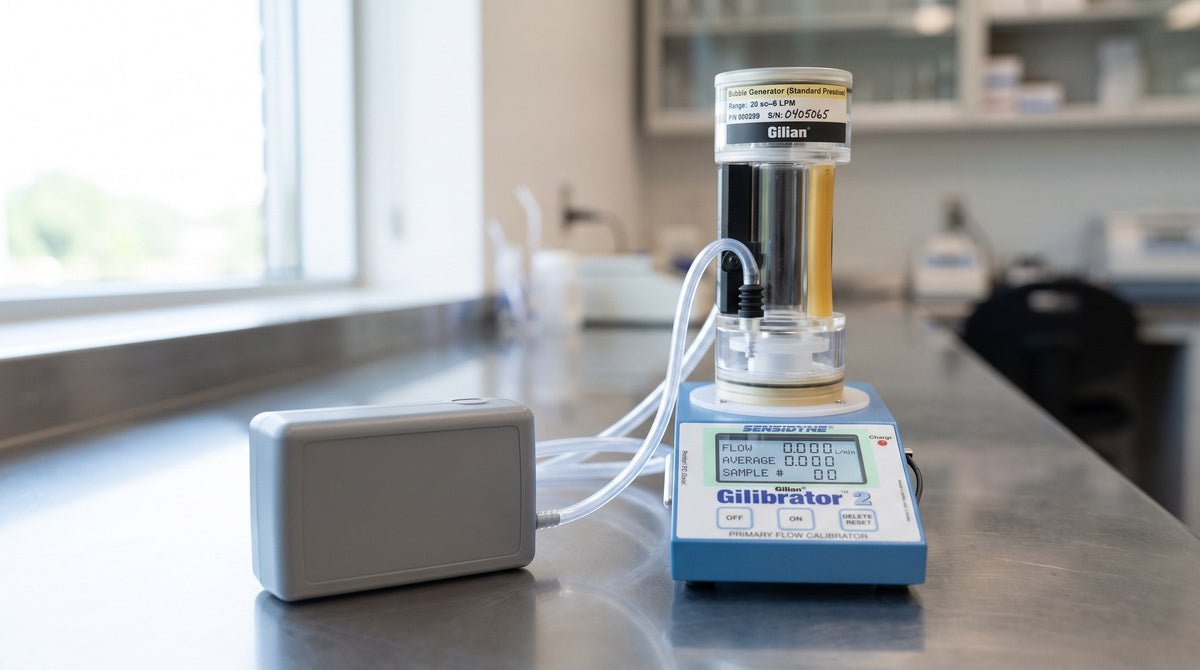
An air sampling pump is only as good as its flow rate, and the only way to know the flow rate is to measure it before and after every sample. This guide compares the primary and secondary flow calibrators ERE lists (Gilian® Gilibrator-2, Zefon® DigiCal™, Defender 500 Series, Mini-Buck™ and the Zefon® field rotameter) by flow range and accuracy, and shows how to run the pre and post check.
In this guide
- Why Does an Air Sampling Pump Need a Flow Calibrator?
- What Is the Difference Between Primary and Secondary Calibrators?
- Which Calibrator Covers Which Flow Range?
- What Do the ERE Records Say About Each Calibrator?
- How Do You Calibrate a Pump Before and After Sampling?
- How Do You Choose a Flow Calibrator, Step by Step?
- Frequently Asked Questions
Why Does an Air Sampling Pump Need a Flow Calibrator?
The sample volume is flow rate multiplied by time, so any flow error is carried straight into the reported concentration. ASTM D5337 states that the precision and bias of exposure methods are directly affected by the precision and bias of the pumps used to measure the air volume sampled (ASTM D5337). The practice covers primary and secondary calibration techniques for personal sampling pumps.
Your analytical method sets the flow rate or flow range you must hold. A pump display can drift between calibrations, so the display is not the reference. A calibrator is. See our air sampling pump buyer's guide for choosing the pump itself.
What Is the Difference Between Primary and Secondary Calibrators?
A primary calibrator measures volume directly, and a secondary device is checked against one. The bubble-based calibrators on this page time a soap film moving through a known volume, which is why the Gilibrator-2 and Mini-Buck records say they need soap solution. The Defender 500 Series is a volumetric primary flow standard that, per its record, needs no soap solution.
- Primary (bubble or volumetric): Gilibrator-2, DigiCal™, Mini-Buck™, Defender 500. Accuracy on the records: ±0.5% (DigiCal™, Mini-Buck™), better than 1% (Gilibrator-2 cells) and 1% volumetric (Defender).
- Secondary (rotameter): the Zefon® field rotameter. Its record states mid-range calibration against a master flowmeter and an accuracy of ±3%.
The University of Arizona guide adds that most safety and health professionals use a dry calibration device or a bubble tube device, with a source traceable to a NIST primary standard (University of Arizona).
Which Calibrator Covers Which Flow Range?
Match the calibrator's range to the lowest and highest flow your pumps are set to, because a cell used outside its range reads poorly. The table is built from each ERE product record.
| Flow band | Calibrator and range on the record |
|---|---|
| Very low flow | Mini-Buck™ M-1: 0.1-300 cc/min; Gilibrator-2 Low Flow Cell: 1-250 cc/min; Defender 500 Low: 5-500 cc/min |
| Mid flow | DigiCal™ 5: 1-6,000 cc/min; Gilibrator-2 Standard Flow Cell: 20-6,000 cc/min; Defender 500 Medium: 50-5,000 cc/min |
| High flow | DigiCal™ 30: 0.1-30 L/min; Gilibrator-2 High Flow Cell: 2-30 L/min; Defender 500 High: 300-30,000 cc/min |
| Quick field check | Zefon® rotameters: 0-4, 1-20 and 3-30 L/min (low, medium, high) |
The Gilibrator-2 is sold as a control base with one flow cell (low, standard or high) or as a Deluxe kit with all three cells. A lab that calibrates both tube-sampling pumps and high-volume area samplers usually needs the Deluxe kit or two calibrators.
What Do the ERE Records Say About Each Calibrator?
Each calibrator has a different strength, and the records are specific about it.
| Calibrator | Type | What the record states |
|---|---|---|
| Gilian® Gilibrator-2 | Wet-bubble primary | Three interchangeable bayonet cells; infrared sensors read the bubble flow rate; cells certified accurate to better than 1% and NIST-traceable; DC power with internal battery; hard shell case in the kits. |
| Zefon® DigiCal™ | Digital primary (plunger and flow cell) | ±0.5% accuracy; microprocessor controlled; works at any altitude without correction; up to 100 hr battery life; made for the Escort® LC pump and the Escort ELF® secondary standard. |
| Defender 500 Series | Volumetric primary | Models 510, 520 and 530+; 1% volumetric accuracy; 520 and 530+ add temperature and pressure sensors in the flow stream; 530+ adds a 1.2% standardized accuracy; no soap solution needed. |
| Mini-Buck™ | Electronic primary | ±0.5% NIST-traceable; not affected by temperature or humidity changes; accurate at any altitude; up to 8 hours on the rechargeable battery; includes AC adapter, soap solution and manual. |
| Zefon® field rotameter | Secondary | Acrylic housing with large direct-reading scales; ±3% mid-range; includes Tygon® tubing, hose barb and Luer adapter. |
For bubble-based units, a replacement A.P. Buck soap solution, 8 oz is listed for the Mini-Buck™ line, and the Gilibrator-2 and DigiCal™ kits carry their own soap solution part numbers. The records give no stock status we can promise here, so ask us to confirm availability when you quote.
How Do You Calibrate a Pump Before and After Sampling?
You calibrate with the complete sampling train in place, set the pump to the method's flow rate, sample, then measure again. The University of Arizona guide says to calibrate with the pump, tubing, cassette or tube holder and the media in line, and to include the cyclone for respirable particle sampling (University of Arizona). It also says the post-calibration check ideally uses the used sampling media to reflect the extra resistance from captured contaminant.
Worked example (our arithmetic, not a method requirement). A pump is set to 2.00 L/min before an 8-hour shift. The post-sample check reads 1.88 L/min.
- Deviation: (1.88 - 2.00) / 2.00 = -6%, inside the 5-10% band but at the edge of it.
- Average flow: (2.00 + 1.88) / 2 = 1.94 L/min.
- Sample volume: 1.94 L/min × 480 min = 931 L, instead of the 960 L the pre-set flow would suggest.
That 3% difference in volume moves the concentration by about 3%, which is why the average flow, not the set point, belongs on the calculation sheet. Your analytical method and laboratory decide the acceptance limit.
The sampling media and cyclone you calibrate with come from our other guides: see air sampling cassette types and the respirable dust cyclone buyer's guide. If you only need a pump for a short project, our air sampling pump rental guide covers renting.
How Do You Choose a Flow Calibrator, Step by Step?
- List your flow rates. Write down the lowest and highest flow your methods call for, in cc/min or L/min.
- Choose the range. Pick the cell or model whose range brackets those flows (see the table above). Add a second cell if one range cannot cover both.
- Choose the type. Bubble units are the classic primary standard; the DigiCal™, Mini-Buck™ and Defender give instant digital readouts.
- Check traceability. Ask for the NIST-traceable certificate and plan a recalibration interval for the calibrator itself.
- Add a field check. A rotameter is cheap for a quick look between calibrations, but record ±3% as its limit.
- Stock the consumables. Soap solution for bubble units, tubing and adapters for your pumps.
If you want help matching a calibrator to the pumps in your fleet, request a quote and we will return a specific list.
Need help choosing a flow calibrator?
ERE Inc. has served Canadian industrial hygiene and environmental buyers for 30+ years. Tell us the pumps and flow rates you calibrate, and we will quote the matching calibrator, soap solution and accessories.
→ Request a Quote | 1-888-287-EREC | Browse Air Sampling | sales@ereinc.com
Frequently Asked Questions
How often should an air sampling pump be calibrated?
Calibrate before and after each sampling event. The University of Arizona guide says the post-calibration flow should not vary from the pre-calibration flow by more than 5-10%.
What is a primary flow calibrator?
A primary calibrator measures volumetric flow directly, for example by timing a soap film through a known volume, and is traceable to a NIST primary standard. On ERE's records the Gilibrator-2, DigiCal™, Mini-Buck™ and Defender 500 Series are primary-style calibrators.
Can I use a rotameter to calibrate a sampling pump?
A rotameter is suited to a quick field check, not as a primary standard. The Zefon® field rotameter record states an accuracy of ±3%, compared with ±0.5% to 1% on the primary calibrators.
Do I need soap solution for every flow calibrator?
No. The Gilibrator-2, DigiCal™ and Mini-Buck™ records list soap solution in the kit, while the Defender 500 Series record says there is no preparation and no messy soap bubble solution.
Which Gilibrator-2 flow cell do I need?
Choose by pump flow: Low covers 1-250 cc/min, Standard 20-6,000 cc/min and High 2-30 L/min. The Deluxe kit includes all three cells.
Related articles
- Air Sampling Pumps: Buyer's Guide for Environmental and Occupational Hygiene Professionals in Canada
- Air Sampling Cassette Types Compared
- Respirable Dust Cyclone Buyer's Guide for Canada
Lire en français : Calibrateurs de pompe d'échantillonnage d'air : bulle, numérique et rotamètre comparés pour le Canada