
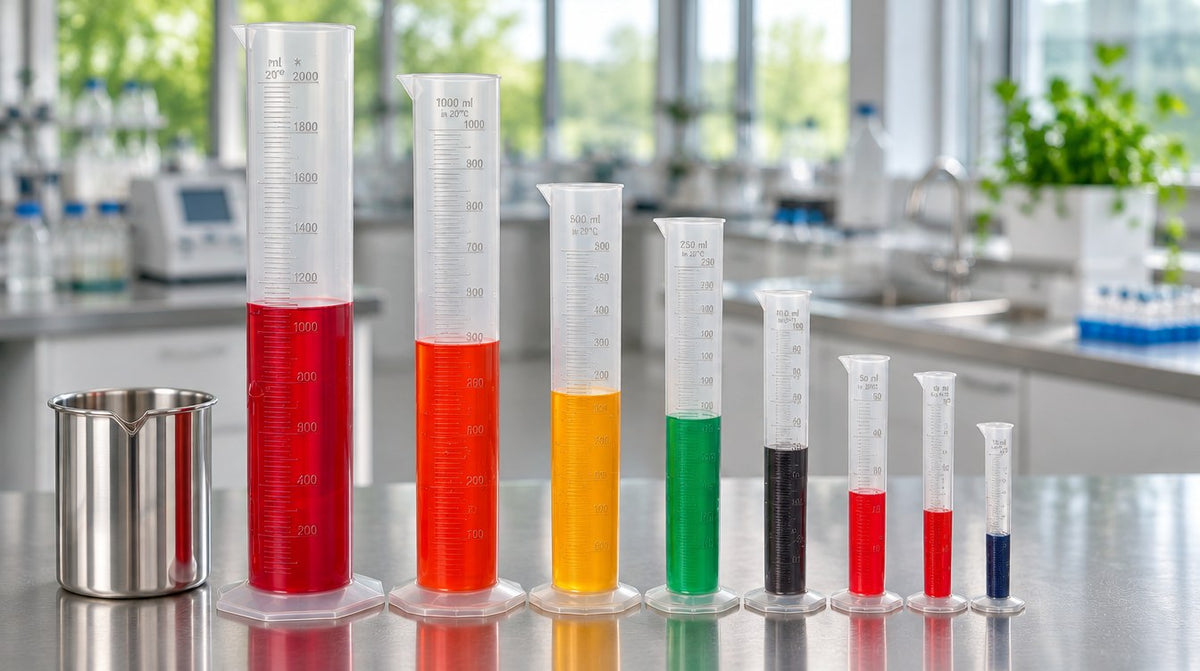
A graduated cylinder measures a liquid volume to a stated accuracy; a beaker holds, mixes and pours it. Use a graduated cylinder when you need to read a volume off a scale, and a beaker when you are heating, stirring, decanting or collecting. For field and plant work, pick the material (polypropylene, 316L stainless steel or disposable sterile plastic) before you pick the size.
What is the difference between a graduated cylinder and a beaker?
A graduated cylinder is the measuring tool: a tall, narrow body with a scale for reading volume. A beaker is the working vessel: wide and open for mixing, heating, pouring and collecting. About 8,100 searches a month in Canada are for "graduated cylinder", and another 50 compare it with a beaker. ERE lists both in its cylinders collection and beakers collection.
| Item | Material | Sizes listed | Best for |
|---|---|---|---|
| Single Scale Graduated Cylinders (SP Bel-Art) | Polypropylene | 10 ml to 2,000 ml | Reading a measured volume; reusable, autoclavable |
| 316L Stainless Steel Beakers (Sampling Systems Ltd.) | 316L stainless steel | 200 ml to 3,000 ml | Collecting and processing powders and liquids in laboratory or production |
| SteriWare Graduated Beakers (Sampling Systems Ltd.) | Polypropylene, single use | 25 ml to 2,000 ml | Measuring and decanting where cross-contamination is the risk; sterile (SAL 10-6) or non-sterile |
Which graduated cylinder should you buy for a lab or field kit?
Choose the smallest cylinder that holds your volume, because the scale is finer on a smaller cylinder. The Bel-Art single scale cylinders run from 10 ml (0.2 ml subdivisions) through 25 ml (0.5 ml), 50 ml and 100 ml (1.0 ml), 250 ml (2.0 ml), 500 ml (5.0 ml), 1,000 ml (10.0 ml) to 2,000 ml (20.0 ml).
They have raised numerals for easy reading, a flared top rim and large spout for pouring, and an octagon-shaped base for stability. The "nonwetting" polypropylene surface eliminates the concave meniscus and makes reading easier. The material is chemically resistant and autoclavable at 121°C (250°F). Cylinders are sold individually.
Is a beaker accurate enough for measuring volume?
No. Use a beaker to hold and pour; use a graduated cylinder (or a pipette) when the volume matters. Beaker markings are for a rough check, while a cylinder is made to be read. If you are dispensing small fixed volumes, see our micropipette guide.
When should you use a stainless steel beaker?
Use stainless steel when the beaker will see production or field duty where glass would break. The 316L beakers come from 200 ml to 3 L, with welds ground and polished smooth, a high-quality finish with no crevices, and an easy-clean design after use. They are listed for laboratory or production environments, with datasheets and a certificate of conformity on the product page.
| Volume | Internal diameter | Overall diameter | Height |
|---|---|---|---|
| 200 ml | 80 mm | 95 mm | 53 mm |
| 500 ml | 82 mm | 95 mm | 100 mm |
| 1,000 ml | 99 mm | 110 mm | 150 mm |
| 2,000 ml | 140 mm | 155 mm | 155 mm |
| 3,000 ml | 203 mm | 219 mm | 100 mm |
Stainless steel is a poor choice for reading a volume by eye; if you need to see the liquid level, use the plastic graduated beaker or a cylinder.
When does a disposable graduated beaker make sense?
A disposable beaker makes sense when cleaning time or cross-contamination costs more than the part. The SteriWare graduated beakers are single-use polypropylene with graduation marks, manufactured and packed in a cleanroom, individually bagged, and made from FDA, EC 1935/2004 and EU 10/2011 conforming polymers. They are BSE/TSE free, available sterile (SAL 10-6) and non-sterile, in 25, 50, 100, 250 and 2,000 ml (50 per box up to 100 ml, 40 per box at 250 ml, 15 per box at 2,000 ml).
Pharmaceutical, chemical and cosmetic production teams use sterile beakers so the sample is not compromised. For containers beyond beakers, see our lab scoop guide and lab forceps guide.
How do you choose between a cylinder and a beaker?
- Define the task. Reading a volume: cylinder. Mixing, pouring, collecting or heating: beaker.
- Define the contamination risk. Reusable polypropylene or stainless when you will clean; SteriWare when you will not.
- Check chemistry. Review the safety data sheet under WHMIS for laboratories and confirm the material is compatible with the sample.
- Check sterilization. Polypropylene cylinders tolerate autoclaving at 121°C (250°F); disposables ship sterile or non-sterile as specified.
- Size it. Pick the smallest cylinder that holds your volume for the finest subdivision; pick the beaker one size above the working volume to avoid spills.
Browse the full range in the cylinders collection, the beakers collection and the wider laboratory sampling collection. For heating, see our laboratory hot plate guide.
Frequently asked questions
What is a graduated cylinder used for?
Measuring a liquid volume by reading a scale. A polypropylene cylinder is chemically resistant and can be autoclaved at 121°C (250°F).
Can you heat liquid in a graduated cylinder?
No. A cylinder is a measuring tool, not a heating vessel. Heat liquids in a beaker or vessel rated for the temperature.
What sizes of graduated cylinder does ERE list?
The Bel-Art single scale cylinders are listed from 10 ml to 2,000 ml, in eight sizes.
Do you offer sterile beakers?
Yes. SteriWare graduated beakers are available sterile (SAL 10-6) or non-sterile. Request a quote and we will confirm stock and lead time.
Need help choosing cylinders or beakers?
ERE Inc. has supplied environmental and laboratory equipment from Montreal for 30+ years. Tell us the volumes, the material and the sterility you need, and we will match the part.
→ Request a Quote | 1-888-287-EREC | Browse Cylinders | sales@ereinc.com
Lire en français : Éprouvette graduée ou bécher : types, matériaux et choix au Canada