
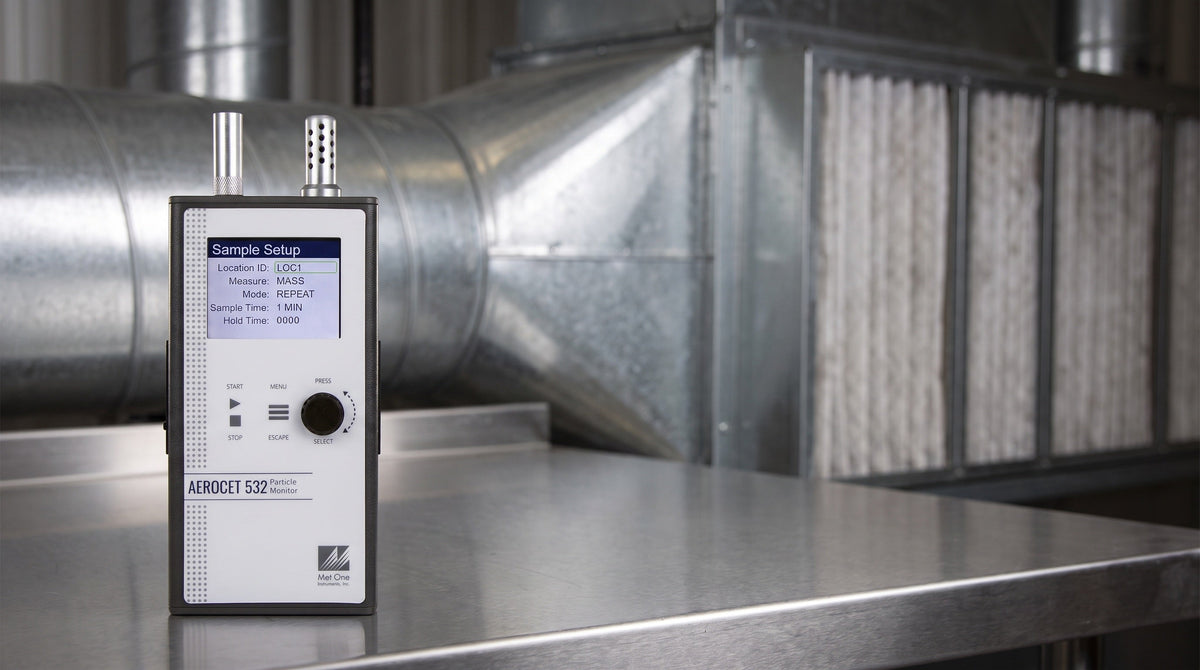
A particle counter counts airborne particles by size; a particle monitor reports their mass concentration. The Met One Aerocet 532 does both in one handheld unit: an 8-channel counter from 0.3 to 10 microns that also reports PM1, PM2.5, PM4, PM7, PM10 and TSP in micrograms per cubic metre. Choose it for indoor air quality surveys, dust source tracing and occupational screening. Do not choose it to certify a cleanroom, which is a different instrument and a different standard.
In this guide
- Is a particle counter the same as a particle monitor?
- What does the Aerocet 532 measure?
- Can a handheld counter classify a cleanroom?
- How do counts become mass, and how far can you trust it?
- What do Canadian guidelines say about PM2.5?
- How do you keep a particle counter accurate?
- Does ERE list other particle counters?
- How do you choose and use one, step by step?
- Frequently Asked Questions
Is a Particle Counter the Same as a Particle Monitor?
No. A particle counter reports how many particles of each size passed through its sensor. A particle monitor reports mass per unit volume, such as micrograms per cubic metre. Light-scattering instruments can produce either, because the count in each size channel can be converted to an estimated mass. The table maps the question you are asking to the output you need.
| Question | Output you need | Typical use |
|---|---|---|
| How many particles of a given size are in this air? | Particle count per volume, by size channel | Ventilation and filter checks, source tracing |
| How much dust mass is in the air I am breathing? | PM1, PM2.5, PM10 mass concentration | Indoor air quality surveys, workplace screening |
| Does this room meet a cleanroom air cleanliness class? | Cumulative counts at the thresholds the standard names | Cleanroom classification under ISO 14644-1 |
| Is there particulate in this water or liquid? | Liquid particle counter | Process and water quality work (a different instrument) |
What Does the Aerocet 532 Measure?
The Aerocet 532 Handheld Particle Monitor from Met One Instruments measures particle count in eight size channels and mass in six fractions at the same time. Per the datasheet, the count sizes are 0.3, 0.5, 1.0, 2.5, 4.0, 5.0, 7.0 and 10 µm, and the mass ranges are PM1, PM2.5, PM4, PM7, PM10 and TSP (total suspended particulate). Measurements are computed and totalled in as little as 60 seconds.
| Specification | Aerocet 532 (datasheet and manual) |
|---|---|
| Count channels | 0.3, 0.5, 1.0, 2.5, 4.0, 5.0, 7.0, 10 µm |
| Mass fractions | PM1, PM2.5, PM4, PM7, PM10, TSP |
| Concentration range | 0 to 3,000,000 particles per cubic foot (105,900 per litre) |
| Mass concentration limit | 0 to 1,000 µg/m³ |
| Size accuracy | ±10% to calibration aerosol |
| Flow rate | 0.1 cfm (2.83 L/min) |
| Sample time | 1, 2, 5, 10, 15, 30 or 60 minutes |
| Light source | Laser diode, 90 mW, 780 nm (Class I product) |
| Temperature and humidity probe | ±3 °C and ±5% RH |
| Battery | Li-ion, 8 hours continuous, about 2.5 hours to charge |
| Size and weight | 8.8 x 3.75 x 2.25 in., 0.84 kg |
| Operating temperature | 0 to 50 °C |
The unit ships with an isokinetic sample probe, a temperature and humidity probe, a zero particulate filter, carrying case, USB cable and COMET software, which exports readings as CSV. A docking station with WiFi, Ethernet and RS-485 is optional. Check the current product page for what is included on the unit you order.
Can a Handheld Counter Classify a Cleanroom?
Not on the strength of the records we hold. ISO 14644-1:2015 specifies classification of air cleanliness by particle concentration, considers threshold sizes from 0.1 µm to 5 µm, and bases the determination on light-scattering discrete airborne particle counters at designated sampling locations (ISO 14644-1:2015, Classification of air cleanliness by particle concentration). The Aerocet 532's smallest channel is 0.3 µm, and neither the datasheet nor the manual states that it is built or calibrated to that standard.
That makes it a survey instrument for occupied spaces, not a certification tool. If a pharmaceutical, lab or electronics client needs ISO 14644 classification, tell us the class and the sizes your protocol names and we will check what we can supply. A mislabeled instrument costs more than a longer lead time.
How Do Counts Become Mass, and How Far Can You Trust It?
The instrument converts counts to mass with a proprietary algorithm for typical-density aerosols, then lets you correct it with a K-factor for each mass fraction. The manual states that the accuracy of the mass output can be affected by variations in the size, colour, shape and index of refraction of the sampled particles, and that the K-factor is only valid for the same site and the same particulate type.
The manual's own worked example: if a reference instrument reads a total of 51 µg/m³ and the Aerocet reads 38 µg/m³ over the same period, the K-factor is 51 divided by 38, or 1.34. K-factors can be set from 0.1 to 20.0 and should be derived by comparison with a reference or gravimetric unit. The calibration itself uses polystyrene latex spheres, which are ideal particles, so real dust such as drywall, welding fume or pollen will read differently until you tune it.
In practice: use the factory setting to compare locations and track trends in one building, and derive a K-factor against a gravimetric sample before you quote mass numbers against a limit. For the gravimetric and real-time trade-off on dusty process air, see our DustTrak photometer guide.
What Do Canadian Guidelines Say About PM2.5?
Outdoors, the Canadian Ambient Air Quality Standards for 2020 are 8.8 µg/m³ for the annual PM2.5 average and 27 µg/m³ for the 24-hour value, as published by Environment and Climate Change Canada (Air quality indicator, Canada.ca). Those standards use multi-year statistical forms. A single 60-second reading from a handheld unit is a screening value, not a compliance result.
Indoors, Health Canada does not propose a specific maximum PM2.5 exposure limit for homes. It recommends that indoor PM2.5 be lower than the PM2.5 outside, and notes that an indoor level above the outdoor level points to a strong indoor source that needs to be found (Health Canada, Guidance for fine particulate matter (PM2.5) in residential indoor air). That is exactly what a handheld monitor is good at: take an outdoor reading, walk the building, and see where the indoor number climbs above it. For the wider building-monitoring picture, see our indoor air quality monitoring guide.
How Do You Keep a Particle Counter Accurate?
Follow the manual's service schedule. A zero-count test weekly, a flow rate test monthly, an annual calibration, and a filter change yearly or as required by the dust you sample.
- Weekly zero-count test: fit the zero count filter, run a 1-minute count sample, and the smallest particle size should read 1 count or fewer. Repeat if needed to flush the air path.
- Monthly flow rate test: check against a non-loading reference flow meter. The set point is 2.83 L/min (0.1 cfm) and the manual calls for adjustment when the error is greater than ±5%.
- Annual calibration: the manual says the unit should be returned to Met One yearly. It cannot be done by the customer because it needs specialized equipment and a skilled technician. See our instrument calibration guide for how that works from Canada.
- Exhaust filter: a 0.2 micron filter cleans the instrument exhaust, and change frequency depends on how dusty your sites are.
Does ERE List Other Particle Counters?
ERE lists one active particle counter today, the Aerocet 532. The particle counters collection holds that single product. We do not currently list liquid or water particle counters, or handheld cleanroom counters for ISO 14644 classification, so if you searched for one of those, ask us before assuming it is unavailable. For a short project, ask whether a unit is available through the rental program.
How Do You Choose and Use a Particle Counter, Step by Step?
- Name the decision. Find a dust source, check a filter, screen a workplace, or certify a room. Only the first three fit a handheld monitor.
- Pick count or mass. Counts show where particles of a given size come from; mass is what exposure guidance talks about.
- Check the size range against your protocol. If the standard names 0.1 µm, a 0.3 µm channel does not meet it.
- Zero it. Run the zero-count test with the filter fitted before the survey day.
- Take an outdoor or clean-area reference. Compare every indoor reading against it, as Health Canada suggests for PM2.5.
- Survey on a fixed route. Same points, same sample time, same instrument settings every visit.
- Derive a K-factor if you need mass for a limit. Compare with a gravimetric or reference result on your own dust.
Need help choosing a particle counter?
ERE Inc. has been Canada's environmental equipment specialist for 30+ years. Tell us the space, the particle sizes and the standard you work to, and we will match the instrument.
→ Request a Quote | 1-888-287-EREC | Browse Particle Counters | sales@ereinc.com
Frequently Asked Questions
What is the difference between a particle counter and a particle monitor?
A counter reports the number of particles by size. A monitor reports mass concentration, such as PM2.5 in micrograms per cubic metre. The Aerocet 532 reports both.
What sizes does the Aerocet 532 count?
Eight channels: 0.3, 0.5, 1.0, 2.5, 4.0, 5.0, 7.0 and 10 microns, with mass fractions PM1, PM2.5, PM4, PM7, PM10 and TSP.
Can I use it for ISO 14644 cleanroom classification?
The datasheet and manual do not state that it is built or calibrated for ISO 14644-1, whose classification uses threshold sizes from 0.1 to 5 microns. Ask us for the right instrument if you need classification.
How accurate is the mass reading?
The mass is calculated from counts for typical-density aerosols. Particle size, colour, shape and refractive index affect it, so derive a K-factor against a reference or gravimetric instrument for your own dust.
How often does an Aerocet 532 need calibration?
The manual calls for a yearly return to Met One for calibration and inspection, with a weekly zero-count test and a monthly flow rate test in between.
What PM2.5 level is acceptable indoors in Canada?
Health Canada does not set a specific indoor limit. It recommends indoor PM2.5 be lower than outdoor PM2.5, and treats a higher indoor level as a sign of an indoor source to find.
Related articles
- Indoor Air Quality Monitoring for Commercial Buildings
- DustTrak Aerosol Monitors: Photometer vs Gravimetric Sampling
- Instrument Calibration Services in Canada
- Environmental Instrument Rental in Canada
Lire en français : Compteur de particules : guide des moniteurs portatifs de masse et de comptage au Canada