
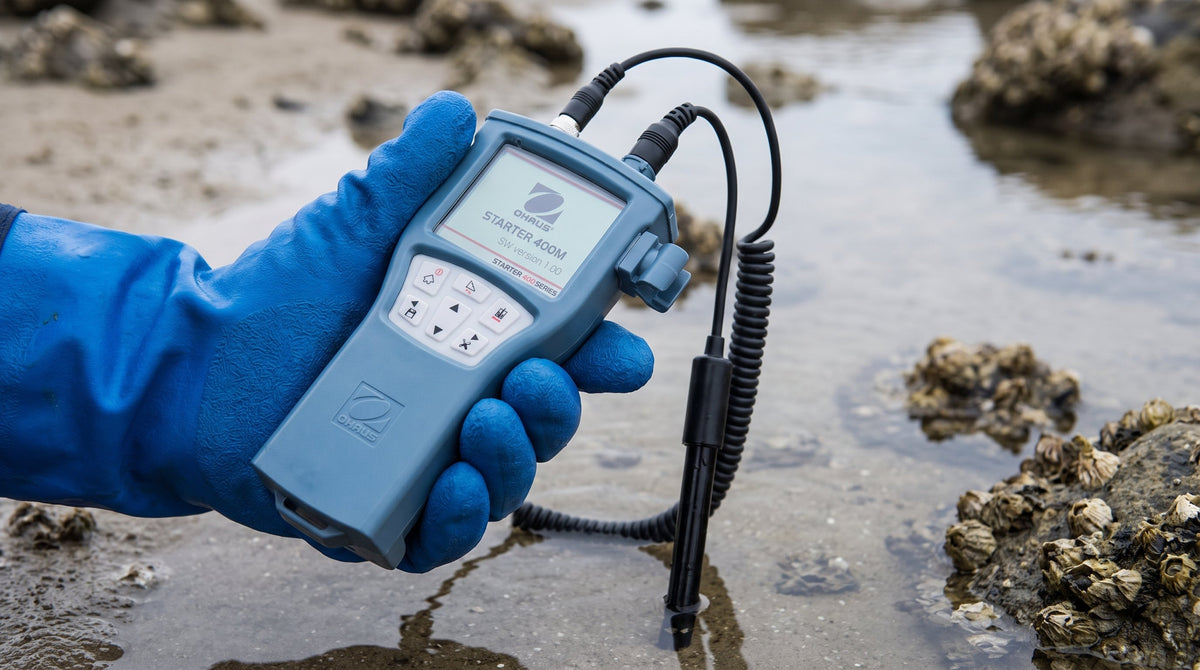
A salinity meter does not measure salt directly — it measures electrical conductivity and calculates salinity from it, the same way a TDS meter calculates dissolved solids. For buying, three things decide whether the meter fits the job: which unit it reports (ppt, PSU or specific gravity), which format matches your sampling — portable, bench or multiparameter — and whether it is calibrated against a standard that brackets your samples. This guide compares the instruments ERE carries and explains Canada's guideline for salinity in marine and estuarine water.
In this guide
- What a salinity meter actually measures
- ppt, PSU or specific gravity: what's the difference?
- Portable, bench or multiparameter: which format do you need?
- Is there a Canadian salinity guideline?
- How do you calibrate a salinity meter?
- Where are salinity meters used in Canadian environmental and industrial work?
What Does a Salinity Meter Actually Measure?
A salinity meter measures electrical conductivity and converts the reading to salinity, the same underlying measurement a conductivity or TDS meter reports in a different unit. The U.S. EPA's salinity indicator page describes salinity as the dissolved salt content of a body of water and notes that it is a strong contributor to conductivity — the two rise and fall together because dissolved salts are what carry the electrical current a conductivity probe reads.
That relationship is why every salinity-capable instrument ERE carries is, underneath, a conductivity meter with a salinity conversion built in. There is no separate "salinity sensor" on any of the three instruments below — the conversion runs on the same EC signal used to report conductivity or TDS. For the conductivity side of a field kit, including probe range and four-pole vs two-electrode design, see our portable conductivity meter guide.
What's the Difference Between ppt, PSU and Specific Gravity?
Ppt (parts per thousand, also written ‰) and PSU (Practical Salinity Units) are effectively the same scale for most field purposes; specific gravity is a different, density-based unit used mainly in marine and process work. The modern reference is the Practical Salinity Scale (PSS-78), which defines salinity from a sample's conductivity ratio to a standard seawater reference at a given temperature and pressure — the method behind every conductivity-derived salinity reading, oceanographic or portable.
The Ohaus Starter 400M reports salinity directly in psu (0 to 99.9 psu, per its ERE spec sheet). The Hanna HI9829 reports both salinity and seawater specific gravity from the same EC-derived calculation, per Hanna's own product description, so the same probe can answer either question depending on which unit your report needs. Confirm the unit your client, lab or regulator expects before you quote a number — a specific-gravity reading and a ppt reading are not interchangeable without a conversion.
Portable, Bench or Multiparameter: Which Salinity Meter Format Do You Need?
Choose a portable multiparameter meter for field programs that need salinity alongside pH and conductivity, a bench meter for lab confirmation of field samples, and a submersible multiparameter probe when salinity is one of several parameters logged from a single drop. The table compares the three real, ERE-stocked instruments this guide covers.
| Instrument | Format | Salinity output | Also reads | Notes |
|---|---|---|---|---|
| Ohaus Starter 400M | IP67 portable multiparameter | 0 to 99.9 psu | pH, conductivity, TDS, resistivity, temperature | 1,000-record memory; micro-USB; rechargeable battery (40 h); 0.35 kg |
| Hanna HI9829 | Multiparameter, submersible probe | Salinity and seawater specific gravity (EC-derived) | pH, ORP, DO, EC/TDS, turbidity, temperature (by model) | 44,000-sample logger; IP67 meter, IP68 probe; up to 140 h battery |
| Ohaus Aquasearcher AB23EC | Benchtop | Conductivity/TDS/salinity mode | Conductivity, TDS | EC 00.0 µS/cm to 199.9 mS/cm, ±1% of reading ±3 LSD; 99-item memory |
The HI9829 is built as a submersible multiparameter probe first — its salinity and specific-gravity output rides on the same cable/probe assembly used for pH, DO, EC and turbidity, so it is the instrument to specify when salinity is one line item in a broader field-parameter list rather than the primary target. For a wider comparison of that class of instrument, see our water quality meter guide.
Is There a Canadian Salinity Guideline for Aquatic Life?
Yes, but it caps the change, not a fixed value. The Canadian Council of Ministers of the Environment's salinity guideline states that human activities should not cause the salinity of marine and estuarine waters, expressed in parts per thousand, to fluctuate by more than 10% of the natural level expected at that time and depth. It is an interim guideline (1996), and CCME lists no numeric freshwater salinity guideline — the freshwater entry shows no data for either short-term or long-term values.
The practical consequence for a monitoring program is that a single salinity reading rarely answers a compliance question on its own. What matters is the deviation from the seasonal baseline at that location and depth, which means a program needs either historical baseline data or a paired reference station — not just a spot reading against a fixed number. The EPA's indicator page reinforces why the baseline matters ecologically: organisms in an estuary sort themselves along the salinity gradient, with less salt-tolerant species upstream where salinity is lower, so a shift in that gradient changes which species can persist at a given point, independent of whether any single reading looks "high" or "low" in isolation.
How Do You Calibrate a Salinity Meter?
Calibrate on a conductivity standard, not a salinity standard — a salinity-capable meter derives its salinity or specific-gravity output from the same EC calibration it uses for conductivity and TDS. The Hanna HI9829 manual and ERE's own product record confirm this directly: the meter's TDS calibration is described as based on conductivity or salinity calibration, meaning the single EC calibration point covers all three calculated outputs.
- Choose a standard that brackets your expected range. ERE stocks Hanna conductivity calibration solutions at 84 µS/cm, 1,413 µS/cm and 12,880 µS/cm — the 12,880 µS/cm standard is the one that brackets brackish and higher-salinity samples.
- Calibrate the EC channel first. Standardize the meter on conductivity before reading salinity or specific gravity, since both are calculated from that same channel.
- Confirm the unit setting. Set the meter to the salinity unit (ppt/psu) or specific-gravity mode your report requires before recording a reading, and record which one you used.
- Rinse and immerse. Rinse the probe with deionized water, then immerse it fully in the sample, clearing any trapped air.
- Record the baseline context. Note the location, depth and date alongside the reading — since the CCME guideline judges deviation from a seasonal baseline, an isolated number is far less useful than one tied to a location's history.
Where Are Salinity Meters Used in Canadian Environmental and Industrial Work?
Environmental consultants use salinity meters to track saltwater intrusion in coastal and near-shore groundwater, to profile estuarine and near-shore water bodies for impact assessments, and to establish the seasonal baseline the CCME guideline requires before a deviation can be judged. Industrial and municipal teams use the same instruments on brine streams, de-icing runoff and process water where conductivity, TDS and salinity are read from the same probe to save a second field trip.
Where the work also touches conductivity, TDS or pH as separate reportable parameters, see our companion guides to portable conductivity meters, TDS meters and pH meters. For coastal and estuarine groundwater profiling, the Heron Conductivity+ tape meter covered in the conductivity guide reads conductivity, temperature and water level in the same drop down a well.
For our full range of field water-quality meters, probes and calibration standards, see the Water Quality Instrumentation collection. Multi-brand supply means one quote can cover the meter, the probe and the standards.
Need help choosing a salinity meter?
ERE Inc. has been Canada's environmental equipment specialist for 30+ years. Tell us your sample range and reporting unit and we will match the meter, probe and calibration standards.
→ Request a Quote | 1-888-287-EREC | Browse Water Quality Instrumentation | sales@ereinc.com
Frequently Asked Questions
Is a salinity meter the same as a conductivity meter?
It makes the same underlying measurement. A salinity meter reads conductivity and converts it to ppt, PSU or specific gravity using the Practical Salinity Scale. The EPA describes salinity as a strong contributor to conductivity, which is why the two move together and why every salinity-capable instrument ERE carries is a conductivity meter with a salinity conversion built in.
What is the Canadian guideline for salinity in water?
CCME's guideline for marine and estuarine waters is a relative one: human activities should not change salinity by more than 10% of the natural seasonal level at that time and depth. It is an interim guideline from 1996, and CCME lists no numeric freshwater salinity value.
Should I report salinity in ppt, PSU or specific gravity?
Use the unit your client, lab or regulator specifies, and record it with every reading. The Ohaus Starter 400M reports in psu; the Hanna HI9829 can report both salinity and seawater specific gravity from the same probe, so confirm which output your report format expects before you quote a number.
Can I calibrate a salinity meter without a salinity standard?
Yes. Salinity-capable meters calculate their output from the conductivity channel, so calibrating on a conductivity standard that brackets your expected range — such as a 12,880 µS/cm standard for brackish or higher-salinity samples — calibrates the salinity reading as well.
Related articles
- Portable Conductivity Meters: How to Choose One for Field Water Monitoring in Canada
- TDS Meters: How to Choose One, Set the Conversion Factor and Calibrate It in Canada
- Water Quality Meters for Environmental Work: A Buyer's Guide for Canada
- pH Meters: How to Choose a Pocket, Portable or Bench Meter for Water Testing in Canada
Lire en français : Salinomètres : comment choisir le bon format et lire ppt, PSU ou densité au Canada