
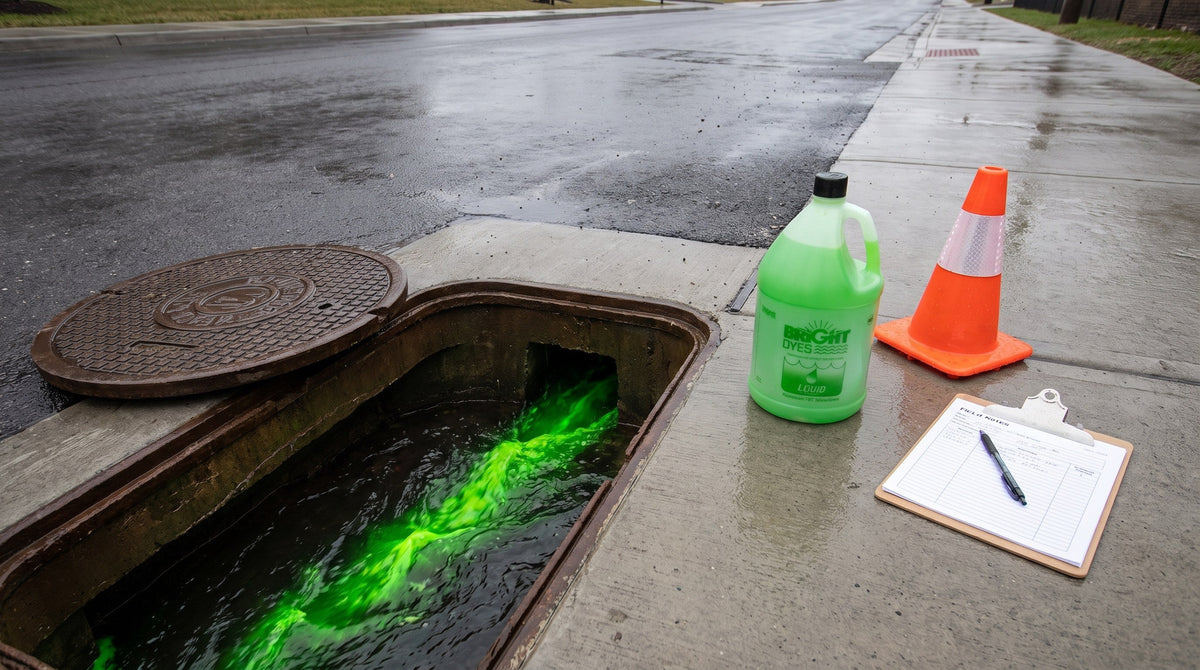
Sewer dye testing traces the path of water through a pipe network by introducing a visible or fluorescent dye at one point and watching where it turns up. Municipal engineers use it to find illicit sanitary/storm cross-connections, environmental consultants use it during Sanitary Sewer Evaluation Surveys (SSES) to locate inflow & infiltration (I&I) sources, and inspectors use it to confirm septic system leaks — all with the same basic method, different dye colors and concentrations for each application.
What Is a Sewer Dye Test?
A sewer dye test introduces a fluorescent or brightly visible dye into a fixture, drain, or pipe segment, then monitors a downstream point — a manhole, outfall, ditch, or receiving water body — to see whether and where the dye appears. If dye shows up somewhere it shouldn't, that confirms a physical connection between two systems that were supposed to be separate.
The method is simple by design: no excavation, no camera crew, no confined-space entry required to get a first confirmation. Dye testing narrows the search area before a more expensive method (CCTV pipe inspection, smoke testing, excavation) confirms the exact defect location.
How Do You Detect Illicit Sanitary/Storm Cross-Connections?
Introduce dye at the suspect source — a floor drain, roof leader, sump pump discharge, or building lateral — and watch the system it shouldn't be connected to. A storm-to-sanitary cross-connection shows up as dye appearing in a sanitary manhole after being poured into a catch basin or storm drain. A sanitary-to-storm cross-connection (the more serious case, since it puts untreated sewage into a receiving water body) shows up as dye poured into a toilet, drain, or cleanout appearing at a storm outfall or in a ditch.
Because the two dye colors used for these two use cases are meant to be visually distinct on sight (Bright Dyes' Standard Blue is designated for storm lines, FLT Orange for sanitary/sewer lines), a crew running both a storm-side and sanitary-side test in the same inspection window can tell the two results apart at a glance without needing separate visits.
How Does Dye Testing Identify I&I Sources?
Inflow & infiltration is stormwater and groundwater that enters a sanitary sewer system where it doesn't belong — inflow through direct connections like roof drains, foundation drains, and sump pumps; infiltration through cracked pipe joints, deteriorated manholes, and root intrusion. Both drive up wet-weather flow at the treatment plant and are a standard target of a Wastewater Systems Effluent Regulations-driven capacity assessment.
Dye testing is the fastest way to confirm a suspected inflow source before committing to smoke testing or CCTV across an entire collection system segment. Pour dye at each candidate inflow point (a specific roof leader, a specific sump discharge) one at a time and monitor the nearest downstream sanitary manhole; a positive hit identifies the exact connection, not just "somewhere on this block." The U.S. EPA's guidance on sanitary sewer overflows lists dye testing alongside smoke testing and CCTV as a standard SSES field method for exactly this reason.
Which Bright Dyes Product Should You Use?
Bright Dyes ships in tablet, liquid, and powder formats, each dosed for a specific job. All colors are visible by eye down to roughly 100 parts per billion in clear water, and down to about 10 ppb under a UV blacklight for a low-concentration or long-run trace.
Format and Application Reference
| Format / Color | Rated Application | Dosage |
|---|---|---|
| FLT Orange Tablets | Sewer lines | 1 tablet : 35 gallons |
| Standard Blue Tablets | Storm lines | 1 tablet : 20 gallons |
| FLT Blue Liquid | Trace cross-connections | 1 pint : 12,500 gallons |
| FLT Orange Liquid | Detect illegal sewer connections | 1 pint : 4,000 gallons |
| FWT Red 25 Liquid | Septic inspections | 1 pint : 3,125 gallons |
| FWT Red 50 Liquid | Detect leaks in sewage systems | 1 pint : 6,250 gallons |
| FWT Red 200 Liquid | Fluorometric dye test | 1 pint : 25,500 gallons |
Tablets dissolve in 5–8 minutes and are the easiest format to carry and dose in the field — drop one down the suspect fixture and start your downstream watch. Liquid formats are the right choice when you need precise metering (dosing pumps, timed release for a long trace run) or a specific concentration for fluorometric analysis rather than a visual read. See the full Bright Dyes product line for every color, format, and pack size ERE carries.
How Do You Run a Sewer Dye Test?
The procedure is the same core steps whether you're chasing a cross-connection, an I&I source, or a septic leak — only the dye color/format and the monitored point change.
- Identify the suspect source and the monitoring point. Pick the single fixture, drain, or pipe segment you're testing and the downstream manhole, outfall, or inspection point where dye would appear if a connection exists.
- Station an observer at the monitoring point before introducing dye. Dye can appear within minutes on a short run or take much longer on a long or partially blocked line — don't leave the monitoring point unwatched.
- Introduce the dye at the source. Drop the rated number of tablets down the fixture, or meter in the liquid dose, then flush with water to carry it into the system.
- Watch the monitoring point for dye arrival. Note the time dye first appears and how it dissipates — a fast, strong trace usually means a direct connection; a slow, faint trace can mean a partial or intermittent one.
- Repeat one source at a time if testing multiple suspects. Running two untested sources simultaneously with the same dye color makes it impossible to tell which one is the actual connection.
- Document the result. Record source, dye color/dose, monitoring point, time to first appearance, and photo evidence for the inspection report.
Can Dye Testing Check a Septic System?
Yes — a septic dye test uses the same visible-dye principle to confirm a failing drain field or a leak between the tank and the field. Flush dye down a toilet or sink, then check the drain field surface, nearby ditches, or a neighboring water body for dye breakthrough over the following hours to days, depending on soil conditions. FWT Red 25 and FWT Red 50 liquid are dosed specifically for septic and sewage-leak inspection work, at lower concentrations suited to a single-property test rather than a municipal-scale sewer segment.
Browse ERE's full environmental sampling equipment guide for the sampling tools that typically accompany a dye-test inspection program, or see our guide to fluorescent tracer dyes for leak detection and water tracing for the groundwater/surface-water tracing use case — a related but separate application from sewer-line dye testing.
Planning an I&I study, cross-connection survey, or septic inspection program?
ERE Inc. has been Canada's environmental equipment specialist for 30+ years, stocking the full Bright Dyes line in every rated color and format. Talk to a real technical rep before you order the wrong dose for your test scale.
→ Request a Quote | 1-888-287-EREC | Browse Bright Dyes | sales@ereinc.com
Frequently Asked Questions
How long does sewer dye stay visible?
It depends on flow and dilution, not a fixed shelf life — a strong dose in a low-flow line can stay visually traceable for hours, while heavy flow or a long pipe run dilutes it faster. Fluorescent colors stay detectable under UV blacklight (down to roughly 10 ppb) well after they're too faint to see by eye.
Is sewer dye testing safe for the environment?
Bright Dyes' tracer colors are NSF/ANSI Standard 60 certified for use in drinking water systems, which is a materially higher safety bar than sewer or septic tracing requires.
What's the difference between a sewer dye test and smoke testing?
Dye testing confirms a specific suspected connection with a liquid tracer; smoke testing pressurizes a sewer segment with non-toxic smoke and watches for smoke emerging at unexpected surface points (cracked cleanouts, downspouts, foundation drains) across a wider area. Consultants often run smoke testing first to find candidate defect locations, then dye test each one individually to confirm it.
Can one dye color be used for both storm and sanitary testing?
You can, but running distinct colors for each system (Bright Dyes designates Standard Blue for storm lines and FLT Orange for sanitary lines) lets a single inspector distinguish a storm-side result from a sanitary-side result without needing two separate site visits.
Related articles
- Fluorescent Tracer Dyes: Leak Detection & Water Tracing Guide for Canada
- Fluorescein Dye: Colors, Detection & Uses in Water Tracing
- Phase II Environmental Site Assessment: Equipment Checklist for Canadian Consultants
Lire en français : Test de colorant pour égouts : détecter les branchements croisés et les sources d'I/I