
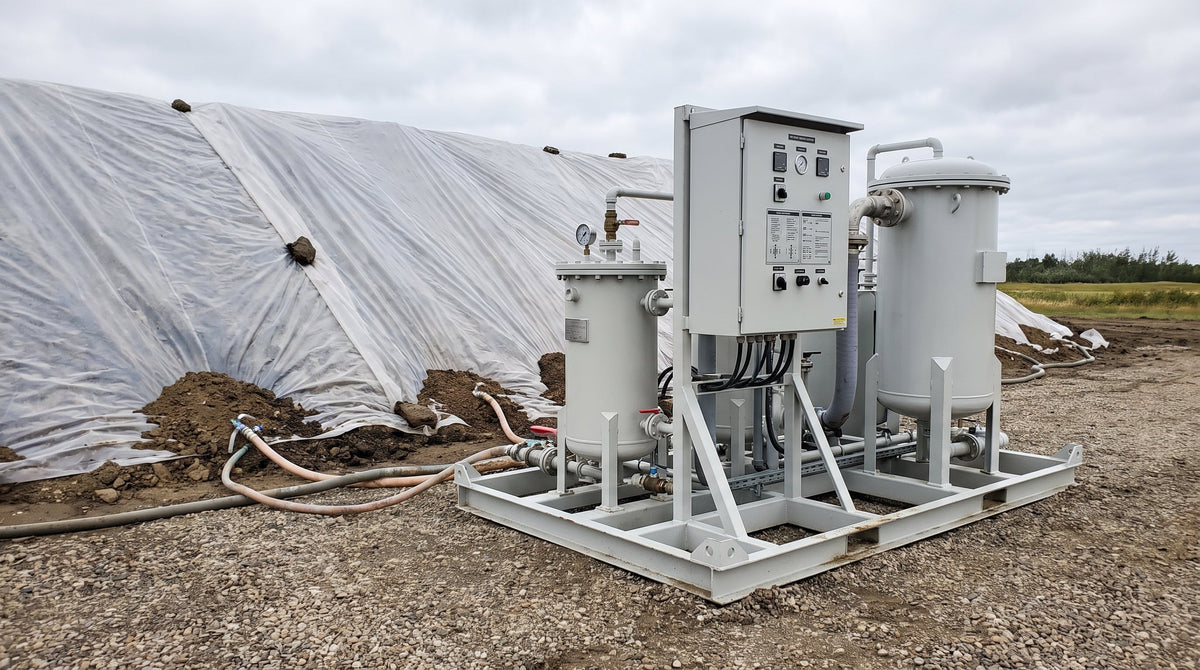
Air sparging and bioventing both use one thing — air — to clean up petroleum-contaminated soil and groundwater, but they target different zones and use different equipment. Air sparging injects compressed air below the water table to volatilize dissolved contaminants; bioventing and biopile treatment supply oxygen above the water table to speed up microbial biodegradation. Here's how each works, when to specify which one, and the equipment ERE stocks for both.
What Is Air Sparging and How Does It Treat Contaminated Groundwater?
Air sparging is an in-situ technology that injects air below the water table to volatilize dissolved petroleum and solvent contaminants, then relies on a vapor-collection system to capture the gas phase at surface. A Government of Canada federal contaminated-sites fact sheet describes it as injecting air into the saturated zone and below the upper groundwater table to oxygenate groundwater and strip volatile contaminants before they reach a treatment or extraction point.
Why Air Sparging Is Almost Always Paired With SVE
Sparged air rises through the saturated zone, carries volatilized contaminants up into the unsaturated (vadose) zone, and — without a vapor-capture step — those vapors can simply migrate through the soil column uncontrolled. That's why almost every real air sparging design pairs the injection wells with a soil vapor extraction system pulling a vacuum above the water table. ERE stocks both halves: the Sparging System for injection and the EvacuSol™ line covered in our soil vapor extraction guide for the vacuum side.
| Spec | ERE Sparging System |
|---|---|
| Compressor type | Oilless rotary vane |
| Motor | 3 HP, 115/230 V |
| Open flow | 25 CFM |
| Maximum pressure | 15 PSI |
| Filtration | Dedicated sparging filter, included |
How Does Bioventing Differ From Air Sparging?
Bioventing supplies oxygen to soil bacteria above the water table instead of stripping contaminants by volatilization below it — it's a biological process, not a physical extraction one. The U.S. EPA's Federal Remediation Technologies Roundtable defines bioventing as introducing gas into the unsaturated zone specifically to enhance the biodegradation of a contaminant by indigenous microorganisms, using low, controlled airflow rates designed to maximize oxygen uptake by bacteria rather than to volatilize and vent vapors.
In practice, most Canadian remediation projects that fall under the "bioventing" label are run as ex-situ biopile treatment: contaminated soil is excavated, mounded, and aerated through a manifold rather than treated in place. That's the equipment class ERE's BioVent™ Soil Biopile Treatment System is built for.
What's Inside a Biopile Treatment System?
BioVent™ routes air through the biopile via a manifold, a moisture knockout stage with a 10 GPM transfer pump, and a bag-filter vessel, all monitored through a NEMA 4 weatherproof control panel and mounted on a fork-liftable welded steel skid. Each system is custom fabricated to the site's pile volume and blower duty.
| Spec | ERE BioVent™ System |
|---|---|
| Moisture knockout | KO tank with 3-point level control |
| Transfer pump | 10 GPM, pressure-switch protected |
| Filtration | Bag filter vessel, 0–60" H2O vacuum gauge |
| Inlet / outlet | 8" flange inlet / 6" outlet |
| Control panel | NEMA 4 weatherproof, CSA approved |
| Skid | Welded steel, UV-resistant urethane finish |
When Should You Use Air Sparging Instead of Bioventing or Biopile Treatment?
The contaminant's depth relative to the water table decides it: below the water table, air sparging is the applicable in-situ technology; above it, in undisturbed soil, true bioventing applies; and where excavation is already part of the site plan (or the impacted volume is too shallow or too small for in-situ injection to be practical), biopile treatment is the ex-situ equivalent.
- Dissolved-phase plume below the water table (gasoline, diesel, solvents in groundwater) → air sparging, typically with SVE.
- Residual hydrocarbons in the unsaturated zone, treated in place → true in-situ bioventing (lower airflow, oxygen-uptake monitoring rather than vapor extraction).
- Excavated or stockpiled contaminated soil (tank removals, small-footprint sites, soil already slated for on-site treatment rather than disposal) → biopile treatment.
All three are aerobic, in-situ or ex-situ variants of the same underlying idea — get more oxygen to the microorganisms or strip the contaminant directly — and site geology, depth to water table, and project timeline usually settle which piece of equipment is the right one.
What Canadian Regulations Apply to Air Sparging and Bioventing Projects?
Petroleum hydrocarbon remediation in Canada is benchmarked against the CCME Canada-Wide Standard for Petroleum Hydrocarbons in Soil, which sets the numeric cleanup targets most provincial regulators reference for contaminated sites. Consultants scoping an air sparging or biopile project should confirm applicable site criteria against the CCME Canada-Wide Standard for Petroleum Hydrocarbons in Soil alongside the province's own regulation (Ontario O.Reg 153/04, Quebec's RPRT, or the equivalent in other jurisdictions).
Field crews handling recovered product, spent filtration media, or biopile leachate should also confirm WHMIS classification and safe-handling requirements through CCOHS's WHMIS overview before mobilizing.
ERE stocks both the in-situ Sparging System and the ex-situ BioVent™ Soil Biopile Treatment System, alongside the EvacuSol™ SVE line these are typically paired with. See the full Bioventing collection or the broader Treatment Systems collection for related remediation equipment.
Need help sizing an air sparging or biopile system?
ERE Inc. has supplied environmental and remediation equipment to Canadian consultants and contractors for 30+ years. Tell us your site conditions and we'll recommend the right equipment.
→ Request a Quote | 1-888-287-EREC | Browse Bioventing Equipment | sales@ereinc.com
Frequently Asked Questions
What's the difference between air sparging and bioventing?
Air sparging injects air below the water table to volatilize dissolved contaminants for capture by a vapor-extraction system. Bioventing supplies air above the water table to feed oxygen to bacteria that biodegrade the contaminant in place — it's a biological process, not a physical stripping one.
Does air sparging need to be paired with soil vapor extraction?
Almost always. Sparged air carries volatilized contaminants up into the unsaturated zone; without an SVE system pulling a vacuum above the water table, those vapors can migrate uncontrolled instead of being captured and treated.
How is biopile treatment different from true in-situ bioventing?
Biopile treatment is ex-situ — contaminated soil is excavated, mounded, and aerated through a manifold. True bioventing treats soil in place, without excavation, using lower controlled airflow rates tuned to oxygen uptake rather than vapor venting.
What size compressor does an air sparging system need?
It depends on injection depth, well spacing, and soil permeability — ERE's standard Sparging System runs a 3 HP oilless rotary-vane compressor at 25 CFM open flow / 15 PSI maximum pressure, sized for typical soil sparging duty. Contact ERE for site-specific sizing.
Are air sparging and biopile systems available to rent?
Yes — both the Sparging System and the BioVent™ Soil Biopile Treatment System are available for rental or purchase, deployed across Canada and the USA. Contact ERE for site-specific sizing, media selection, and rental rates.
Related articles
- Soil & Groundwater Remediation Equipment Guide for Canada
- Air Stripping for VOC Removal: Groundwater Treatment Guide
- Soil Vapor Extraction Systems: How They Work and When You Need One
- Bioremediation Products for Contaminated Soil & Groundwater: Buyer's Guide
Lire en français : Air Sparging et Bioventing : équipement de remédiation in situ comparé