
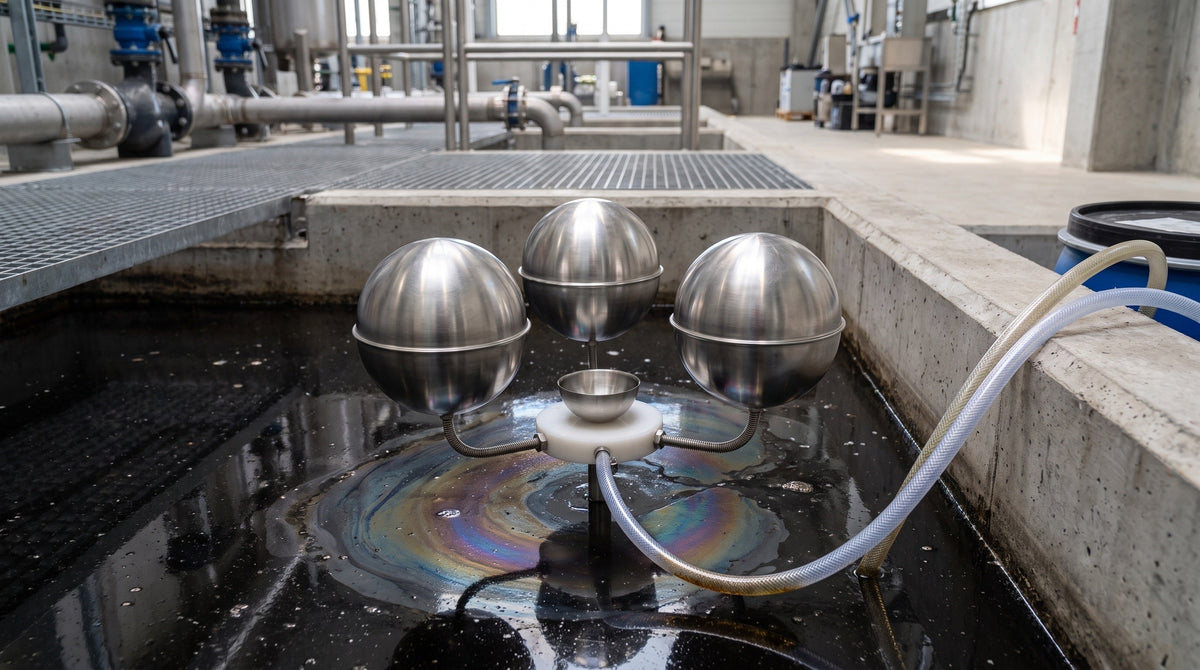
An oil skimmer recovers free-floating oil from water or coolant without pumping out the water itself — but "oil skimmer" covers five mechanically different tools built for five different jobs, from a passive canister in a 2" monitoring well to an active belt-free unit running continuously in a CNC coolant sump. This guide compares the five oil skimmers ERE Inc. stocks so you can match the mechanism to your application.
Table of contents
- What Is an Oil Skimmer and How Does It Recover Free Product?
- Which Oil Skimmer Fits Your Application?
- How Do You Choose Between Passive and Active Recovery?
- Why Does Oil Recovery Matter for Site Closure and Wastewater Compliance?
- How Do You Install and Maintain an Oil Skimmer?
- Frequently Asked Questions
What Is an Oil Skimmer and How Does It Recover Free Product?
An oil skimmer removes a floating hydrocarbon layer from the surface of water without drawing off the water underneath it. Because oil is less dense than water and doesn't mix with it, the layer stays at the surface — a skimmer either sits at that interface and drains the oil off passively, or uses a pump, belt, or selective media to actively pull the oil away while rejecting the water. The mechanism differs by product; the target is always the same free-floating layer, sometimes called LNAPL (light non-aqueous phase liquid) in an environmental context.
Skimming is a separate step from measuring how much product is present. If you need to confirm free-product thickness in a well before deciding whether recovery is warranted, see ERE's oil/water interface meter guide — the interface probe measures the layer, the skimmer recovers it.
Which Oil Skimmer Fits Your Application?
ERE stocks five skimmers spanning passive well recovery through active industrial and coolant applications.
| Skimmer | Mechanism | Environment | Best for |
|---|---|---|---|
| PRC Passive Skimmers | Passive — floating intake drains product into a canister, no pump or power | 2"+ monitoring wells | Ongoing LNAPL recovery down to a sheen with zero site visits between canister emptying |
| Oil Scavenger™ System | Active — pumped separating/recovery system, 115V | Open water, lagoons, large-diameter or open-area sites | Higher-volume LNAPL recovery where a well-diameter passive skimmer can't reach the surface area |
| Oil Bucket™ | Passive — independently floating 100-mesh membrane skimmer with a visual full alarm | Pits and sumps | Set-and-forget recovery where a visual signal (not a scheduled check) should trigger emptying |
| Olio-Skim™ | Active — floats at the oil/water interface, adjustable head, feeds a Vertical Gravity Separator (VGS) | Industrial and food-industry wastewater, 6"+ water depth | Continuous wastewater streams where screened floating solids and varying effluent levels rule out a fixed intake |
| Centipede Coolant Oil Skimmer | Active — continuous, no belts or blades, oil-selective (93% oil / 7% coolant vs. ~51%/49% for a belt skimmer) | CNC and machining coolant sumps | Fixed installation on a cutting-machine sump where minimizing coolant loss matters as much as removing tramp oil |
For the full line, see ERE's skimmers collection.
How Do You Choose Between Passive and Active Recovery?
Passive skimmers — the PRC and the Oil Bucket™ — have no pump, no power connection, and nothing to run continuously. They sit at the oil/water interface and let gravity and the product's own buoyancy do the work, which makes them the standard choice for long-term, low-maintenance recovery: a well that's slowly seeping LNAPL between site visits, or a sump pit that only needs emptying when the Oil Bucket's visual alarm trips. The tradeoff is throughput — a passive skimmer recovers at the rate product accumulates, not faster.
When Do You Need an Active Skimmer Instead?
Active skimmers — the Oil Scavenger™, Olio-Skim™, and Centipede — are the right call when recovery has to keep pace with a continuous process rather than a slow seep. An open lagoon or large-area spill needs the Oil Scavenger's pumped capacity because a passive canister-sized skimmer can't cover the surface area. An industrial wastewater stream needs the Olio-Skim's adjustable interface head because effluent levels change hour to hour. A CNC coolant sump needs the Centipede's continuous, oil-selective operation because tramp oil accumulates as fast as the machine runs, and every gallon of coolant the skimmer takes with the oil is coolant you have to replace.
Why Does Oil Recovery Matter for Site Closure and Wastewater Compliance?
On a contaminated site, free-product presence and thickness are standard field measurements used to decide whether active recovery is required before the site can move toward closure — a trigger distinct from the dissolved-phase lab results measured separately. Provincial site-assessment frameworks that draw on the CCME Canada-Wide Standard for Petroleum Hydrocarbons in Soil treat LNAPL recovery — the job the PRC and Oil Scavenger™ do — as an expected remediation step, not an optional one.
On the industrial side, oil and grease are regulated parameters in any discharge to a sewer or receiving water. The federal Wastewater Systems Effluent Regulations set the baseline treatment standard a facility's discharge has to meet, and most municipal sewer-use bylaws set their own oil-and-grease limits on top of it — which is exactly what an Olio-Skim™ feeding a Vertical Gravity Separator is built to help a facility hit. Recovered product from any of these skimmers is a hazardous waste stream in its own right; follow your site's WHMIS hazard-communication requirements for handling, storing, and disposing of it.
How Do You Install and Maintain an Oil Skimmer?
- Confirm the recovery environment. Well diameter, open-water surface area, pit/sump dimensions, or wastewater flow rate determines which of the five skimmer types applies before you look at any other spec.
- Size for throughput, not just fit. A passive skimmer sized correctly for the well or pit will still underperform if the accumulation rate exceeds what gravity-fed recovery can handle — that's the signal to move to an active unit.
- Position at the interface. Passive units (PRC, Oil Bucket™) float and self-adjust; active units with a fixed or adjustable head (Olio-Skim™, Centipede) need the intake or sump depth set correctly at commissioning.
- Connect discharge to the next stage. Route recovered product to a canister (PRC), a collection drum, or — for continuous wastewater applications — the Vertical Gravity Separator the Olio-Skim™ is designed to feed.
- Check and empty on schedule. Passive units need periodic canister/bucket checks (or rely on the Oil Bucket's visual alarm); active units need routine inspection of the pump, head adjustment, or — on a Centipede — confirmation that no belts or blades need replacing, since it has none.
- Handle and dispose of recovered product per WHMIS. Recovered hydrocarbon is a waste stream with its own handling and disposal requirements — treat it accordingly rather than as an afterthought once the skimmer's done its job.
For the separators and treatment systems these skimmers commonly feed, see ERE's oil-water separator maintenance guide and the soil and groundwater remediation equipment guide.
Need help choosing an oil skimmer?
ERE Inc. has supplied environmental and industrial equipment to Canadian consultants and facilities for 30+ years. Tell us your recovery environment and we'll recommend the right skimmer.
→ Request a Quote | 1-888-287-EREC | Browse Skimmers | sales@ereinc.com
Frequently Asked Questions
What's the difference between a passive and an active oil skimmer?
A passive skimmer, like the PRC or Oil Bucket™, has no pump or power connection — it floats at the oil/water interface and lets gravity drain product into a canister or reservoir. An active skimmer, like the Oil Scavenger™, Olio-Skim™, or Centipede, uses a pump or continuous mechanism to recover oil faster than passive gravity feed alone.
Can an oil skimmer replace an oil-water separator?
No. A skimmer recovers a floating oil layer from a well, pit, or tank; an oil-water separator is a treatment vessel that continuously separates oil from a flowing water stream. The Olio-Skim™ is typically used to feed a Vertical Gravity Separator rather than replace one — see ERE's oil-water separator guide for the treatment-vessel side of the equation.
Why does the Centipede recover more oil and less coolant than a belt skimmer?
A traditional belt skimmer relies on an oleophilic belt surface that also picks up some coolant as it passes through the sump — typically around 51% oil to 49% coolant. The Centipede's mechanism is oil-selective by design, recovering roughly 93% oil to 7% coolant, which means less coolant is lost (and needs replacing) for the same amount of tramp oil removed.
How do I know if I need a skimmer or an interface meter?
An interface meter measures how much free product is present and how thick the layer is; a skimmer physically removes it. Most remediation and recovery programs use both — measure with an interface probe (see ERE's interface meter guide) to confirm recovery is warranted and to track progress, then recover with the skimmer matched to the environment.
Related articles
- Oil/Water Interface Meters: How to Detect LNAPL and DNAPL in Monitoring Wells
- Oil-Water Separator Maintenance Guide
- Above-Ground vs. Underground Oil-Water Separators
- Soil and Groundwater Remediation Equipment Guide for Canada
Lire en français : Écumeurs à huile industriels : 5 types comparés