
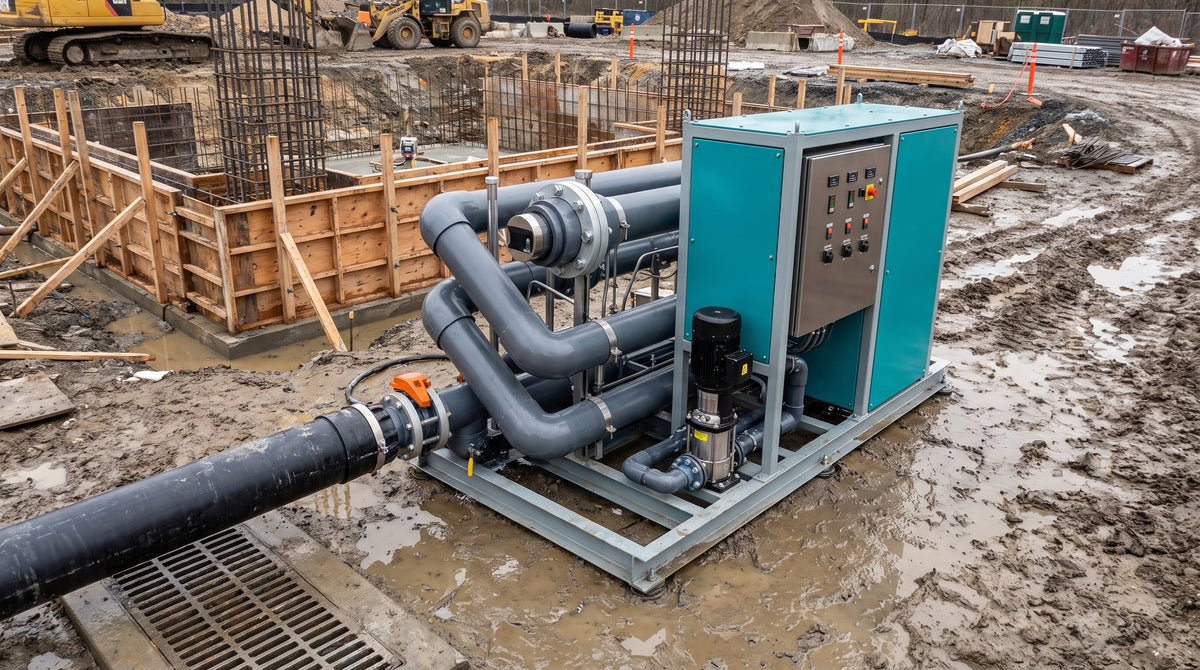
A continuous-flow pH adjustment system corrects alkaline wastewater automatically, in real time, without batch tanks or manual dosing — the right choice whenever discharge volume is steady and a facility can't stop production to treat water in batches. This guide compares continuous-flow to batch neutralization, walks through sizing, and covers ERE's PH-200™ system for construction, concrete, and industrial applications.
Table of Contents
- What Is a Continuous-Flow pH Adjustment System?
- Why Does Construction and Industrial Wastewater Need pH Correction in Canada?
- How Does Continuous-Flow pH Adjustment Differ from Batch Neutralization?
- When Do You Need a Concrete Wash Water Treatment System?
- How Is a pH Adjustment System Sized?
- What's Included in ERE's PH-200™ System?
- Frequently Asked Questions
What Is a Continuous-Flow pH Adjustment System?
A continuous-flow pH adjustment system monitors incoming water in real time and doses acid or base automatically to hold discharge within a target pH range — no batch tanks, no manual sampling between cycles. A controller reads a pH probe, calculates the dose needed for the current flow rate, and drives a metering pump accordingly.
Where It's Used
These systems show up most often where the water source is naturally alkaline and the flow is steady rather than occasional: construction dewatering, concrete batch plants and wash-out pits, industrial process discharge, and groundwater remediation sites where the aquifer itself runs high pH.
- Construction site dewatering with alkaline pH exceedances
- Concrete wash water and batch-plant discharge
- Industrial process water requiring pH correction before sewer or surface discharge
- Alkaline groundwater treatment on remediation sites
Why Does Construction and Industrial Wastewater Need pH Correction in Canada?
Because concrete, cement, and lime-contact water runs highly alkaline — often pH 11 to 13 — and every Canadian discharge pathway (municipal sewer, storm sewer, or surface water) caps the pH range a facility can release. Discharging outside that range without treatment is a bylaw and, in most provinces, an environmental-protection-act violation.
Municipal sewer-use bylaws typically set the acceptable band at pH 6.0 to 9.5, though the exact number varies by municipality. Surface-water discharge is stricter: the CCME Canadian Water Quality Guidelines for the Protection of Aquatic Life set a working range of pH 6.5 to 9.0, reflecting how sensitive fish and invertebrate life is to pH swings outside that band. Federally, effluent from regulated wastewater systems also falls under the Wastewater Systems Effluent Regulations.
Concrete wash water is the most common offender on construction sites specifically — a single truck rinse-out can produce runoff at pH 12+, enough to trigger a stop-work order or a fine if it reaches a storm drain untreated.
How Does Continuous-Flow pH Adjustment Differ from Batch Neutralization?
Continuous-flow treats water as it moves through the system; batch neutralization collects water in a tank, tests it, doses it, waits for the reaction to finish, then releases one batch at a time. The right choice depends on flow pattern, not just volume.
| Factor | Continuous-flow | Batch neutralization |
|---|---|---|
| Best fit | Steady or high flow (dewatering, ongoing plant discharge) | Intermittent, lower-volume discharge (occasional wash-down, small sites) |
| Labor | Automated dosing, minimal operator time | Operator tests and releases each batch manually |
| Footprint | Smaller — no holding tank required | Larger — needs tank sized to hold a full batch |
| Response to flow spikes | Adjusts dosing automatically as flow changes | Can be overwhelmed if inflow exceeds tank capacity |
| Discharge confidence | Real-time monitoring, compliant at all times | Confirmed per-batch before release |
Construction dewatering and concrete batch plants usually run continuous or near-continuous flow, which is why continuous-flow systems dominate that segment — a batch tank sized for peak dewatering flow would be impractically large.
When Do You Need a Concrete Wash Water Treatment System?
You need concrete wash water treatment whenever truck rinse-out, batch-plant washdown, or slurry runoff could reach a storm drain, ditch, or municipal sewer without first being brought into the local discharge pH range. Concrete's high lime content means the runoff is almost always alkaline, regardless of the mix design.
Typical Trigger Points
- A ready-mix or precast plant washing out drums or chutes daily
- A construction site with a designated concrete washout pit that drains toward a storm system
- A dewatering operation pumping groundwater that has picked up alkalinity from nearby concrete or lime-stabilized soil
- Any site under a municipal or provincial discharge permit that specifies a pH range
ERE's PH-200™ handles this exact use case — see the PH-200™ pH Adjusting System for full specifications, or browse the full water treatment systems collection for related equipment.
How Is a pH Adjustment System Sized?
A pH adjustment system is sized on four numbers: peak flow rate (GPM), incoming pH range, target discharge pH, and the alkalinity (buffering capacity) of the source water — alkalinity, not just the starting pH number, determines how much acid it actually takes to bring the water down.
- Measure peak flow rate. Use the highest expected GPM, not the average — a dosing system undersized for peak flow will let untreated spikes through.
- Establish the incoming pH range. Take multiple readings across a representative period; concrete and construction water can swing significantly between a fresh pour day and a dry stretch.
- Confirm the target discharge pH. Pull the exact number from your municipal sewer-use bylaw or provincial discharge permit — don't assume a generic 6-9 band applies without checking.
- Test alkalinity. Two water sources at the same starting pH can need very different acid doses if their buffering capacity differs — this is the number that actually sizes the dosing pump and acid supply interval.
ERE sizes every PH-200™ deployment against these four numbers before quoting — request a quote with your site's flow rate and pH data for a site-specific recommendation.
What's Included in ERE's PH-200™ System?
ERE's PH-200™ pH Adjusting System is a continuous-flow unit built for alkaline wastewater from construction, concrete, and industrial sources, with automated dosing and a submersible transfer pump included as standard.
| Component | Detail |
|---|---|
| Operation mode | Continuous flow — no batch processing |
| Treatment | Automated acid dosing, controller-driven, self-adjusts to incoming pH and flow |
| Water transfer | Submersible pump included |
| Instrumentation | pH monitoring and control sensors |
| Acid resupply interval | Approximately every 3–4 months |
| Availability | Rental or purchase, deployed across Canada and the USA |
| Origin | Made in Canada |
An optional service contract covers acid resupply, sensor calibration, preventive maintenance, and technical support — relevant for sites that don't have staff dedicated to water-treatment upkeep. For sites also managing separated oil in the same water stream, see our guide to oil/water separators, since pH correction and oil separation are frequently paired on the same discharge line.
Frequently Asked Questions
What pH range does wastewater discharge need to meet in Canada?
Most municipal sewer-use bylaws set the range at pH 6.0 to 9.5, while surface-water discharge follows the tighter CCME aquatic-life guideline of pH 6.5 to 9.0. Always confirm the exact figure in your specific municipal bylaw or discharge permit — it varies by jurisdiction.
How much does a pH adjustment system cost?
Cost depends on flow rate, dosing chemistry, and whether you rent or buy — pricing is site-specific. Request a quote with your flow rate and pH data for an exact number.
Can I rent a pH adjustment system instead of buying one?
Yes. ERE's PH-200™ is available as a rental for project-length deployments (construction sites, temporary dewatering) as well as an outright purchase for permanent installations.
How often does the acid supply need to be replaced?
On the PH-200™, acid resupply runs approximately every 3–4 months under normal operation, and an optional service contract handles resupply, calibration, and maintenance on that schedule.
Does a pH adjustment system need a discharge permit to operate?
The system itself doesn't require a permit, but discharging treated water to a municipal sewer or surface water almost always does. Confirm your permit's pH limit before commissioning — the system should be set to hit that number, not a generic default.
Related articles
- Industrial Water Filtration Systems: Types, Applications & Selection Guide for Canada
- Industrial Reverse Osmosis Water Treatment Guide for Canada
- Ion Exchange Resin for Industrial Water Treatment: Cation, Anion & Mixed-Bed Compared
- Soil & Groundwater Remediation Equipment Guide for Canada
Need help with pH adjustment for your site?
ERE Inc. has been Canada's environmental equipment specialist for 30+ years. Talk to a real engineer about your flow rate, discharge limit, and rental vs. purchase options.
→ Request a Quote | 1-888-287-EREC | Browse Water Treatment Systems | sales@ereinc.com
Lire en français : Systèmes d'ajustement du pH pour eaux usées industrielles au Canada