
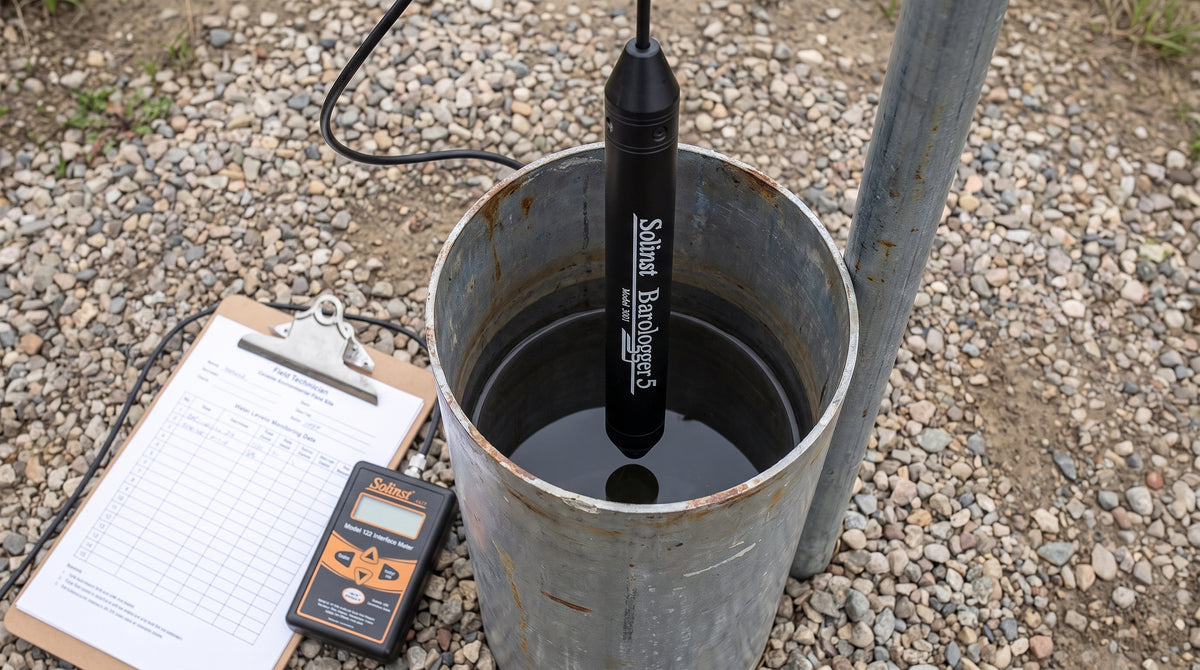
A barologger is a small datalogger that records only atmospheric pressure and temperature, deployed above the water table so software can subtract barometric noise from a submerged Levelogger's readings. Without one, "water level" data is really water level plus whatever the weather did that week — and every reading is wrong by a fluctuating, unpredictable margin.
Table of Contents
- What Is a Barologger and Why Does It Matter?
- How Does Barometric Compensation Actually Work?
- How Many Barologgers Does One Site Need?
- Do Vented Loggers Still Need a Barologger?
- Where Should a Barologger Be Installed?
- How Do You Deploy and Compensate a Barologger?
- What Happens If You Forget to Deploy One?
- Frequently Asked Questions
What Is a Barologger and Why Does It Matter?
A barologger is a Levelogger-family datalogger built to measure air pressure only — it is never submerged. Standard water level dataloggers like the Solinst Levelogger 5 are "absolute pressure" instruments: submerged in a well or surface water body, they record the combined weight of the water column above them plus the atmospheric pressure pressing down on the water's surface. To isolate the water-level change you actually care about, that atmospheric component has to be measured separately and subtracted out. That's the barologger's entire job.
The reference standard for measuring water levels in a monitoring well is ASTM D4750, the standard test method for determining subsurface liquid levels in a borehole or monitoring well — the method continuous absolute-pressure dataloggers like the Levelogger are commonly deployed to satisfy in place of manual tape-and-probe readings, with barometric compensation handled automatically by the Barologger/Levelogger pair rather than a manual correction.
How Does Barometric Compensation Actually Work?
Compensation is a subtraction problem solved in software, not in the well. The Barologger 5 logs ambient air pressure on the same schedule as the submerged Leveloggers on site (for example, every 15 minutes). Solinst's Levelogger Software Data Compensation Wizard then matches each Barologger reading to the corresponding Levelogger reading by timestamp and subtracts it, leaving true water-level change.
Why This Can't Be Done with a Fixed Offset
Atmospheric pressure isn't constant — it drifts with weather systems, sometimes by 2–3 kPa over a few days, which is enough to look like several centimetres of water-level change on an uncompensated absolute logger. A single static correction factor doesn't track that drift; only a second, continuously logging air-pressure instrument does.
How Many Barologgers Does One Site Need?
Usually just one. A single Barologger 5 accurately compensates every absolute Levelogger within roughly a 30 km radius and/or a 300 m change in elevation from the Barologger's location — atmospheric pressure is regional, not well-specific. Multi-well monitoring networks spread across a tight footprint (a single industrial site, a small wellfield) typically need only one Barologger, mounted centrally, to serve the whole network.
Large or topographically varied programs — a remediation site spanning a valley, or Phase II ESA work across multiple properties — may need a second Barologger if elevation change between well clusters exceeds that 300 m threshold. See our Phase II ESA equipment checklist for how barometric compensation fits into a full site-assessment monitoring plan.
Do Vented Loggers Still Need a Barologger?
No — vented (F-type) Leveloggers already solve this problem mechanically, so they don't need a Barologger. A vented logger runs a small pressure-equalization vent tube up through its cable to the surface, exposing the reference side of its pressure sensor to open air in real time. That built-in venting cancels atmospheric pressure at the point of measurement, which is why vented loggers cost more and need more careful cable handling (the vent tube is vulnerable to condensation and physical damage in the field).
Absolute (non-vented) Leveloggers are cheaper, more rugged, and easier to deploy in tight or debris-prone wells — which is why most Canadian groundwater monitoring programs choose absolute loggers plus one shared Barologger over paying the vented-cable premium on every well.
Where Should a Barologger Be Installed?
Above the highest water level the site will ever see, in a location that stays dry and stays representative of the same air mass as the monitored wells. In practice that means:
- Inside a vented monitoring well casing, suspended well above the maximum expected static water level
- In a dedicated dry stilling well or weatherproof enclosure near the wellfield
- Never in a location where it could be submerged, even briefly, during a high-water event
In Canadian Phase II ESA work, water-level data feeds directly into the contaminant fate-and-transport picture assessed against the CCME Canadian Environmental Quality Guidelines — so an improperly sited or accidentally submerged Barologger doesn't just lose data for one well, it breaks the compensated record for every well it was supposed to serve.
How Do You Deploy and Compensate a Barologger?
The workflow is the same whether you're setting up a single well or a network:
- Pick a central, above-water location within the 30 km / 300 m elevation coverage window of every Levelogger it needs to serve.
- Mount it above the highest expected water level — in a vented well casing, dry stilling well, or shielded enclosure. Never submerge it.
- Program the logging interval to match your Leveloggers (e.g. 15-minute readings) using Solinst Levelogger Software so timestamps line up exactly.
- Leave it running for the full monitoring period — the Barologger 5's 10-year battery and 150,000-reading memory cover multi-year programs without a swap.
- Retrieve data with a Solinst Readout Unit (SRU) or the Levelogger app interface — the same tools used to pull data from the submerged Leveloggers.
- Run the Data Compensation Wizard in Levelogger Software to subtract the Barologger's synchronized readings from every Levelogger file, producing true, barometrically-compensated water-level data.
What Happens If You Forget to Deploy One?
Every submerged absolute logger on site records unusable raw data until it's compensated after the fact — and after-the-fact compensation is a downgrade, not a fix. Without a site Barologger, the only fallback is pulling historical air-pressure data from the nearest weather station, which is rarely close enough or frequent enough to match real conditions at the well. The result is systematic error that regulators and peer reviewers can flag on a Phase II ESA or long-term monitoring submission. A Barologger costs a fraction of a single re-mobilization to a remote site — it is cheap insurance against re-doing a monitoring round.
For the full Solinst Levelogger 5 lineup — Standard, Junior, LTC, and the Barologger 5 itself — see our water quality instrumentation collection. ERE stocks the complete series for Canadian Phase II ESA, long-term monitoring, and pump-test applications.
Setting up a groundwater monitoring network?
ERE Inc. has stocked and supported Solinst dataloggers for Canadian environmental consultants for over 30 years. Talk to us about sizing a Levelogger + Barologger network for your site.
→ Request a Quote | 1-888-287-EREC | Browse Water Quality Instruments | sales@ereinc.com
Frequently Asked Questions
Do I need a Barologger if I already own a Levelogger 5?
Yes, if your Levelogger 5 is the absolute (non-vented) version — which most are. The Levelogger measures water level plus atmospheric pressure combined; only a Barologger's separate air-pressure record lets software subtract the atmospheric portion and isolate true water-level change.
How many wells can one Barologger cover?
One Barologger 5 accurately compensates every absolute Levelogger within about a 30 km radius and/or a 300 m change in elevation from its location, since atmospheric pressure varies regionally rather than well-to-well.
Can I skip the Barologger with a vented logger?
Yes. Vented (F-type) Leveloggers equalize to atmospheric pressure in real time through a vent tube in the cable, so they don't need separate barometric compensation. Most programs still choose absolute loggers plus one shared Barologger because they're more rugged and easier to deploy in tight wells.
What happens if barometric pressure isn't compensated?
Uncompensated absolute-logger data includes several centimetres of "phantom" water-level swing driven purely by weather systems, not the aquifer — data that's unreliable for trend analysis, pump-test drawdown curves, or regulatory reporting.
How long does a Barologger battery last?
The Barologger 5 runs on a 10-year battery with 150,000-reading memory, so a single unit typically covers the full duration of a multi-year monitoring program without a battery swap.
Related articles
- Solinst Levelogger 5: Groundwater Monitoring Guide for Canada
- Water Level Data Loggers: Buyer's Guide for Canadian Groundwater Monitoring
- Phase II Environmental Site Assessment (ESA) Equipment Checklist
Lire en français : Qu'est-ce qu'un barologue? La compensation barométrique expliquée