
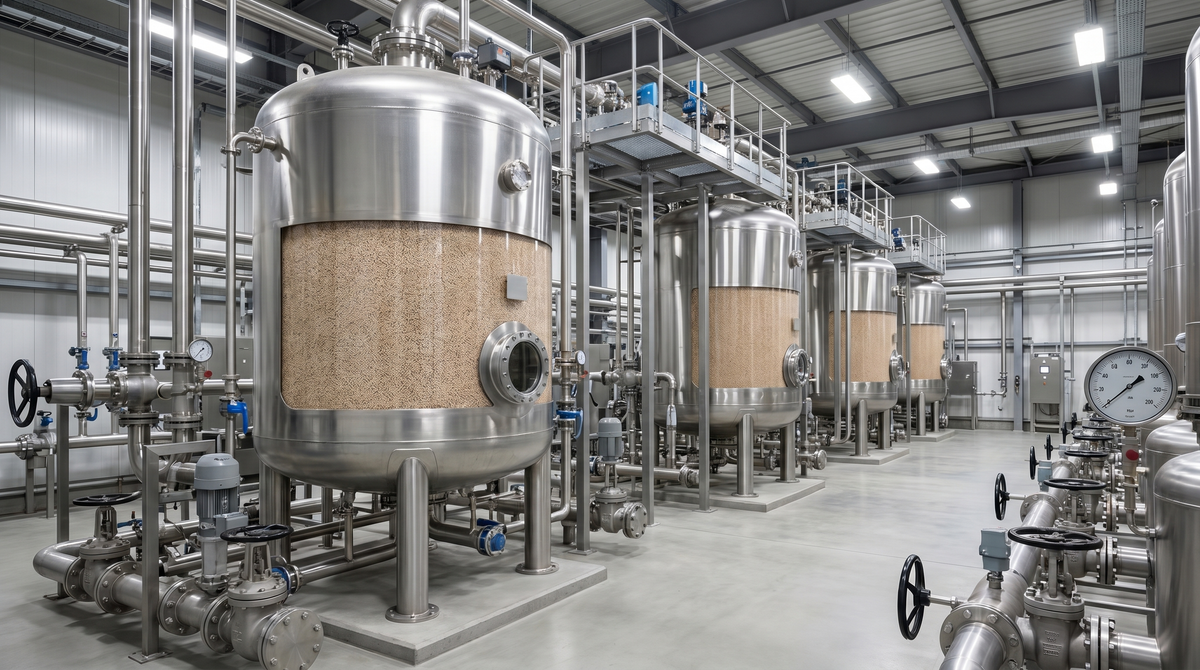
Activated alumina removes fluoride, arsenic, and selenium from water through adsorption — not filtration. It works by binding target contaminants to its highly porous aluminum oxide surface as water flows through a packed bed. For industrial and municipal water treatment in Canada, it is one of the few media that can reliably reduce fluoride to below the Health Canada drinking water guideline of 1.5 mg/L — and it does so without chemicals, under the right pH and flow conditions.
What Is Activated Alumina and How Does It Remove Contaminants?
Activated alumina is a highly porous form of aluminum oxide (Al₂O₃) produced by dehydrating aluminum hydroxide at high temperatures. The resulting granular material has an internal surface area of 200–400 m²/g — similar to activated carbon — but its surface chemistry is amphoteric, meaning it can both donate and accept protons. This makes it uniquely effective at adsorbing anionic species like fluoride (F⁻), arsenate (AsO₄³⁻), and selenite (SeO₃²⁻) from water.
The removal mechanism is adsorption, not mechanical filtration. Contaminant ions bind to active sites on the alumina surface through electrostatic attraction and ligand exchange. The media becomes exhausted as sites fill, at which point it must be regenerated or replaced. Unlike sand or anthracite (which physically block particulates), activated alumina produces no significant pressure drop for particulate removal and should be used downstream of a pre-filter when turbidity is present.
Activated Alumina vs. Ion Exchange Resin
Both activated alumina and ion exchange resin can remove fluoride and arsenic, but they operate differently. Ion exchange resins have higher capacity per unit volume and faster kinetics, but they cost significantly more, are sensitive to competing ions (silica, chlorides, sulfates), and require specialized regenerant handling. Activated alumina is more robust under variable feed water chemistry, lower in cost, and well-suited for rural and remote water treatment systems where technical complexity is a constraint. For systems treating more than 50 m³/day with consistent feed water chemistry, ion exchange may be the right choice; for smaller systems or variable-chemistry groundwater, activated alumina typically wins.
Which Contaminants Does Activated Alumina Remove?
Activated alumina is effective for a specific set of inorganic anions. It is NOT a general-purpose media — do not use it expecting removal of chlorine, VOCs, sediment, or bacteria.
Fluoride Removal
Fluoride is the primary application in Canadian water treatment. Health Canada's drinking water guidelines set the maximum acceptable concentration (MAC) for fluoride at 1.5 mg/L. Many private wells in Quebec, Ontario, and the Prairie provinces exceed this limit due to natural geological sources. Activated alumina can reduce fluoride from concentrations of 2–10 mg/L to below 0.1 mg/L when operated at pH 5.5–6.0 and at the correct empty bed contact time (EBCT).
ERE's Actiguard activated alumina for fluoride removal is pre-conditioned and optimized for fluoride adsorption capacity. It is available in bulk quantities for water treatment facility supply across Canada.
Arsenic Removal
Arsenic contamination in groundwater is a significant concern in parts of British Columbia, Nova Scotia, and Quebec. The Health Canada MAC for arsenic is 0.01 mg/L (10 µg/L). Activated alumina removes arsenate (As(V)) effectively at pH 5.5–7.0 with typical reduction from 50–500 µg/L to below 10 µg/L. Arsenite (As(III)) must be oxidized to arsenate first — typically with chlorine or permanganate — before activated alumina treatment is effective.
ERE also supplies a dedicated activated alumina grade for arsenic removal, formulated for high-capacity arsenate adsorption. For government and municipal water treatment procurement, arsenic-removal media should meet CCME Canadian Water Quality Guidelines for the receiving water body.
Selenium Removal
Selenite (Se(IV)) is adsorbed by activated alumina at neutral to slightly acidic pH. Selenate (Se(VI)) is much more difficult to remove — it requires reduction to selenite first or alternative treatment such as ion exchange. For industrial effluent treatment where selenium limits apply (e.g., mining and oil sands operations in Alberta and BC), confirm speciation before selecting activated alumina.
What Water Conditions Does Activated Alumina Need to Perform?
Activated alumina's performance is highly pH-dependent. This is the most common reason systems underperform: the media is good, but the feed water pH is wrong. Here is what operating conditions must look like:
| Parameter | Fluoride Removal | Arsenic Removal |
|---|---|---|
| Optimal feed pH | 5.5 – 6.0 | 5.5 – 7.0 |
| EBCT (empty bed contact time) | 5 – 7 minutes minimum | 3 – 5 minutes minimum |
| Temperature | 5 – 35°C | 5 – 35°C |
| Turbidity | <1 NTU (pre-filter recommended) | <1 NTU (pre-filter recommended) |
| Competing ions (interfere) | Sulfate, chloride at high concentration | Silica, phosphate, competing anions |
If your source water pH is above 7.0, acid injection (sulfuric acid or CO₂) is required upstream of the activated alumina bed to drop pH to the 5.5–6.0 range. Failing to control pH is the single most common cause of early breakthrough in activated alumina systems.
"Activated alumina is effective for fluoride removal when the pH of the water is between 5 and 6 and the contact time is sufficient." — CAWST (Centre for Affordable Water and Sanitation Technology), a Canadian charity and WASH knowledge hub
How Do You Size an Activated Alumina System for Your Flow Rate?
Sizing an activated alumina system requires three inputs: flow rate (m³/hr or GPM), target contaminant concentration (mg/L), and discharge limit (mg/L). From these, you calculate the required bed volume using EBCT.
EBCT Calculation
EBCT (empty bed contact time) is the key design parameter. For fluoride removal to below Health Canada's MAC:
- Minimum EBCT = 5 minutes (7 minutes recommended for conservative design)
- Bed volume (m³) = Flow rate (m³/min) × EBCT (min)
- Example: 10 m³/hr flow ÷ 60 = 0.167 m³/min; at 5 min EBCT → bed volume = 0.83 m³
Bed Life Estimation
Activated alumina has a finite capacity before regeneration is needed. Typical throughput before exhaustion is 40,000–60,000 bed volumes (BV) for fluoride removal at optimal pH. For a 0.83 m³ bed treating 10 m³/hr of water at 3 mg/L fluoride:
- Bed life ≈ 50,000 BV × 0.83 m³ = 41,500 m³ of treated water
- At 10 m³/hr operating 16 hr/day: approximately 260 days per cycle
- Allow dual-vessel configuration so one vessel stays online during regeneration
When Should You Choose Activated Alumina vs. Other Filtration Media?
Activated alumina is the right choice when the target contaminant is fluoride, arsenic, or selenium and the budget favors a simple adsorption system. It is the wrong choice when the contaminant is dissolved iron, hydrogen sulphide, turbidity, or organic compounds. For a full comparison of filtration media types, see our guide to water filtration media types and applications.
| Contaminant | Use Activated Alumina? | Better Option |
|---|---|---|
| Fluoride | Yes — preferred media | — |
| Arsenic (As V) | Yes — effective | — |
| Selenium (Se IV) | Yes — moderate capacity | Ion exchange for Se(VI) |
| Iron / Manganese | No | Filox, Birm, or greensand |
| H₂S / Hydrogen Sulphide | No | Filox or aeration + filtration |
| Chlorine / THMs | No | Activated carbon |
| Turbidity / Sediment | No | Sand, multi-media filter |
For systems treating groundwater with multiple contaminants (e.g., iron plus fluoride), a treatment train is required: iron removal first (Filox bed), then pH adjustment, then activated alumina. ERE designs these multi-stage systems — request a quote to discuss your specific water chemistry.
Can Activated Alumina Be Regenerated, and Is It Worth It?
Yes — activated alumina can be regenerated, and for large systems it is economically necessary. Regeneration involves two sequential steps:
- Caustic backwash (NaOH): A 1–4% sodium hydroxide solution is applied upflow to desorb the accumulated fluoride or arsenic from the media surface. Contact time is typically 30–60 minutes.
- Acid rinse (H₂SO₄): A dilute sulfuric acid rinse follows to neutralize residual caustic and restore the media to acidic pH for adsorption. Contact time 10–30 minutes, followed by a water rinse to target operating pH.
Spent regenerant — concentrated NaOH solution containing desorbed fluoride or arsenic — must be handled as a hazardous waste stream and disposed of in accordance with provincial regulations. In Quebec, this means compliance with the Règlement sur les matières dangereuses (RMD). In Ontario, it falls under the Environmental Protection Act, O. Reg. 347.
For small systems (less than 2 m³/hr) or remote locations where regenerant handling is impractical, a non-regenerative single-use approach — replace exhausted media and dispose per provincial guidelines — is often more cost-effective than building regeneration infrastructure.
ERE Canada stocks both activated alumina grades alongside the full range of industrial filtration media — including Filox for iron and H₂S removal, activated carbon, and mixed-bed resin. Contact us with your water test results for a sizing recommendation.
Need help specifying activated alumina for your water treatment system?
ERE Inc. has been Canada's environmental equipment and water treatment media specialist for 30+ years. We supply industrial quantities of activated alumina and can help you select the right grade, bed volume, and regeneration protocol for your application — from private well systems to municipal groundwater treatment.
→ Request a Quote | 1-888-287-EREC | Browse Filtration Media | sales@ereinc.com
Frequently Asked Questions
Does activated alumina remove lead from drinking water?
Activated alumina does not effectively remove lead (Pb²⁺). Lead is a cationic species, and activated alumina's adsorption mechanism preferentially targets anions (fluoride, arsenate, selenite). For lead removal, use activated carbon, ion exchange, or reverse osmosis. The Health Canada MAC for lead is 0.005 mg/L.
How do I know when the activated alumina bed needs regeneration or replacement?
Breakthrough occurs when the treated water concentration begins rising above the target limit — typically detected by inline ion-selective electrode monitoring or periodic grab samples. In practice, tracking cumulative volume processed (bed volumes) and scheduling regeneration at 40,000–50,000 BV provides a conservative operating interval. Install an effluent fluoride or arsenic monitor as a backup alarm; this is especially important for municipal applications where regulatory compliance is continuous.
Can I use activated alumina for fluoride removal in a well water system in Quebec?
Yes — activated alumina is commonly used for private well fluoride treatment in Quebec. The feed water must be pre-filtered to remove iron and manganese (which can foul the media), and pH must be adjusted to 5.5–6.0 if your well water pH is higher (many Quebec groundwaters are neutral to slightly alkaline). ERE can size a system for your flow rate and fluoride concentration — request a quote with your water test results.
Related articles
- Water Filtration Media: Types, Applications & Selection Guide
- Industrial Water Filtration Systems: Complete Guide for Canada
- Bag vs. Cartridge Filtration: Which to Use
Lire en français : Alumine activée pour le traitement de l'eau : guide complet pour le Canada